$720 Million
WHO HE IS
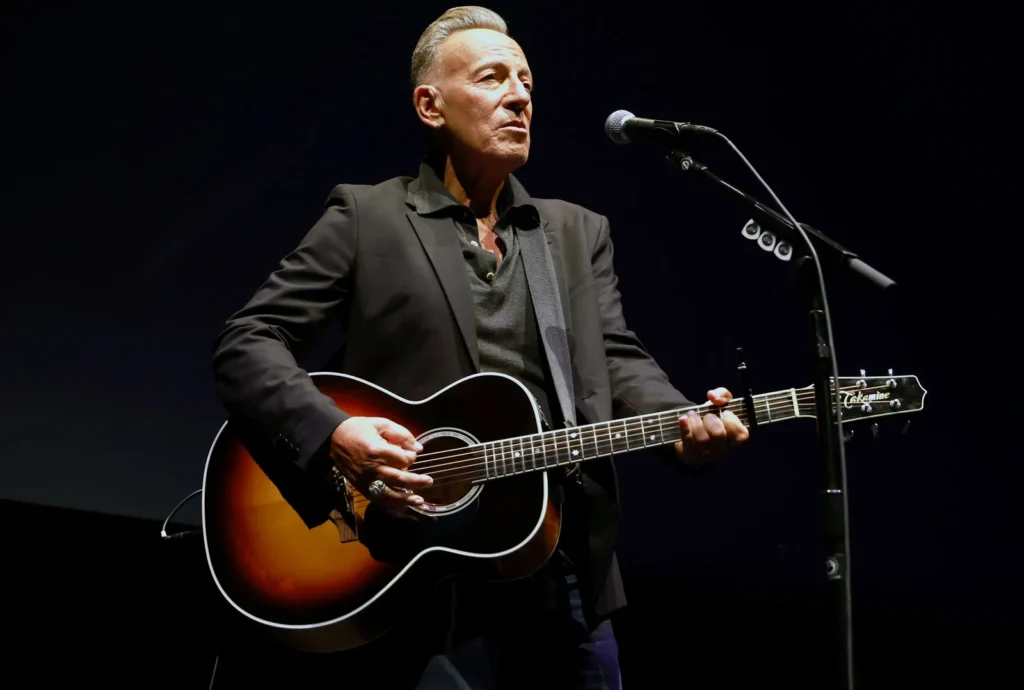
Bruce Frederick Joseph Springsteen, born September 23, 1949, in Long Branch, New Jersey, and known widely as The Boss, is an American singer, songwriter, and guitarist whose five decade career with the E Street Band made him one of rock music’s defining figures. He broke through commercially with 1975’s Born to Run and became a global superstar with 1984’s Born in the U.S.A., which sold more than 30 million copies and produced seven top 10 singles. He has sold more than 150 million records worldwide, won 20 Grammy Awards, an Academy Award, and a special Tony Award for his solo stage show Springsteen on Broadway. In December 2021, he sold the master recordings and publishing rights to his entire catalog, spanning more than five decades and over 300 songs, to Sony Music Entertainment. He has been married to fellow musician Patti Scialfa since 1991, with whom he has three children, and remains based primarily in New Jersey.
1. Touring and Live Performance
Springsteen’s touring history spans more than 1,000 shows across five decades, but his E Street Band shows are famously large scale productions, a 17 piece ensemble with a horn section performing three hour sets, meaning a meaningful share of box office revenue funds the production itself rather than reaching him directly.
- Career touring gross across more than 1,000 shows, spanning the 1970s through 2022, prior to his most recent tour: ~$1.57B in box office revenue
- Springsteen and the E Street Band 2023 to 2025 tour, which grossed $729.7M and sold 4.9 million tickets, nightly averaging $5.7M: ~$729.7M in box office revenue
Total career touring box office gross: ~$2.3B, making Springsteen only the fifth artist ever to surpass $2 billion in lifetime touring revenue.
Applying a conversion rate reflecting the substantial but not extreme production overhead of a large ensemble touring act:
Touring income, personal take at an estimated 40 percent of box office gross: ~$920M.
Springsteen on Broadway, by contrast, was a stripped down solo show built around just Springsteen and a guitar or piano, an economics profile closer to a low overhead solo act than a full band production.
Springsteen on Broadway, personal take at an estimated 65 percent of its $113M gross: ~$73.45M.
2. The Catalog Sale
In December 2021, Springsteen sold the master recordings and publishing rights to his entire catalog to Sony Music Entertainment, with private equity firm Eldridge Industries co-investing alongside Sony in the transaction, a deal industry reporting has placed between $500M and $600M, with $550M serving as a reasonable midpoint estimate across sourcing. The sale was, at the time, the largest transaction ever struck for a single artist’s body of work, and covered both his solo recordings and his work with the E Street Band. Because this was a completed, outright sale rather than a leveraged financing arrangement, it is counted here as realized cash, consistent with how this database treats any confirmed catalog sale.
Catalog sale proceeds (December 2021): +$550M.
3. Songwriting and Publishing Catalog (Post Sale)
Everything Springsteen has written and released since the December 2021 sale, including the 2022 covers album Only the Strong Survive and standalone singles like the 2025 protest song Streets of Minneapolis, falls outside that transaction. Given the limited scope of new original output since the sale relative to his sold back catalog, we apply a modest, conservative value here.
Applying a 6x multiple to an estimated $2M a year in personal songwriting and royalty income from material released since the sale:
Songwriting and publishing catalog, held asset for material released since December 2021 (6x multiple on ~$2M/yr estimated personal royalty share): ~$12M.
4. Business Ventures
No significant outside business holdings, production companies, or brand equity stakes have been publicly documented for Springsteen. Unlike many peers who have built diversified portfolios in spirits, fashion, or other consumer brands, his wealth is concentrated almost entirely in touring, songwriting, and the catalog sale, a deliberate reflection of a career built around music rather than commercial diversification.
5. Representation
A blended representation rate of 20 percent is applied to touring and Broadway income. A reduced blended rate of 10 percent is applied to the catalog sale proceeds, reflecting that a one time asset sale typically carries lower ongoing representation costs than active touring income.
Representation (20% on $993.45M touring and Broadway income, plus 10% on $550M catalog sale proceeds): -$198.69M and -$55M.
6. Tax
Springsteen is treated here as a US resident for his touring and Broadway income, applying the standard 42 percent effective rate used for established entertainment talent. The catalog sale is treated separately at a lower 25 percent effective rate, reflecting more favorable tax treatment typically available for the sale of a capital asset like a publishing catalog compared to ordinary income.
Tax (42% effective on $794.76M post-representation touring and Broadway income, plus 25% effective on $495M post-representation catalog sale proceeds): -$333.8M and -$123.75M.
7. Lifestyle Burn
Springsteen has maintained a comparatively grounded, blue collar public image relative to his wealth, staying rooted in New Jersey rather than adopting the more visibly lavish spending patterns documented for some peers, though he has held valuable real estate and pursued an equestrian hobby at his Florida property.
- Early career through Born in the U.S.A.’s breakthrough (1973 to 1984, 12 years): ~$500K/yr consumed = $6M
- Peak stardom, family formation with Patti Scialfa, New Jersey and Beverly Hills properties (1985 to 2000, 16 years): ~$2M/yr consumed = $32M
- Continued major stardom, extensive touring, equestrian property in Florida (2001 to 2020, 20 years): ~$3M/yr consumed = $60M
- Catalog sale era, continued touring as an elder statesman of rock (2021 to 2026, 6 years): ~$4M/yr consumed = $24M
Total lifestyle burn: ~$122M, roughly 15 percent of post-tax income, modest relative to his overall scale and consistent with his grounded public reputation.
8. Real Estate
Springsteen’s real estate history includes properties in New Jersey, Beverly Hills, and Florida, but none has both a documented original purchase price and a documented sale price attached to a completed transaction.
- A 378-acre horse farm in Colts Neck, New Jersey, his longtime primary residence with Patti Scialfa, which includes a full recording studio, purchase price and history not fully itemized in public reporting
- Beverly Hills, California compound, purchased in 1999 for $13.75M, still associated with the family, though reports surfaced in 2015 of a quiet off-market listing attempt at $60M to $70M that does not appear to have resulted in a completed sale
- An equestrian property in Wellington, Florida, purchase price undisclosed, still held
- Additional New Jersey properties bought and sold over the decades, with no itemized purchase and sale prices publicly available for any specific transaction
Real estate: $0 (no documented gain on any property with both a purchase and sale price on record).
9. Wealth Management
No dedicated investment manager, fund, or disciplined personal portfolio program has been publicly documented for Springsteen.
Wealth Management: None reported ($0).
Net Worth Waterfall
| Line Item | Amount |
|---|---|
| Touring, personal take at an estimated 40% of box office gross | +$920M |
| Springsteen on Broadway, personal take at an estimated 65% of gross | +$73.45M |
| Catalog sale proceeds (December 2021) | +$550M |
| Less: representation (20% touring/Broadway, 10% catalog sale) | -$253.69M |
| Less: tax (42% touring/Broadway, 25% catalog sale) | -$457.55M |
| Less: lifestyle burn (era-scaled, consumed only) | -$122M |
| Available to accumulate | +$710.21M |
| Real estate | $0 |
| Songwriting and publishing catalog, held asset since December 2021 (6x) | +$12M |
| Business ventures | $0 |
| Wealth Management | $0 |
| Total (raw) | ~$722.21M |
| Final Figure (rounded) | $720M |
Our calculation: $720 Million.
Why Our Figure Differs From Widely Circulated Estimates
Two very different figures circulate for Springsteen’s net worth. Forbes has estimated his fortune at $1.1 billion to $1.2 billion, declaring him a billionaire, while Celebrity Net Worth places him at a more conservative $750M. Springsteen himself pushed back publicly when asked about billionaire status, denying he actually has that much money. Our independent figure lands closer to the more conservative estimate, modestly below it.
The gap with the Forbes billionaire framing traces to how his lifetime touring gross is treated. Springsteen’s career total of roughly $2.3 billion in box office revenue across more than 1,000 shows is real and well documented, but a large ensemble act touring with a 17 piece band for three hour sets carries substantial production costs that a simple representation deduction does not capture, the same distinction that separates a stadium tour’s box office gross from an artist’s actual take home pay. Treating the full $2.3 billion as though it were close to personal income, without accounting for that production overhead, is likely how estimates arrive at billionaire status. Once a more disciplined conversion rate is applied to that touring history, alongside the fully disclosed $550M catalog sale and a properly built value for his modest post-sale output, the total lands in the mid $700 millions rather than the billion dollar range, a figure that lines up with Springsteen’s own account of his finances more closely than the Forbes framing does.
The Boss Doesn’t Recognize the Number Either
When Bruce Springsteen was told Forbes had declared him a billionaire, his response was not celebration. It was a denial, the kind of flat correction that suggests the number did not match anything he recognized about his own finances. That instinct turns out to be well founded. The gap between what a stadium tour grosses at the box office and what its bandleader actually takes home is enormous when the production involves a full horn section and three hour sets, and once that gap is properly accounted for, Springsteen’s fortune looks less like a billionaire’s and more like what a working musician who happened to write some of the best selling records in history has actually earned.