

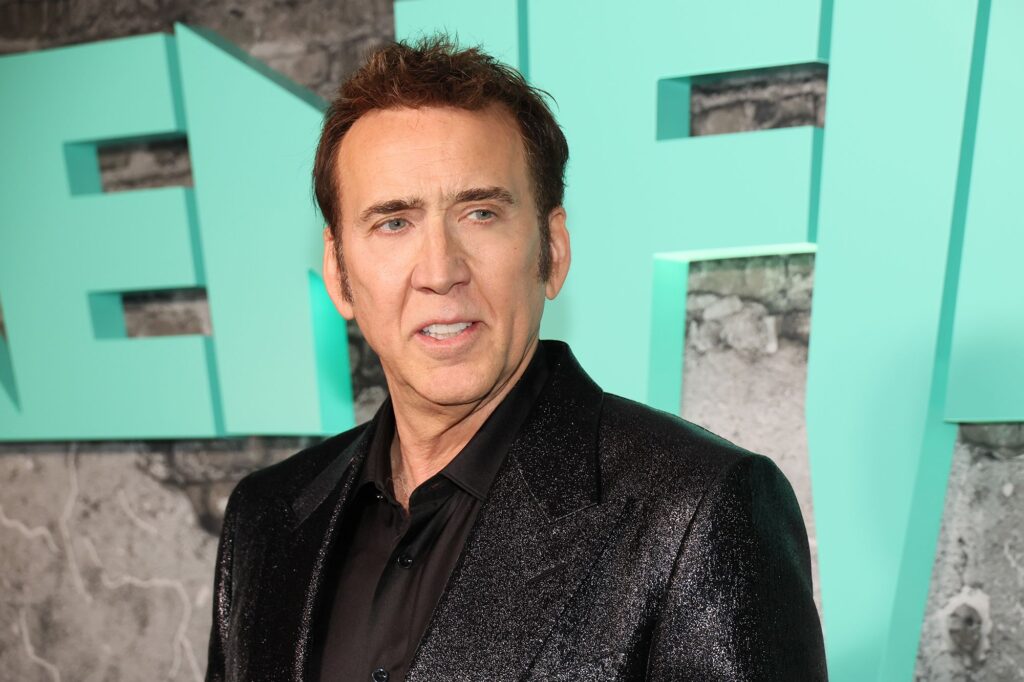
$35 Million
WHO HE IS
Born Nicolas Kim Coppola on January 7, 1964 in Long Beach, California, the nephew of director Francis Ford Coppola, Nicolas Cage changed his name early to escape the shadow of his famous family and built one of the most singular careers in Hollywood. He won an Academy Award for “Leaving Las Vegas,” anchored blockbusters like “Face/Off,” “Con Air,” and “National Treasure,” and has worked more relentlessly than almost any A-lister of his generation. He is also the defining cautionary tale of this entire series. Cage earned a fortune that rivaled any actor of his era, spent it on a scale that became the stuff of legend, fell into deep tax debt when the real estate market collapsed, and then worked his way back to solvency one film at a time. His net worth is not a story about earning. It is a story about what happens to the money afterward.
1. THE FORTUNE HE EARNED
At his commercial peak between roughly 1996 and 2011, Cage was one of the highest-paid actors in the world, commanding around $20 million per film and earning a reported $150 million or more across that stretch alone. His box-office run, “The Rock,” “Con Air,” “Face/Off,” the “National Treasure” films, made him a genuine A-list draw, and his earlier dramatic work, including the Oscar-winning “Leaving Las Vegas,” gave him the prestige to match. In his later comeback years he has remained extraordinarily prolific, often appearing in several films a year, which has steadily rebuilt his income.
- Estimated lifetime acting earnings (gross): ~$280M
2. THE SPENDING
This is the section that makes Cage unique. His spending was not merely lavish, it was historic. He acquired two European castles, Schloss Neidstein in Bavaria and Midford Castle near Bath, England. He bought a private island in the Bahamas (Leaf Cay), the reputedly haunted LaLaurie Mansion in New Orleans, and at his peak owned as many as fifteen properties. He outbid Leonardo DiCaprio for a dinosaur skull, paying around $276,000 (later returned when it emerged the fossil had been smuggled out of Mongolia). He bought a rare copy of “Action Comics #1,” the comic that introduced Superman, which he later sold for $2.16 million. He collected shrunken heads, exotic animals, and rare cars, and reportedly purchased a pyramid-shaped tomb for himself in a New Orleans cemetery. The spending was the engine of his downfall.
3. THE TAX COLLAPSE
In 2009 the IRS filed a federal tax lien against Cage, alleging he owed over $6.2 million in unpaid federal income taxes. He blamed the collapse on real estate: heavily over-invested in property, he was unable to exit before the market crashed, leaving him cash-poor against enormous obligations. He sued his former business manager for $20 million, alleging negligence and fraud, and was countersued in turn. To dig out, Cage sold his trophies, the castles, the comic, the cars, and accepted nearly every role offered, a period he later described as dark but necessary. By the early 2020s he confirmed he was completely debt-free.
4. THE COMEBACK AND CURRENT HOLDINGS
The 2020s brought a genuine artistic revival, with acclaimed performances in “Pig,” “The Unbearable Weight of Massive Talent,” “Dream Scenario,” and “Longlegs” reminding audiences of his range. He continues to produce through his company Saturn Films, and now lives primarily in Las Vegas, Nevada, a state with no personal income tax, a meaningful change after years of heavy liabilities. His current assets are modest by his former standards: a stable home base, his production company, and remaining collectibles.
5. REAL ESTATE
Cage’s real estate history is the clearest illustration of his rise and fall. At his peak he owned castles in Germany and England, a Bahamian island, the New Orleans LaLaurie Mansion (around $3.4 million), a Rhode Island estate, a Bel Air home, and Las Vegas property, among roughly fifteen holdings. Almost all of it was sold during the debt crisis, frequently at a loss, as the very over-investment in property that built the portfolio also triggered the collapse. Today his real estate footprint is a fraction of what it was, anchored by his Las Vegas base, and represents a stabilizing asset rather than the sprawling, value-destroying empire of his peak years.
- Estimated current real estate and collectibles: ~$5M
6. TAX AND LIFESTYLE
For most stars, the lifestyle-and-losses line is a footnote. For Cage it is the entire story. Between extravagant spending, the property collapse, the IRS debt, and years of high tax liability, the overwhelming majority of what he earned never converted into lasting wealth. His current Nevada residency lowers his tax burden going forward, but the damage to his accumulation was done over the preceding two decades.
RICHPEEK ESTIMATE: $35 Million
| Calculation | Amount |
|---|---|
| Lifetime acting earnings (gross) | ~$280M |
| Minus representation (~15%) | -$42M |
| Minus tax (~45%, including years of IRS debt) | -$107M |
| Minus lifestyle, spending, and investment losses | -$102M |
| Available to accumulate | ~$29M |
| Plus investment compounding (~6% real) | +$1M |
| Plus current real estate, Saturn Films, and collectibles | +$5M |
| Total Net Worth | ~$35M |
We land at $35 million.
Why we land where we do: Celebrity Net Worth lists Cage at $30 million, with other outlets at $40 million, and we land in the middle at $35 million. Unlike anyone else in this batch, his number is low not because he earned little, he earned more than Margot Robbie is currently worth, but because the lifestyle-and-losses line consumed almost everything. The compounding line, which adds tens of millions to a disciplined peer, is effectively zero for Cage, because for years he had nothing to compound and was instead servicing millions in debt.
The most expensive lesson in Hollywood: Cage is the photographic negative of an athlete like Jayson Tatum, who banks his salary and lives on side income. Cage spent the principal, the interest, the castle, and the dinosaur. And yet the ending is not a tragedy, it is a lesson with a second act. He did not vanish or declare bankruptcy. He out-worked the hole he had dug, took every role until the debt was gone, and rebuilt a real, if smaller, fortune on firmer ground. The principle this series teaches over and over, that what you keep matters more than what you earn, Cage demonstrates more vividly than anyone, because he is the one who learned it the hard way.




[…] the mid 2000s, Nicolas Cage was one of the most bankable actors on the planet. Con Air, Face/Off, and the National Treasure […]