$365 Million
WHO HE IS
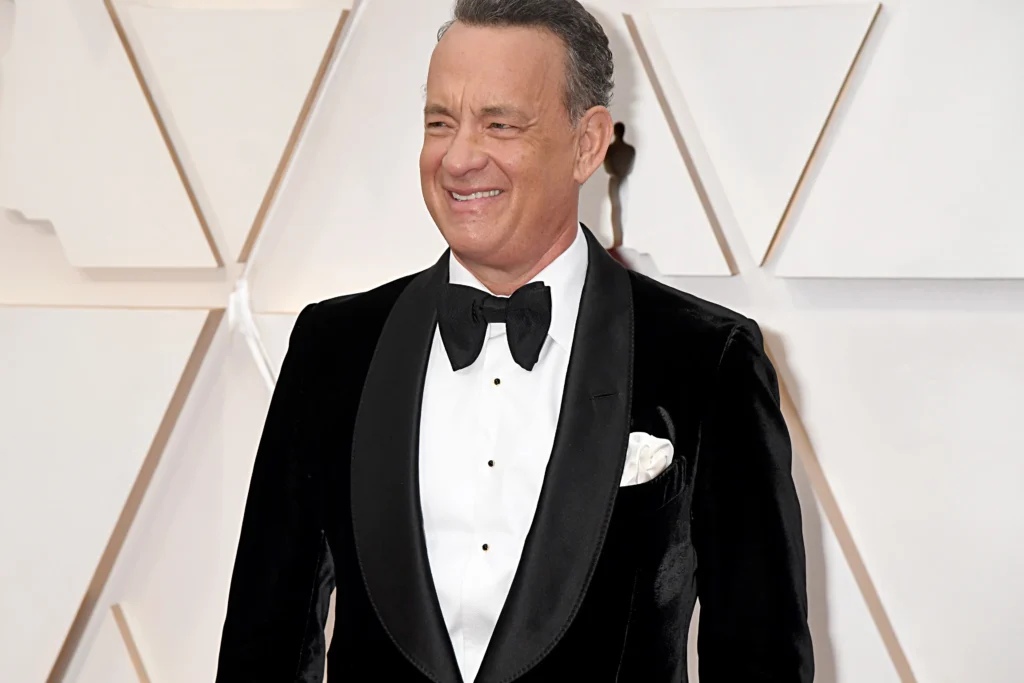
Thomas Jeffrey Hanks was born on July 9, 1956, in Concord, California, and grew up moving frequently between homes after his parents divorced when he was young. He discovered acting in high school after watching a friend perform, studied theater at Chabot College and California State University Sacramento, and landed an internship at the Great Lakes Theater Festival in Ohio that stretched into a three year stay and launched his professional career. After stage work and a breakout sitcom role on Bosom Buddies, Hanks became a movie star with 1984’s Splash, then spent the 1990s transforming himself from a comedic leading man into one of the most decorated dramatic actors of his generation, winning back to back Best Actor Oscars for Philadelphia in 1993 and Forrest Gump in 1994. He went on to anchor Saving Private Ryan, Cast Away, and the Toy Story franchise as Woody, while building Playtone, the production company he co-founded with Gary Goetzman in 1998, into an award winning force behind Band of Brothers, The Pacific, and Masters of the Air. Hanks has been married to actress and singer Rita Wilson since 1988, and the couple have two sons together in addition to two children from his first marriage.
1. Film Career, Early Years
Hanks built his early career through television and comedy before establishing himself as a serious dramatic lead. His fee climbed steadily through the 1980s as Splash, Bachelor Party, and Big built his profile as a bankable comic lead.
- Bosom Buddies and early television work (1980-1983): ~$2M
- Splash, Bachelor Party, and other early 1980s film roles: ~$5M
- Big, confirmed salary (1988): $1.75M
- Turner and Hooch, Punchline, and other late 1980s roles: ~$6.25M
Phase total: ~$15M.
2. Film Career, Breakthrough and Dramatic Era
This decade transformed Hanks from a comedic star into Hollywood’s most trusted dramatic lead, and it produced his largest single paydays of his entire career. His Forrest Gump deal, in which he took a share of the film’s box office rather than a flat salary, became a landmark in profit participation structuring.
- Sleepless in Seattle and Philadelphia, combined (1993): ~$10M
- Forrest Gump, profit participation payout (1994): $60M
- Apollo 13 (1995): ~$15M
- Toy Story, confirmed voice salary (1995): $50K
- That Thing You Do!, acting and directing (1996): ~$5M
- Saving Private Ryan, upfront fee and backend bonuses (1998): $40M
- You’ve Got Mail (1998): $20M
- Toy Story 2, confirmed voice salary (1999): $5M
- The Green Mile (1999): $20M
- Cast Away (2000): $20M
Phase total: ~$195.05M.
3. Film Career, Established A-Lister Era
By the early 2000s Hanks commanded a reported minimum base salary of $25 million per film, and his Robert Langdon trilogy for the Da Vinci Code franchise alone totaled a confirmed $68 million across three installments.
- Road to Perdition, Catch Me If You Can, The Terminal, Charlie Wilson’s War, Larry Crowne, Captain Phillips, Saving Mr. Banks, Bridge of Spies, and Sully, nine films at an average fee reflecting his established A-list rate: ~$180M
- Toy Story 3, confirmed voice salary (2010): $15M
- The Da Vinci Code, Angels & Demons, and Inferno, confirmed combined trilogy total: $68M
Phase total: ~$263M.
4. Film Career, Recent Era
Hanks has continued commanding top tier fees into his late sixties, taking on a mix of awards contenders, streaming exclusives through the Playtone and Apple TV+ relationship, and continued franchise work.
- The Post, A Beautiful Day in the Neighborhood, News of the World, Greyhound, Finch, A Man Called Otto, Asteroid City, Pinocchio, Here, and Toy Story 5, ten projects at his established rate: ~$220M
- Elvis, confirmed salary (2022): $8M
Phase total: ~$228M.
5. Endorsements
Hanks has been selective with brand partnerships throughout his career, favoring companies that align closely with his public image over high volume endorsement deals.
- Intel, Sony, Starbucks, and other selective brand partnerships across the career: ~$10M
Phase total: ~$10M.
6. Combined Entertainment Gross
Early years ($15M) plus breakthrough era ($195.05M) plus established era ($263M) plus recent era ($228M) plus endorsements ($10M) equals $711.05M gross entertainment income.
7. Representation
Representation across Hanks’ acting career, covering agent, manager, and legal fees, is applied at a blended 13 percent, standard for a full Hollywood team across a four decade career.
Representation (13% on $711.05M): -$92.44M.
8. Tax
Hanks is a longtime California resident based in Pacific Palisades. Established entertainment talent typically achieves an effective tax rate below California’s roughly 50 percent combined marginal rate through loan-out company structures, bringing the effective rate to approximately 42 percent.
Tax (42% on $618.61M post-representation income): -$259.82M.
Post-tax entertainment income: ~$358.79M.
9. Lifestyle Burn
Hanks and Wilson have been married since 1988 and raised a blended family of four children. Multiple profiles describe Hanks as one of Hollywood’s more grounded and financially disciplined stars, with a public image built more around career longevity than visible extravagance, though the couple maintains an extensive real estate footprint and has personally funded elements of passion projects like the WWII documentary work behind Band of Brothers and The Pacific.
- Early career, Bosom Buddies through Big (1980-1992, 12 years): ~$150K/yr consumed = $1.8M
- Rising and peak dramatic fame, growing blended family (1993-2000, 8 years): ~$500K/yr consumed = $4M
- Established fame, extensive real estate footprint and philanthropic commitments (2000-2026, 26 years): ~$1.2M/yr consumed = $31.2M
Total lifestyle burn: ~$37M. Available to accumulate: ~$321.79M.
10. Real Estate
Hanks and Wilson own an extensive real estate portfolio, but only one property carries both a documented purchase price and a credible current valuation sufficient to calculate a real gain rather than assume one.
- Malibu Colony oceanfront home, purchased $2.95M (1991), current estimate ~$20M: gain of $17.05M
- Pacific Palisades primary residence, purchased $26M (2010): no independently documented current appraisal beyond general estimates, held at cost, no gain claimed
- Additional Pacific Palisades properties, a Sun Valley, Idaho ski house, and properties in Greece: no disclosed purchase prices, held at cost, no gain claimed
Real estate appreciation: ~$17.05M.
11. Business Equity Held
Playtone, which Hanks co-owns with longtime producing partner Gary Goetzman, has produced Emmy and Peabody winning television including Band of Brothers, The Pacific, and Masters of the Air, alongside box office hits like My Big Fat Greek Wedding and Mamma Mia, and holds an exclusive overall deal with Apple TV+ signed in 2022. No dollar figure for that deal, nor any funding round or sale, has been publicly disclosed for the company.
Playtone’s output cadence, roughly one major prestige television project every one to two years alongside occasional theatrical features, implies a smaller and less contractually anchored earnings base than a high volume studio deal, translating to an estimated annual company profit in the $5M to $12M range once production costs, above the line fees, and licensing income are accounted for. Applying the standard 6x to 8x earnings multiple used for independent production studios with a stable, ongoing distribution relationship values the company at approximately $50M. Hanks and Goetzman are understood to hold the company jointly, placing Hanks’ stake at roughly half that value.
Playtone equity, held stake: +$25M.
12. Wealth Management
No disciplined outside investment program or wealth manager has been publicly documented for Hanks. Default applies.
Wealth Management: None reported ($0).
Net Worth Waterfall
| Line Item | Amount |
|---|---|
| Early career (1980-1992) | +$15M |
| Breakthrough and dramatic era (1993-2000) | +$195.05M |
| Established A-lister era (2001-2016) | +$263M |
| Recent era (2017-2026) | +$228M |
| Endorsements | +$10M |
| Less: representation (13% on $711.05M entertainment gross) | -$92.44M |
| Less: tax (42% blended, California resident) | -$259.82M |
| Less: lifestyle burn (era-scaled, consumed only) | -$37M |
| Available to accumulate | +$321.79M |
| Real estate appreciation | +$17.05M |
| Playtone equity, held stake | +$25M |
| Wealth Management | $0 |
| Total Net Worth | $365M |
Our calculation: $365 Million.
Why Our Figure Differs From Consensus
Celebrity Net Worth places Tom Hanks at $400 million. Our independent calculation lands at $365 million, a more modest gap than many entertainer comparisons produce, which reflects how consistently Hanks’ major paydays have been publicly documented over four decades. The remaining difference likely traces to two things: Playtone’s equity value, which this calculation prices conservatively given the absence of any disclosed Apple TV+ deal figure or comparable anchor point, and the broader real estate portfolio, where five additional Pacific Palisades properties along with homes in Sun Valley and Greece carry no disclosed purchase prices and are therefore excluded from any appreciation calculation entirely rather than estimated. A full accounting of either category would likely close most of the remaining gap. Working in the calculation’s favor toward accuracy, California’s full effective tax rate for established entertainment talent is applied throughout, and the film era averages used for Hanks’ recent and established periods are built from his own reported minimum base rate rather than assumed upward.
Hollywood’s Most Durable Fortune
Tom Hanks built his wealth the slow way, through four uninterrupted decades of being the actor studios trust to open a film, carry a war drama, or voice a cowboy that three generations of children have grown up with. There was no single business exit, no minority stake sold to private equity, no headline grabbing brand deal that reset the numbers overnight. Instead there was a profit participation clause on Forrest Gump that turned out to be one of the smartest contract negotiations in film history, a production company that has spent 25 years quietly winning Emmys and Peabodys without ever needing outside investment, and a real estate portfolio assembled property by property over three decades rather than acquired in a single spree. That steadiness is precisely what makes his fortune harder to pin an exact number on than a peer with one or two enormous, well documented liquidity events. It is also exactly the kind of career arc that built one of the most trusted brands in Hollywood, on screen and financially alike.