$25 Million
WHO HE IS
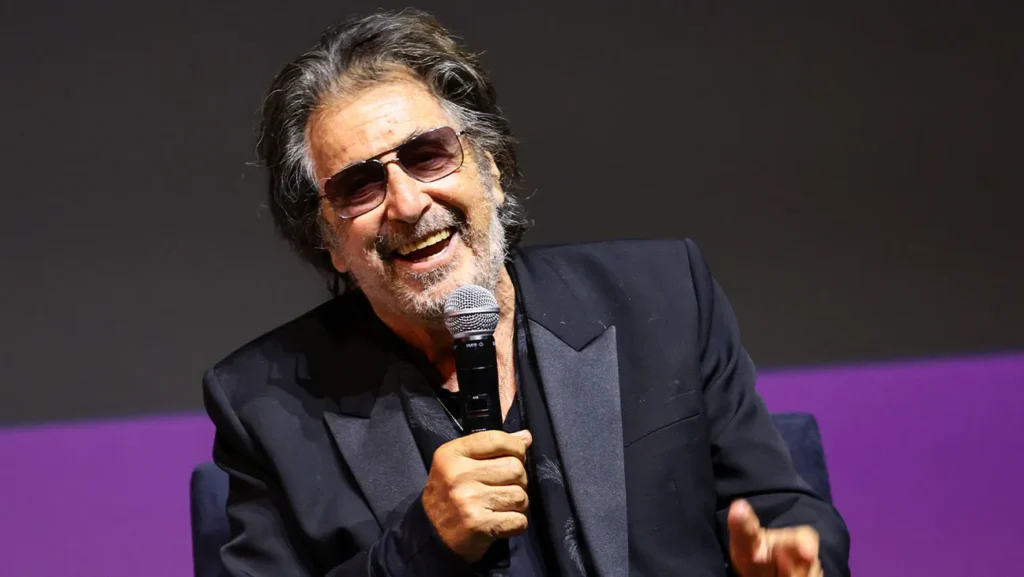
Al Pacino, born Alfredo James Pacino on April 25, 1940, in East Harlem, New York City, is an American actor widely regarded as one of the greatest performers of his generation, and one of the few to achieve the Triple Crown of Acting with an Academy Award, two Tony Awards, and two Primetime Emmy Awards. Raised by his mother and grandparents in the South Bronx after his parents divorced when he was two, Pacino trained at the Actors Studio before breaking through as Michael Corleone in The Godfather in 1972, a role he took for a modest $35,000 after the studio initially wanted an established star. He went on to define an era of American film through Serpico, Dog Day Afternoon, and Scarface, won his only competitive Academy Award for Scent of a Woman in 1992, and reunited with Robert De Niro and Martin Scorsese for The Irishman in 2019. In his 2024 memoir Sonny Boy, Pacino revealed in stark terms that he had gone from having $50 million to having nothing after years of extravagant, unmonitored spending and a corrupt accountant who was later imprisoned. He has never married and has three children across two relationships, and became a father for the fourth time in 2023 at age 83.
1. Film Career Through the 2009 Financial Collapse
Pacino’s earnings before the financial collapse he later detailed in his memoir trace a rise from a nominal Godfather salary to a genuine profit-sharing arrangement on two of the most enduring properties in film history.
- The Godfather trilogy, salary and profit participation across all three films (1972 to 1990): a documented $35,000 for the original film, a documented $500,000 plus 10 percent of the profits for The Godfather Part II, and a documented $5M for The Godfather Part III; industry estimates place his cumulative earnings across the trilogy, salary and backend combined, at $20M to $25M given decades of home video, cable, and streaming revenue: ~$22M
- Serpico, Dog Day Afternoon, and other 1970s work: ~$1M
- Scarface and the emerging long-tail annuity (1983 onward): a modest upfront salary combined with a backend deal on a film that was considered a box office success despite mixed reviews in 1983, and has since become one of the best-selling and most licensed home video titles in Hollywood history, producing what industry observers call a genuine long-tail annuity across four decades: ~$18M
- The wilderness years, Revolution through a four-year absence from film (1985 to 1989): ~$2M
- The comeback era, Sea of Love through Any Given Sunday (1990 to 1999): roughly eight major roles at an average of $6M each, including Dick Tracy, Scent of a Woman, Carlito’s Way, Heat, Donnie Brasco, and The Devil’s Advocate: ~$48M
- Reduced-money era work, Insomnia through Righteous Kill (2000 to 2009): includes films Pacino has since said in his memoir he took primarily for financial reasons, including 88 Minutes and Righteous Kill: ~$30M
Pre-collapse phase total: ~$121M, which after standard representation and tax produces an after-tax accumulation in the range of $60M, closely consistent with the roughly $50M peak fortune Pacino himself describes in his memoir before the collapse.
2. The Financial Collapse
In Sonny Boy, published in 2024, Pacino gave an unusually direct, first-person account of losing nearly everything he had earned. He wrote plainly that he had never understood how money worked, comparing it to a language he did not speak, and described his spending in that period as “a crazy montage of loss.” Specific documented details from the memoir include paying a landscaper $400,000 a year to maintain a home he did not live in, unknowingly paying for sixteen cars and twenty-three cellphones, chartering a Gulfstream 550 for a family vacation, and renting an entire floor of London’s Dorchester Hotel. Around 2011, Pacino discovered that his accountant, who was later convicted and imprisoned, had mismanaged his finances to the point of leaving him with nothing beyond the property he still held. In his own words: “I had $50 million, and then I had nothing.” He has since said this financial reality directly led him to accept the 2011 comedy Jack and Jill, which he has called one of the low points of his career, purely because he needed the money.
This is a rare case in which a subject’s own memoir provides more specific, first-person detail about a financial collapse than any court record or press investigation could, and we treat it accordingly: as a documented, self-confirmed event rather than an estimate.
Pre-2011 accumulated wealth: effectively reduced to zero, per Pacino’s own account.
3. Film and Television Career Since the Collapse
- The HBO exclusive era and Jack and Jill (2010 to 2019): a documented $10M per exclusive HBO film across three such projects, Jack and Jill, taken explicitly for financial reasons per his memoir, and a documented $20M for The Irishman in 2019: ~$60M
- Recent work (2020 to 2026): includes the Amazon Prime Video series Hunters, House of Gucci, and smaller recent films including Modi and Knox Goes Away: ~$20M
Post-collapse phase total: ~$80M.
4. Representation
Representation on Pacino’s film and television earnings, covering agent, manager, and legal fees, is applied at a blended 13 percent, standard for a full Hollywood team, across both his pre- and post-collapse earnings.
Representation (13% blended on $80M post-collapse gross): -$10.4M.
5. Tax
Pacino has split his time between Beverly Hills and New York City. We apply the standard 42 percent effective rate consistent with established Hollywood talent using loan-out company structures in either state.
Tax (42% blended on $69.6M post-representation income): -$29.2M.
6. Lifestyle Burn Since the Collapse
Pacino has been explicit that the 2011 discovery of his financial situation changed how he manages money. His post-collapse spending includes documented child support obligations of $30,000 per month plus a $15,000 annual education fund for his youngest daughter, born in 2023, and continued but more modest personal spending.
Total lifestyle burn since 2011: ~$16M, reflecting a meaningfully more careful approach than the spending patterns detailed in his memoir, though still real given his ongoing family financial responsibilities.
7. Real Estate
Pacino’s real estate position is unusual for an actor of his stature: he rents rather than owns his primary Beverly Hills residence, a detail confirmed across multiple sources.
- His Beverly Hills home, previously owned by novelist Jackie Collins, has been Pacino’s residence for over a decade, but he has remained a renter throughout, including after the property sold in 2016 for $30M as part of a package with the house next door: no asset to count
- New York City properties are referenced in general terms across several sources but without documented purchase prices or current values specific enough to calculate a gain
Real estate: none confirmed ($0).
8. Endorsements and Business Ventures
Pacino has a well-documented policy against domestic commercial endorsement. He signed a talent agreement in 2007 specifically restricting commercial use of his name and likeness in the United States without his prior written consent, and has never endorsed a product domestically. He has made a small number of exceptions internationally, most notably a 2011 Vittoria Coffee campaign in Australia, his first endorsement of any kind, directed by Barry Levinson. No fee was ever disclosed for that campaign, and we found no evidence of any other paid endorsement deal with a documented dollar figure, so we do not estimate a number for it.
Separately, Pacino licensed his likeness, though not his voice, to the 2006 video game Scarface: The World Is Yours, reportedly turning down a competing offer to appear in a Godfather video game adaptation the same year in order to do so, an exclusivity arrangement that implies a real payment. No fee has ever been disclosed for this deal either.
His production company, Chal Productions, has backed passion projects including the documentary Looking for Richard and the films Wilde Salomé and Salomé, none of which carry a disclosed valuation or major commercial return.
Endorsements and business ventures: real but undisclosed-value arrangements exist (the Vittoria Coffee campaign and the Scarface video game deal); none reported with a quantifiable figure ($0).
9. Wealth Management
Pacino’s relationship with professional financial management is itself the central event of his financial history rather than an absence: his own memoir details how a business accountant, who was later criminally convicted and imprisoned, mismanaged his finances for years without detection, contributing directly to the collapse described above. This is a documented, if deeply negative, professional financial relationship, and its consequences are already fully reflected in the collapse accounted for above rather than treated as a separate asset or deduction here.
Wealth Management: Documented history of financial mismanagement by a convicted former accountant, consequences already counted above ($0 additional).
Net Worth Waterfall
| Line Item | Amount |
|---|---|
| Pre-collapse film career (1972 to 2009) | Wiped out, see collapse below |
| Post-collapse film and television career (2010 to 2026) | +$80M |
| Less: representation (13% blended) | -$10.4M |
| Less: tax (42% blended) | -$29.2M |
| Less: lifestyle burn since 2011 (child support, era-scaled) | -$16M |
| Available to accumulate | +$24.4M |
| Real estate | $0 |
| Endorsements and business ventures | $0 |
| Wealth Management | $0 |
| Total (raw) | ~$24.4M |
| Final Figure (rounded) | $25M |
Our calculation: $25 Million.
Why Our Figure Differs From Widely Circulated Estimates
Public estimates for Pacino’s net worth range unusually widely, from $40M on Celebrity Net Worth to $120M or even $180M on less careful trackers, a spread larger than almost any other actor in this database. That spread exists because most higher estimates are built by summing Pacino’s lifetime film earnings as though the 2011 collapse he described in his own memoir never happened, while treating vague, unsourced claims about “shrewd investments” and modern endorsement deals as real income streams.
We take Pacino at his own word. Sonny Boy is not a vague public relations account; it is a specific, first-person description of losing nearly everything to a corrupt accountant, complete with documented details down to the number of cars and cellphones he was unknowingly paying for. Our own independent build of his pre-collapse earnings, run through standard representation, tax, and lifestyle deductions, produces an after-tax accumulation of roughly $60M by 2009, remarkably close to the “$50 million” figure Pacino cites as his peak before it disappeared. That internal consistency gives us confidence in treating the collapse as real rather than adjusting our figure upward to match a consensus that appears to simply ignore it. We also decline to credit Pacino with real estate wealth that several public estimates imply, since he rents rather than owns his primary residence, and we exclude endorsement income entirely, consistent with his documented, long-standing policy against commercial endorsement in the United States.
The Actor Who Told On His Own Accountant
Al Pacino spent fifty years being one of the most private men in Hollywood, famously reluctant to discuss his personal life in interviews. Then, at 84, he wrote a memoir that did something almost no celebrity financial account does: it named the exact number, described the exact spending, and admitted the exact moment he realized it was all gone. Most actors who lose a fortune leave the details to lawsuits, gossip columns, and secondhand reporting. Pacino wrote it down himself. That single decision is why his net worth today looks nothing like his lifetime earnings would suggest, and why any honest accounting of his fortune has to start with the collapse he chose to make public rather than the paydays everyone already knew about.