$130 Million
WHO HE IS
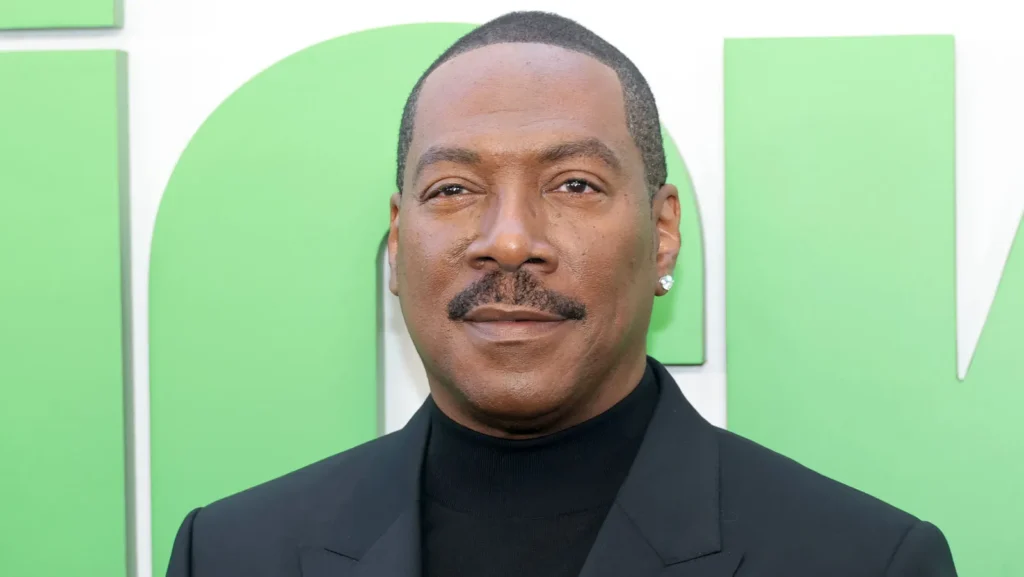
Eddie Murphy, born April 3, 1961, in Brooklyn, New York, is an American actor, comedian, and producer who became one of the first Black performers to reach true A-list, tentpole-carrying status in Hollywood. Raised in the Bushwick neighborhood, Murphy joined Saturday Night Live at nineteen and is widely credited with saving the show from cancellation, before transitioning to film with 48 Hrs. in 1982 and becoming one of the biggest box office draws of the decade through Trading Places, the Beverly Hills Cop franchise, and Coming to America. He reinvented himself repeatedly across five decades, from the prosthetic-heavy comedy of The Nutty Professor in the 1990s to voicing Donkey in the Shrek franchise, to an Academy Award-nominated dramatic turn in Dreamgirls, to a critically acclaimed comeback in Dolemite Is My Name in 2019. His films have grossed nearly $7 billion worldwide, making him the sixth-highest-grossing American actor at the box office. In 2019, he signed a reported $70 million deal with Netflix, and he has continued working steadily into his sixties, including reprising Axel Foley in Beverly Hills Cop: Axel F. Murphy has ten children across multiple relationships and has been engaged to Australian model Paige Butcher since 2012.
1. Film, Television, and Stand-Up Career
Murphy’s earnings trace an unusually long and well-documented arc, from a teenage SNL cast member’s per-episode rate to a $70 million streaming deal signed in his late fifties, with two commercially massive stand-up concert films adding a real, often overlooked income stream in the middle of that run.
- Saturday Night Live and breakthrough film roles (1980 to 1984): a documented $4,500 per episode rising to $30,000 per episode on SNL, plus $450,000 for 48 Hrs., $350,000 for Trading Places, $1M for Best Defense, a reported $14M combined salary and backend for Beverly Hills Cop, and his 1983 HBO special and home video release Delirious: ~$21M
- The 1980s peak, Beverly Hills Cop II through Harlem Nights (1985 to 1989): a documented $8M for Beverly Hills Cop II, a documented $8M for Coming to America, a reported $15M Paramount Television development deal through Eddie Murphy Television Enterprises, his share of Raw, which grossed $50.5M domestically and remains the highest-grossing stand-up comedy concert film ever released, his 1985 debut album How Could It Be, which reached number 26 on the Billboard 200 and produced the RIAA Platinum-certified single Party All the Time, and other film work: ~$57M
- The 1990s transition (1990 to 1995): a documented $7M for Another 48 Hrs., a reported $15M for Beverly Hills Cop III, and other films including Boomerang and The Distinguished Gentleman: ~$37M
- The family comedy and voice-acting era (1996 to 2001): a reported $16M for The Nutty Professor, a documented $14M for voicing Mushu in Mulan, an initial $350,000 for voicing Donkey in Shrek, and Nutty Professor II: The Klumps, for which a $20M salary plus 20 percent of gross receipts reportedly brought his total from that film alone above $60M: ~$118M
- Franchise sequels and dramatic work, Daddy Day Care through Shrek Forever After (2002 to 2010): includes Shrek 2, for which he and his co-stars renegotiated to a reported $10M each, Shrek the Third, Norbit, and his Academy Award-nominated supporting role in Dreamgirls: ~$40M
- A quieter period and the Netflix return (2011 to 2019): reduced film output through the first half of this decade, followed by a reported $70M deal with Netflix signed in 2019 for stand-up specials and other content: ~$85M
- The comeback era, Coming 2 America through Beverly Hills Cop: Axel F (2020 to 2026): includes Coming 2 America for Amazon, You People and Candy Cane Lane for Netflix, and a reported $15M to $20M for Beverly Hills Cop: Axel F: ~$50M
Murphy also released two further albums, So Happy (1989) and Love’s Alright (1993), neither of which repeated the commercial success of his debut, keeping his overall music career a real but modest contributor rather than a major fortune-building venture, since collaborator Rick James, as writer and producer of Party All the Time, would have taken a substantial share of that single’s royalties.
Phase total: ~$408M, broadly consistent with Celebrity Net Worth’s own tally of documented career earnings of at least $420M once every individually sourced figure is added up.
2. Business Ventures
Murphy’s ventures outside acting have a mixed track record. A late 1980s chain of burger restaurants called Murphy’s ultimately failed and holds no current value. Eddie Murphy Television Enterprises, his production arm from the Paramount era, functioned as a development vehicle rather than an independently valuable company and its value is already reflected in the phase one and two earnings above. His current production entity, Eddie Murphy Productions, operates primarily as a vehicle for his own starring vehicles under first-look arrangements with Amazon Studios and Netflix rather than an independently valuable content library, and no public valuation exists for it.
Business equity held: none quantifiable. We found a single, uncorroborated reference to an early investment in an unnamed online music company reportedly sold to Universal Music Group around 2000, but no dollar figure or company name is documented anywhere else, so it is excluded rather than estimated.
3. Representation
Representation on Murphy’s film and television earnings, covering agent, manager, and legal fees across a five-decade career built through the standard Hollywood system, is applied at a blended 13 percent, standard for a full team.
Representation (13% blended on $408M career gross): -$53M.
4. Tax
Murphy has been a California resident for the bulk of his career, based primarily in Beverly Hills and previously Granite Bay. Established Hollywood talent typically brings the state’s roughly 50 percent marginal rate down to an effective rate near 42 percent through loan-out company structures.
Tax (42% blended on $355M post-representation income): -$149.1M.
5. Lifestyle Burn
Murphy has a documented reputation, cited across multiple sources, for keeping his personal spending relatively private compared to peers of his earning level despite supporting ten children across several relationships, a pattern that shows up in specific, documented family support obligations rather than broad public extravagance.
- A $15M alimony award to first wife Nicole Mitchell following their 2005 divorce: $15M
- Documented $35,000 monthly child support payments to Mel B for their daughter, spanning roughly 2007 to 2026: ~$8M
- A modest era-scaled baseline covering general household costs, cars, and support for his other children across four and a half decades of earning: ~$69M
Total lifestyle burn: ~$92M, approximately 47 percent of post-tax income, reflecting the real, ongoing cost of supporting ten children across multiple households rather than conspicuous personal spending, which multiple sources note he has consistently avoided.
6. Real Estate
Murphy’s real estate history includes several fully documented sales with realized gains, alongside his current primary residence.
- Bubble Hill, a 32-room estate in Englewood, New Jersey, purchased in 1985 for $3.2M and sold in 2012 to Alicia Keys and Swizz Beatz for $10.4M: a documented gain of $7.2M
- The Granite Bay, California estate, purchased jointly with then-wife Nicole Mitchell in 1998 for $3.8M and sold in 2007 following their divorce for $6.1M: a documented gain of $2.3M
- A Lower East Side Manhattan co-op, purchased in the early 1980s for $300,000 and sold in 1991 for $1.5M: a documented gain of $1.2M
- His current primary residence at 19 Beverly Park in Beverly Hills, where he purchased a 3.7-acre lot in 2001 for $10M and invested an estimated $20M in custom construction, for a total cost basis near $30M against a current estimated value of $32M to $40M: an estimated gain of $6M
- Rooster Cay, a 15-acre private island in the Bahamas purchased in 2007 for $15M: no current appraisal exists, so no gain is calculated
Real estate appreciation: ~$16.7M.
7. Wealth Management
No disciplined third party investment program or wealth manager has been publicly documented for Murphy. Default applies.
Wealth Management: None reported ($0).
Net Worth Waterfall
| Line Item | Amount |
|---|---|
| Film, television, and stand-up career (1980 to 2026) | +$408M |
| Less: representation (13% blended) | -$53M |
| Less: tax (42% blended, California resident) | -$149.1M |
| Less: lifestyle burn (documented family support, era-scaled) | -$92M |
| Available to accumulate | +$113.9M |
| Real estate (documented and estimated gains) | +$16.7M |
| Business ventures | $0 |
| Wealth Management | $0 |
| Total (raw) | ~$130.6M |
| Final Figure (rounded) | $130M |
Our calculation: $130 Million.
Why Our Figure Differs From Widely Circulated Estimates
Public estimates for Murphy’s net worth cluster between $200M and $250M, generally built by citing his roughly $420M in documented lifetime earnings and treating a large share of that gross figure as though it survived intact to the present. That approach skips the deductions that actually determine what a star keeps: representation, an effective tax rate near 42 percent for a California-based earner across most of his career, and a genuinely large, well-documented family support burden. Murphy has ten children across several relationships, a $15M alimony award from his 2005 divorce, and confirmed $35,000 monthly child support payments to one former partner alone, obligations that public trackers rarely itemize even though they are among the best documented personal expenses of any actor in this database.
Our own build gives Murphy full credit for Delirious and Raw, his two 1980s stand-up concert films, income most public tallies fold vaguely into “comedy career” without ever pricing separately, despite Raw remaining the highest-grossing stand-up concert film ever released at over $50M domestically. We also decline to credit Murphy with business equity that several sources gesture toward without ever attaching a number or even a company name, most notably a vaguely described early-2000s online music investment that appears in exactly one source with no dollar figure. Rather than estimate a number for an asset we cannot verify exists in any specific form, we exclude it entirely. What remains is a career built almost entirely on film, television, and stand-up earnings, properly taxed and diminished by real, itemizable family obligations, which is why our figure sits meaningfully below the round, gross-earnings-adjacent numbers most commonly cited.
Four Decades, Ten Kids, One Number Nobody Itemizes
Eddie Murphy’s career earnings are about as well documented as any actor’s in Hollywood history, down to the exact per-episode rate he made as a teenager on Saturday Night Live. What almost no public estimate accounts for with any specificity is the other side of that ledger: a $15 million alimony award, a confirmed five-figure monthly child support payment stretching across nearly two decades, and nine more children beyond that single documented case. Murphy has spent forty years being one of the most bankable performers alive while keeping his personal financial life almost entirely out of the tabloids, and that discretion is precisely why the public number and the real one have drifted so far apart.ests.