$200 Million
WHO HE IS
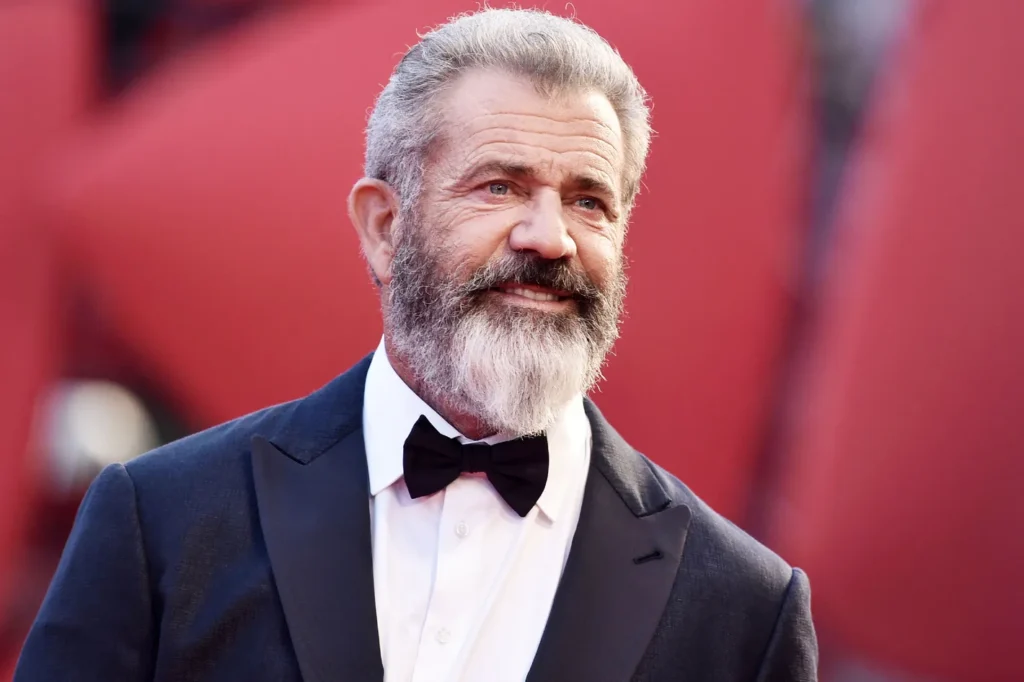
Mel Gibson, born January 3, 1956, in Peekskill, New York, is an Australian American actor, director, and producer who became one of the defining leading men of 1980s and 1990s Hollywood before rebuilding his career as an Oscar nominated director. Raised largely in Sydney after his family relocated when he was twelve, Gibson trained at the National Institute of Dramatic Art and broke through with Mad Max in 1979, followed by global stardom in the Lethal Weapon franchise. He won the Academy Award for Best Director and Best Picture for Braveheart in 1995, and in 2004 self financed The Passion of the Christ through his production company Icon Productions after every major studio passed on the project, a gamble that became the most profitable independent film investment in Hollywood history. A 2006 drunk driving arrest and antisemitic remarks, followed by a highly publicized domestic dispute with former partner Oksana Grigorieva, effectively pushed him out of major studio work for close to a decade. He has rebuilt steadily since Hacksaw Ridge earned him a second Best Director nomination in 2016, most recently directing Mark Wahlberg in Flight Risk in 2025 and developing The Passion of the Christ: Resurrection. Gibson was married to Robyn Moore from 1980 to 2011 and shares seven children with her, has an eighth child with Grigorieva, and a ninth with more recent partner Rosalind Ross.
1. Film Career
Gibson’s onscreen and behind the camera earnings span five decades, with one film in the middle of that run dwarfing everything else combined.
- Breakthrough era, Mad Max through Lethal Weapon 3 (1979 to 1994): documented early paydays include $15,000 for Mad Max, roughly $32,000 for Gallipoli, $120,000 for The Road Warrior, and $1.2M for Mad Max Beyond Thunderdome, climbing to a confirmed $10M for Lethal Weapon 3 (1992), his first eight figure payday, plus other 1980s and early 1990s roles including Bird on a Wire, Maverick, and Forever Young: ~$48M
- Backend and blockbuster peak, Braveheart through Lethal Weapon 4 (1995 to 1999): Braveheart’s salary was never disclosed, but as star, director, and producer of a Best Picture winner that grossed over $210M on a $53M to $72M budget, his combined fee and profit participation through Icon Productions is reasonably placed in the $50M to $70M range, alongside a confirmed $20M for Ransom, a comparable fee for Conspiracy Theory, and a confirmed $25M for Lethal Weapon 4: ~$125M
- The Passion of the Christ era, What Women Want through Apocalypto (2000 to 2006): includes four confirmed $25M paydays for What Women Want, The Patriot, We Were Soldiers, and Signs, plus The Passion of the Christ (2004), which Gibson self funded for $45M through Icon Productions in a 50/50 profit split with distributor Newmarket Films. The film grossed $612M worldwide, and combining box office, DVD sales, and merchandising, Celebrity Net Worth places his total personal take at nearly $475M, the high end of a range multiple outlets converge on, alongside a modest net return on the self funded Apocalypto: ~$590M
- Post scandal reduced output (2007 to 2016): supporting and cameo roles including Edge of Darkness, Get the Gringo, and Expendables 3, reflecting the career disruption following his 2006 arrest and the 2010 Grigorieva dispute: ~$20M
- The Wahlberg era and directing return, Daddy’s Home through The Continental (2017 to 2023): includes supporting roles in the Daddy’s Home franchise and Father Stu, plus his director and producer fee for the Academy Award nominated Hacksaw Ridge: ~$45M
- Recent work, Flight Risk and beyond (2024 to 2026): director and producer fee for Flight Risk, an Icon Productions and Davis Entertainment co-production for Lionsgate, plus Play Dirty and early work on The Passion of the Christ: Resurrection: ~$20M
Phase total: ~$848M.
2. Business Ventures: Icon Productions
Gibson co-founded Icon Productions with Bruce Davey in 1989, and unlike many celebrity production companies it has remained continuously active for over three decades, having produced Braveheart, The Passion of the Christ, and Apocalypto, and most recently co-producing Flight Risk (2025) and Play Dirty (2024) alongside Davis Entertainment, with The Passion of the Christ: Resurrection in development. Icon functions primarily as a financing and production vehicle for Gibson’s own projects rather than a studio with an independently valuable third party slate, which caps its standalone enterprise value relative to a talent backed media company with outside content. No public valuation or transaction has ever priced the company. Given its continued activity but narrow, single star focused mandate, we estimate a modest enterprise value split evenly between Gibson and Davey, its two founding partners.
Icon Productions, estimated 50% founding stake in a company valued in the low tens of millions: ~$10M.
3. The 2011 Divorce Settlement
Gibson’s 31 year marriage to Robyn Moore, which began in 1980 before Mad Max made him a star and ended in a divorce finalized in December 2011, is the single largest financial event of his career. The couple never signed a prenuptial agreement, so California’s community property law entitled Moore to half of everything earned during the marriage, a period covering nearly all of Gibson’s biggest paydays, including the entire Passion of the Christ windfall. The court judgment was sealed, and a figure of $425M, alongside a claim that Gibson’s fortune stood at $850M beforehand, has circulated in entertainment coverage for over a decade. That $850M figure traces to a single 2006 Los Angeles Business Journal estimate, and the commonly cited $425M settlement is simple arithmetic performed on top of it rather than a confirmed court number. Two Malibu properties worth just over $22M were confirmed transferred to Moore, and reporting also indicates she holds an ongoing right to half of Gibson’s future film residuals for life, an income stream layered on top of any lump sum rather than folded into a single cash figure.
Applying California’s actual community property rule, a genuine 50/50 division, directly to our own itemized pre-2011 earnings, after representation, tax, era scaled lifestyle spending, and a documented real estate appreciation estimate for the portfolio Gibson held at the time, produces a settlement in a materially different range than the widely circulated figure.
2011 divorce settlement, community property division applied to documented pre-2011 accumulation: -$147M.
4. Representation
Representation on Gibson’s film earnings, covering agent, manager, and legal fees across a career built through the standard Hollywood system, is applied at a blended 13 percent, standard for a full team.
Representation (13% blended on $848M career gross): -$110.2M.
5. Tax
Gibson has been a California resident for the bulk of his career, based primarily in Malibu. Established Hollywood talent typically brings the state’s roughly 50 percent marginal rate down to an effective rate near 42 percent through loan-out company structures.
Tax (42% blended on $737.8M post-representation income): -$309.9M.
6. Lifestyle Burn
Gibson’s spending is unusually well documented for a private figure, thanks to detailed reporting around the Grigorieva custody dispute and the Moore divorce, alongside a philanthropic record and a real estate history that point to a genuinely high burn rate independent of any single asset purchase.
- Breakthrough years, modest early spending before Braveheart (1979 to 1994, 16 years): ~$1M/yr consumed = $16M
- Peak stardom and family expansion, seven children with Robyn Moore, private jets, and the construction of a private Catholic chapel in Agoura Hills reported at roughly $3M (1995 to 2006, 12 years): ~$4.5M/yr consumed = $54M
- Scandal era, DUI legal costs, the Grigorieva custody dispute and settlement, and reduced but still substantial family spending (2007 to 2016, 10 years): ~$3M/yr consumed = $30M
- Recovery era, a more modest public profile with fewer active controversies (2017 to 2026, 10 years): ~$1.5M/yr consumed = $15M
Total lifestyle burn: ~$124.1M, approximately 29 percent of post-tax career income, consistent with a lifestyle that has included a private island, an international ranch, and a family of nine.
7. Real Estate
Gibson has assembled one of the more unusual real estate portfolios in Hollywood, but under our methodology only documented gains above the real purchase price count, and two of his best known Malibu properties were confirmed transferred to Robyn Moore as part of the 2011 settlement rather than remaining his to appreciate.
- Mago Island, Fiji, a roughly 2,164 hectare private island purchased in 2005 for $15M: no public transaction prices a recent sale, but Gibson has held this trophy asset for two decades, with reporting through the 2020s continuing to associate him with the island. We apply a conservative appreciation estimate for a rare, illiquid asset in this category.
- Costa Rica ranch, a 400 acre property purchased in 2007 for $26M: also still associated with Gibson in later reporting, with no recent sale price, and appreciation applied conservatively given the more agricultural, less liquid nature of the asset class.
- Two Malibu properties worth approximately $22M, confirmed transferred to Robyn Moore in the divorce: excluded entirely, as these no longer belong to Gibson.
- A Greenwich, Connecticut estate purchased in 1994 for $9M and sold in 2007 for $40M, and various Malibu listings between 2020 and 2024 with no confirmed completed sale: the Greenwich sale predates and is already folded into the 2011 settlement base, and the unconfirmed Malibu listings are excluded.
Real estate appreciation: ~$25M, combining conservative held gains on Mago Island and the Costa Rica ranch since 2011.
8. Wealth Management
No disciplined third party investment program or wealth manager has been publicly documented for Gibson beyond his direct, active involvement in Icon Productions and his real estate holdings. Default applies.
Wealth Management: None reported ($0).
Net Worth Waterfall
| Line Item | Amount |
|---|---|
| Film career (1979 to 2026) | +$848M |
| Less: representation (13% blended) | -$110.2M |
| Less: tax (42% blended, California resident) | -$309.9M |
| Less: lifestyle burn (era-scaled, consumed only) | -$124.1M |
| Less: 2011 divorce settlement (community property division) | -$147M |
| Available to accumulate | +$156.8M |
| Real estate (Mago Island and Costa Rica ranch, held gains since 2011) | +$25M |
| Icon Productions, estimated 50% founding stake | +$10M |
| Wealth Management | $0 |
| Total (raw) | ~$191.8M |
| Final Figure (rounded) | $200M |
Our calculation: $200 Million.
Why Our Figure Differs From Widely Circulated Estimates
The commonly cited figure for Gibson’s net worth is $425M, a number built almost entirely on a single chain of estimates rather than itemized earnings. A 2006 Los Angeles Business Journal report pegged his fortune at $850M, and when his sealed 2011 divorce settlement became public knowledge, outlets divided that figure in half and reported $425M as the settlement amount, a number that has been repeated without independent verification for over a decade since. Court documents on the actual settlement remain sealed. The only settlement details ever confirmed on the record are two Malibu properties worth roughly $22M transferred to Robyn Moore and an ongoing entitlement to half of Gibson’s future film residuals, an income stream rather than a lump sum, a very different financial picture than a single $425M cash payment.
Our approach instead builds Gibson’s pre-2011 wealth from itemized, documented paydays, including his well corroborated $475M personal payday from The Passion of the Christ, applies representation, an effective 42 percent tax rate, and era scaled lifestyle spending, then applies California’s actual community property rule, a genuine 50/50 split, to that documented accumulation rather than to an unverified press estimate. That produces a settlement figure materially smaller than $425M, which is also why our final net worth, while still reflecting one of the largest divorce related wealth transfers in Hollywood history, differs substantially from the figure most commonly cited. We also exclude the two Malibu homes confirmed transferred to Moore from Gibson’s current real estate holdings, a detail frequently missing from public tallies that still count his full historical property portfolio as though the 2011 settlement never happened.
The Fortune The Divorce Rewrote
Mel Gibson made $15,000 for the film that made him a star and nearly $475M from the one he had to fund himself because no studio would touch it. Both numbers matter to his net worth, but neither matters as much as a single fact most public estimates account for incorrectly: he built the bulk of that fortune inside a 31 year marriage with no prenuptial agreement, in a state where that means splitting it in half. The real story of Gibson’s finances is not The Passion of the Christ. It is what California family law did to The Passion of the Christ money five years after he earned it.