$115 Million
WHO HE IS
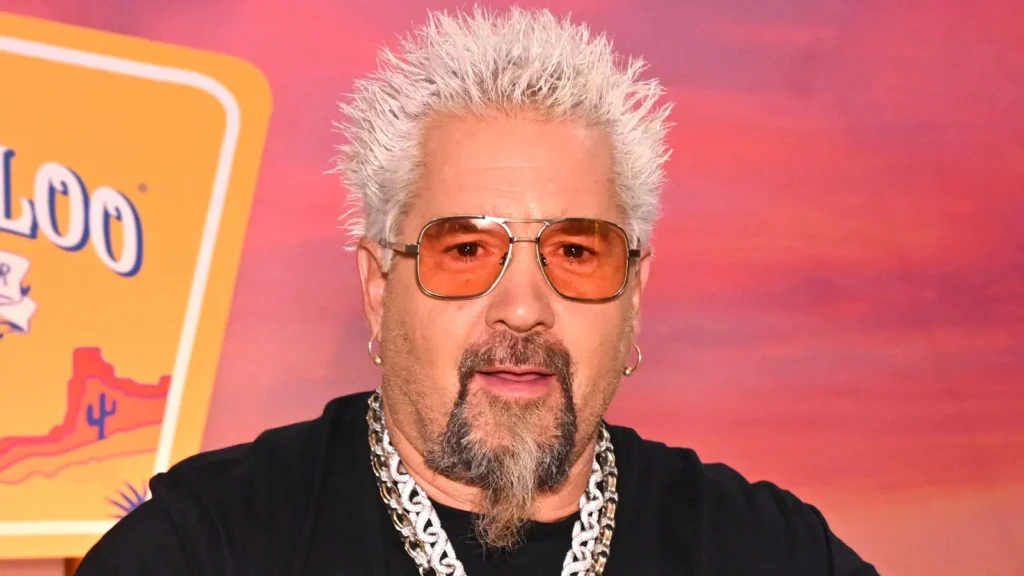
Guy Ramsay Fieri, born January 22, 1968, in Columbus, Ohio, and raised in Ferndale, California, is an American restaurateur, author, and television personality. He began working in food service at age 10, selling pretzels from a cart he called the Awesome Pretzel, and later studied hotel management at the University of Nevada, Las Vegas. In 1996 he opened his first restaurant, Johnny Garlic’s, with business partner Steve Gruber, followed by the Tex-Mex-inspired Tex Wasabi’s. Fieri’s national breakthrough came in 2006, when he won the second season of The Next Food Network Star, reportedly earning $1,000 per episode on his first show, Guy’s Big Bite. In 2007 he launched Diners, Drive-Ins and Dives, the show that transformed him into a household name, and has since added Guy’s Grocery Games, Tournament of Champions, and numerous other Food Network series. He has signed three publicly documented Food Network contracts: a three-year, $30 million deal in 2018, a three-year, $80 million deal in 2021, and a three-year, $100 million deal in 2023, the last of which made him the network’s highest-paid talent. Beyond television, he has built a restaurant and licensing empire including Guy’s American Kitchen & Bar, Chicken Guy!, Guy’s Burger Joint aboard Carnival cruise ships, and the Flavortown Kitchen ghost-kitchen delivery brand, which has expanded to more than 170 locations. He co-owns Santo Tequila with musician Sammy Hagar and has been an investor in the UFC. He lives on a ranch near Santa Rosa, California, with his wife Lori, and has two sons.
1. Television Earnings (2006-2026)
Fieri’s Food Network career is unusually well documented for a celebrity chef, with three specific, publicly reported contract values spanning his more recent career, alongside a much more modest early period building toward that first big deal.
- Early Food Network years, from $1,000 per episode through Diners, Drive-Ins and Dives’ launch and Guy’s Grocery Games (2006-2010): ~$200K/yr = $800K
- Established stardom, pre-first-major-contract era (2010-2018): ~$1.5M/yr = $12M
- First documented Food Network contract, three years at $30M (2018-2021): $30M
- Second documented contract, three years at $80M, superseded after two years by the 2023 renewal (2021-2023): ~$26.67M/yr x 2 = $53.33M
- Third documented contract, three years at $100M, network’s highest-paid talent (2023-2026): $100M
Television earnings: $196.13M gross.
2. Core Owned Restaurants (1996-2018)
Fieri’s earliest restaurants, Johnny Garlic’s and Tex Wasabi’s, were directly owned and operated concepts rather than licensing arrangements, generating owner distributions that grew alongside his rising television fame.
- Pre-fame build-out (1996-2006): ~$150K/yr = $1.5M
- Fame-driven growth in traffic and expansion (2006-2018): ~$500K/yr = $6M
Core owned restaurant distributions: $7.5M gross.
3. Licensing and Franchise Royalties (2011-2026)
The bulk of Fieri’s more recent restaurant-related income comes not from direct ownership but from licensing his name and format to restaurants, casinos, cruise ships, and, most significantly, the Flavortown Kitchen ghost-kitchen delivery brand. The scale here is larger than it might first appear: the Times Square flagship of Guy’s American Kitchen & Bar alone was ranked among the nation’s top 50 grossing independent restaurants, with reported annual sales of approximately $17M before its 2017 closure, and that was just one of 17 Guy’s American Kitchen & Bar locations. The wider licensed footprint also includes 58 Guy’s Burger Joint locations on land and aboard Carnival cruise ships, 11 Chicken Guy! locations, and more than 170 Flavortown Kitchen ghost-kitchen locations. This structure generates royalty income rather than full owner distributions, and is treated as a separate, lower-margin-per-unit income stream from the core owned restaurants above.
- Early licensing era, Guy’s American Kitchen & Bar, Carnival’s Guy’s Burger Joint, casino locations (2011-2018): ~$1M/yr = $7M
- Scaled licensing era, Chicken Guy! and the 170-plus-location Flavortown Kitchen ghost-kitchen network (2018-2026): ~$5M/yr = $40M
Licensing and franchise royalties: $47M gross.
4. Santo Tequila (2021-2026)
Fieri co-owns Santo Tequila, a spirits brand launched with Sammy Hagar, generating a modest but growing royalty stream distinct from his restaurant and television income.
- Santo Tequila royalty income (2021-2026, 5 years): ~$500K/yr = $2.5M
Santo Tequila: $2.5M gross.
5. Cookbook Royalties (2006-2026)
Fieri has authored multiple bestselling cookbooks over the course of his television career, generating steady if secondary income relative to his television and licensing earnings.
- Cookbook royalties (2006-2026, 20 years): ~$300K/yr = $6M
Cookbook royalties: $6M gross.
6. Representation
Standard entertainment representation applies to Fieri’s television, licensing, and publishing income. Core restaurant distributions and the Santo Tequila stake are not run through standard talent representation.
- Representation on television earnings (10% x $196.13M): -$19.61M
- Representation on licensing and franchise royalties (10% x $47M): -$4.7M
- Representation on cookbook royalties (10% x $6M): -$0.6M
Total representation: -$24.91M.
7. Tax
Fieri has been a California resident throughout his career, one of the highest state income tax jurisdictions in the country with limited loan-out mitigation available relative to some other states. We use approximately 48% effective.
- Tax on all income net of representation (48% x $234.22M): -$112.42M
Total tax: -$112.42M.
8. Lifestyle Burn
Fieri has been married since 1995, has two sons, and maintains a well-documented classic car collection alongside multiple residential properties in California and Florida.
- Early career, modest spending (1996-2006, 10 years): ~$150K/yr = $1.5M
- Growing fame and family life (2006-2018, 12 years): ~$600K/yr = $7.2M
- Peak wealth era, Palm Beach properties, car collection, high-profile philanthropy (2018-2026, 8 years): ~$1.5M/yr = $12M
Total lifestyle burn: ~$20.7M.
9. Real Estate
Fieri owns a roughly 450-acre ranch near Santa Rosa, California, and purchased two Florida properties in recent years: a West Palm Beach home for $3.9M in 2021 and a waterfront Palm Beach mansion for $7.325M in September 2023. No purchase price is documented for the Santa Rosa ranch, and neither Florida property has been resold, so no realized gain is counted here. This is treated as a documented gap rather than an assumed $0 outcome.
Real estate: $0 counted (documented, unvalued).
10. UFC Investment (2016)
Fieri participated in a 2016 investment round in the UFC, a funding round with a total raise of $41.25M and a documented minimum individual investment of $250K, though Fieri’s specific stake size was never disclosed. Given the UFC’s substantial valuation growth since 2016, including its subsequent merger into TKO Group, this is treated as a real, documented investment with a genuine but uncertain return, valued conservatively given the lack of disclosure around Fieri’s specific contribution.
- Estimated investment (near the disclosed $250K minimum, scaled modestly for a participant of Fieri’s profile): ~$750K
- Estimated current value, reflecting UFC’s growth since 2016: ~$3M
UFC investment gain: +$2.25M (estimated, based on undisclosed stake size).
11. Business Equity
Beyond the ongoing royalty income already counted, the Flavortown Kitchen brand and licensing entity itself, spanning more than 170 ghost-kitchen locations, represents a going-concern asset of unusual scale relative to other chef-owned brands on this site.
- Flavortown Kitchen brand and licensing entity, estimated value: +$10M
Business equity: +$10M.
12. Wealth Management
No independently documented wealth management program has been found for Fieri beyond the UFC investment and business interests already priced above.
Wealth Management: None reported ($0).
Net Worth Waterfall
| Line Item | Amount |
|---|---|
| Television earnings (2006-2026) | +$196.13M |
| Core owned restaurant distributions (1996-2018) | +$7.5M |
| Licensing and franchise royalties (2011-2026) | +$47M |
| Santo Tequila (2021-2026) | +$2.5M |
| Cookbook royalties (2006-2026) | +$6M |
| Less: representation | -$24.91M |
| Less: tax | -$112.42M |
| Less: lifestyle burn (era-scaled, consumed only) | -$20.7M |
| Real estate | $0 |
| UFC investment gain (estimated) | +$2.25M |
| Flavortown Kitchen brand and licensing equity (estimated) | +$10M |
| Wealth Management | $0 |
| Raw Total | $113.35M |
| Total Net Worth (rounded) | $115M |
Why Our Figure Differs From Consensus
Our build lands at $115M, above the $100M figure widely cited by Parade and other syndicated outlets, but still below Celebrity Net Worth’s own current page, updated in February 2026, which now lists $130M and cites a $33M annual Food Network salary. This looks like a case where CNW revised its figure upward recently and other outlets simply have not caught up yet. Our own math is built from Fieri’s three specific, publicly disclosed Food Network contract values ($30M in 2018, $80M in 2021, $100M in 2023) plus a licensing footprint sized against real, documented figures, including the roughly $17M in annual sales reported at just the Times Square flagship of Guy’s American Kitchen & Bar, and a wider network of 17 Guy’s American Kitchen & Bar locations, 58 Guy’s Burger Joint locations, 11 Chicken Guy! locations, and more than 170 Flavortown Kitchen ghost kitchens. If Fieri’s actual 2023 contract terms extend further into 2026 and 2027 than we have assumed, or if his licensing royalty rate is higher than our conservative estimate, this number would move closer to CNW’s newer $130M figure.
The Chef Who Made Licensing the Whole Business
Guy Fieri’s fortune looks different from nearly every other name in this category because so little of it comes from operating restaurants himself. Where other celebrity chefs built empires one owned location at a time, Fieri’s largest and fastest-growing revenue line is licensing, over 170 ghost kitchens carrying his name without him ever setting foot in most of them, stacked on top of three of the most transparently disclosed Food Network contracts in the industry. It is a model built less around cooking and more around being a brand that other people’s kitchens can rent, and it has made him, by a wide margin, the highest-paid personality his network has ever had.e by understanding, earlier than most, that the talent who drives the audience should be paid like the owner.