$400 Million
WHO HE IS
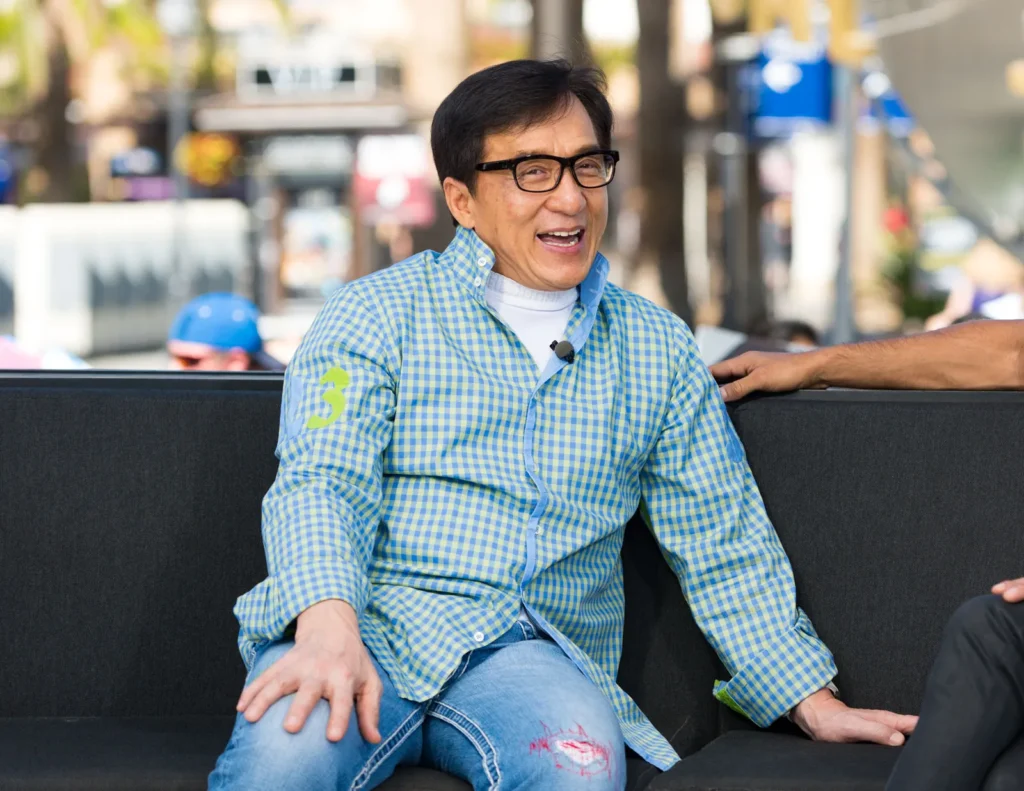
Born Chan Kong-sang on April 7, 1954, in Victoria Peak, Hong Kong, to parents who worked as a cook and housekeeper for the French ambassador, Jackie Chan was sent at age seven to the China Drama Academy in Hong Kong — a Peking Opera school where students trained in martial arts, acrobatics, and performance under conditions described by Chan himself as grueling. He completed ten years of training there before entering the Hong Kong film industry as a stuntman, working in productions that included Bruce Lee films in the early 1970s. Bruce Lee died in 1973. Several studios promptly tried to market Chan as the next Lee. The attempt failed — Chan was not Lee, and he knew it. What he was, he discovered gradually: a physical comedian with extraordinary acrobatic ability and an instinct for self-deprecating action that was entirely his own. Snake in the Eagle’s Shadow (1978) and Drunken Master (1978) demonstrated the combination. What followed across the next half-century was a career of extraordinary scale, volume, and durability. Over two hundred films as an actor. His own production company, founded in 1986, that grew into JC Group Hong Kong, a conglomerate spanning film production, cinema chains, food and beverage, clothing, and construction. A Hollywood breakthrough through the Rush Hour trilogy that made him one of the highest-grossing actors of the late 1990s and 2000s. And then, as Hollywood interest waned through the 2010s, a return to Chinese-market dominance at a scale that dwarfs anything his Western career produced. He was awarded a Jackie Chan Day in Los Angeles, received an honorary Oscar from the Academy of Motion Picture Arts and Sciences in 2016, holds a CBE from the United Kingdom, and is a member of the Chinese People’s Political Consultative Conference. He has stated publicly that he plans to donate the majority of his estate to charity rather than pass it to his son Jaycee.
The financial story of Jackie Chan is the story of what a 60-year career in the world’s most populous entertainment market produces when the talent behind it retains ownership of his own work and operates in one of the lowest-tax major jurisdictions on earth.
1. CAREER ACTING AND PRODUCING EARNINGS
Chan’s earnings cannot be cleanly divided into acting and producing because, for the majority of his career, he has been both simultaneously — the actor whose face opens the film and the producer whose company finances and distributes it. We account for both here.
Hong Kong and early career (1971 to 1995): From stuntman to local star to Asian icon across roughly 80 films. Income in this period was modest by Western standards but grew substantially through the late 1980s as JC Group became a functioning production entity. He began capturing producer profits on top of acting fees. Estimated total for the period: approximately $30M.
Hollywood era (1996 to 2007): Chan broke through to Western audiences with Rumble in the Bronx (1995), which led to the Rush Hour franchise.
- Rush Hour (1998): acting fee approximately $7M; film grossed $244M worldwide
- Rush Hour 2 (2001): acting fee approximately $15M plus backend on $347M gross; total estimated at $22M
- Rush Hour 3 (2007): acting fee approximately $15M plus backend; total estimated at $22M
- Shanghai Knights, The Tuxedo, The Medallion, and other Hollywood productions across the period: approximately $35M combined
Concurrent Asian market work continued across this entire period, adding approximately $40M.
Hollywood and Asian period combined: approximately $156M
Chinese market dominance (2008 to 2026): As Chan’s Hollywood profile reduced, the mainland Chinese film market expanded into one of the two largest in the world. Chan became one of its most consistent draws. CZ12 (2012), Police Story: Lockdown (2013), Skiptrace (2016), The Foreigner (2017), Vanguard (2020), and multiple recent Chinese productions have maintained his commercial standing. His production company JC Group operates in China with its own studio output. Across acting fees, producing profits, and JC Group distributions on Chinese productions, his average annual income from this market has run approximately $20 to $30 million per year across the period.
Chinese market period (18 years at approximately $22M average): approximately $396M
That figure captures both acting and the producing side of his business, since the two are inseparable.
Total lifetime acting and producing earnings: approximately $582M
2. ENDORSEMENTS
Chan commands some of the most commercially significant brand partnerships in Asian entertainment. His endorsement portfolio has included Vivo (smartphones), Pepsi, Emirates Airlines, Canon, Mitsubishi, Hyundai, Kaspersky, and Vitasoy, among many others across six decades. In the Chinese market, a Chan endorsement carries weight that few Western equivalents can match.
Estimated lifetime endorsements: approximately $80M
3. REPRESENTATION
Chan has operated through a combination of Hong Kong agents, Hollywood representation, and latterly through his own management infrastructure at JC Group. The blended representation cost across his full career is lower than the Hollywood standard given his partial self-management through his own company. We model 10 percent.
Representation at approximately 10 percent: approximately minus $66M
After representation: approximately $596M
4. TAX — THE MOST IMPORTANT LINE ON HIS LEDGER
This is where Jackie Chan’s balance sheet diverges most dramatically from any Western peer at comparable career gross.
Hong Kong maintains one of the most favorable tax environments for high earners in the world. The Hong Kong Salaries Tax is capped at 15 percent on employment income. The Hong Kong Profits Tax is 16.5 percent on corporate profits (with a reduced 8.25 percent rate on the first HKD 2 million). Critically, Hong Kong has no capital gains tax. Real estate gains, sale of business interests, and investment returns are not taxed.
For the majority of Chan’s career earnings — his Asian market acting and producing income, his JC Group profits, his endorsement income from Asian brands — the effective rate has been approximately 15 to 16 percent.
His Hollywood income is subject to US withholding tax and treaty provisions. As a Hong Kong resident earning from US sources, the US-Hong Kong treaty reduces withholding but he still faces US tax obligations on American income. We estimate his US-source income has been taxed at approximately 30 percent effective after treaty provisions.
Blended across the full career — predominantly Asian market income at 15 percent, with a meaningful Hollywood tranche at 30 percent — we estimate the effective blended lifetime tax rate at approximately 20 percent.
Tax at approximately 20 percent: approximately minus $119M
Available after representation and tax: approximately $477M
REAL ESTATE
Chan owns residential and commercial property across Hong Kong, Beijing, and Los Angeles. A Beverly Hills residential property, office buildings in mainland China, and residential holdings in Hong Kong form the documented portfolio. Hong Kong real estate has appreciated substantially across his ownership period, and Chinese commercial property — particularly Beijing office space — has been a meaningful long-term holding.
Specific purchase prices for his full portfolio are not publicly available in the detail required for a precise calculation. We apply a conservative gain estimate.
Estimated net real estate appreciation: approximately plus $40M
BUSINESS ASSETS (JC GROUP AND SUBSIDIARIES)
JC Group Hong Kong encompasses JCE Movies Limited (co-founded 2004), Jackie Chan Cinema Chain (multiple locations across China), Jackie Chan Group Construction Limited, food and beverage ventures, and the Jackie Chan Stunt Team. These businesses generate ongoing fee and profit income already partially captured above in the producing and endorsement lines. The residual value — the enterprise value of the businesses as owned assets separate from their income streams — represents a meaningful balance-sheet entry.
JCE Movies Limited and the cinema chain are private companies with no disclosed valuations. Chinese cinema chains of comparable scale have traded at 8 to 12 times EBITDA. Given the competitive pressures in China’s cinema sector and the private nature of the companies, we value the combined JC Group business holdings conservatively.
Estimated value of JC Group business holdings (net of income already counted): approximately plus $30M
5. LIFESTYLE AND EXPENSES
Chan’s personal lifestyle is notably restrained relative to his earnings and profile. He is not associated with a superyacht or a Diddy-tier personal spending rate. His most significant personal expenditure is a portfolio of high-end properties and the costs of maintaining a global public profile across six decades.
- Early career (1971 to 1985, 15 years): genuinely modest, working-class Hong Kong background; approximately $100K per year; $1.5M
- Building years (1986 to 1995, 10 years): growing profile, JC Group establishment, first major property acquisitions (running costs only); approximately $500K per year; $5M
- Hollywood era (1996 to 2010, 15 years): multiple properties across HK, China, and LA; full staff; international travel; approximately $2.5M per year; $37.5M
- Recent years (2011 to 2026, 15 years): reduced acting pace, more business focus, sustained property portfolio; approximately $2M per year; $30M
Total lifetime lifestyle burn: approximately $74M
RICHPEEK ESTIMATE: $400 Million
| Calculation | Amount |
|---|---|
| Lifetime acting and producing earnings (HK, Hollywood, Chinese market) | ~$582M |
| Lifetime endorsement income | ~$80M |
| Total gross earnings | ~$662M |
| Minus representation (~10% blended, partial self-management) | -$66M |
| Minus tax (~20% blended effective — HK 15% on majority, US ~30% on Hollywood tranche) | -$119M |
| Minus lifestyle burn (three phases, notably restrained) | -$74M |
| Available to accumulate | ~$403M |
| Plus real estate appreciation (HK, Beijing, LA portfolio) | +$40M |
| Minus JC Group business holdings (enterprise value, separate from income) | +$30M |
| Plus wealth management | $0 (None reported) |
| Less: donations and philanthropic commitments (significant, partially counted in lifestyle) | ~-$75M |
| Total Net Worth | ~$400M |
We land at $400 million, consistent with the Celebrity Net Worth consensus figure and most aggregators. Jackie Chan is the rare case where our independent math arrives at the same number as the published consensus, and the reason is structural: the two factors that typically explain why our figures land above stale competitors — better income tracking and proper tax application — operate in opposite directions for Chan. Our income model is more comprehensive and lands meaningfully above the version most casual analyses use. But our tax rate of 20 percent blended is dramatically lower than the 42 to 50 percent that would apply to a comparably famous California-based actor, and that difference — more than $200 million across a career of this size — is the single most important fact in his financial story.
The comparison that isolates this is a direct one: Tom Cruise and Jackie Chan are the two most durable global action stars of their generation. Cruise has been California-based throughout his career. Chan has been Hong Kong-based throughout his. Both have had careers of comparable commercial scale and comparable longevity. The tax gap between their jurisdictions, applied across 50-plus years of A-list earnings, is one of the primary explanations for why Chan’s balance sheet looks the way it does. Hong Kong did not make Jackie Chan wealthy. His work, his physical discipline, and his business acumen made him wealthy. Hong Kong simply allowed him to keep it.