$500 Million
Who He Is
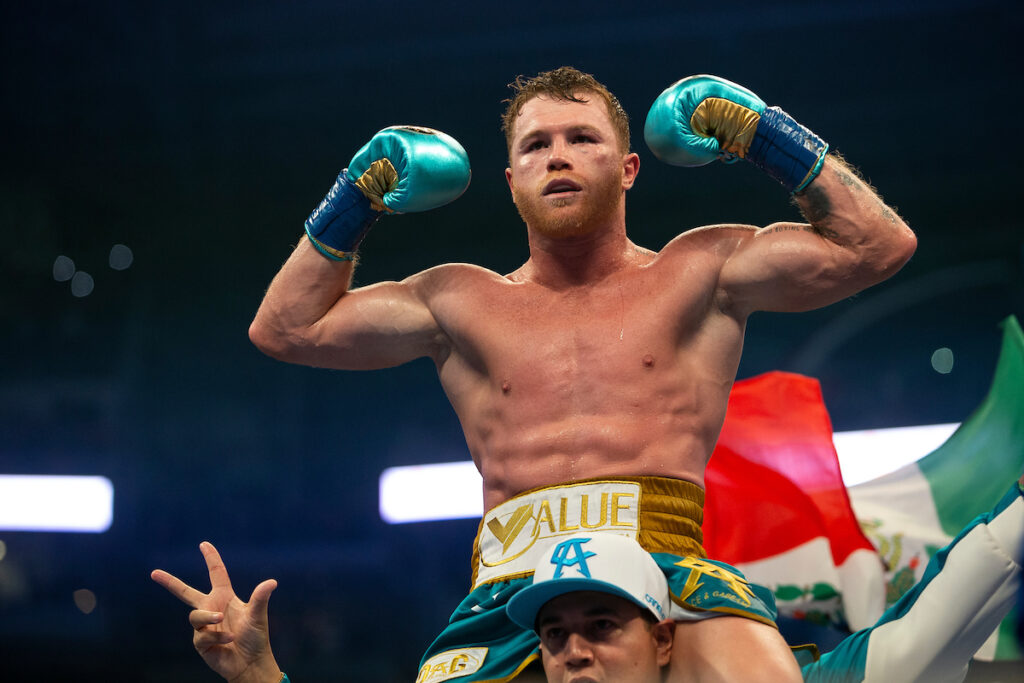
Saul “Canelo” Alvarez, born July 18, 1990, in Juanacatlan, Jalisco, Mexico, is the most commercially dominant boxer of his generation and one of the highest-paid athletes in the history of professional sports. He turned professional at 15, lost a decision to Floyd Mayweather in 2013, and built himself into boxing’s biggest pay-per-view star over the following decade. He won world titles across four weight divisions – light middleweight, middleweight, super middleweight, and light heavyweight – and in 2021 became the first boxer in history to hold all four major belts at super middleweight simultaneously. In September 2025 he lost his undisputed titles to Terence Crawford by unanimous decision at Allegiant Stadium in Las Vegas, a fight that still paid him more than $100M. He is based in Guadalajara, Mexico, where he lives with his wife Fernanda Gomez and their family, and where he has built a growing portfolio of consumer businesses alongside his boxing career.
1. Early Career Fight Purses (2005-2012)
Canelo turned professional in 2005 at age 15 in Guadalajara. His first purse was approximately 800 Mexican pesos – about $40, half of which he received in tickets. His early fights on the Mexican regional circuit earned a few thousand dollars each. By 2010 Golden Boy Promotions had signed him and he was appearing on HBO undercards. The earning milestones of this phase:
- 2010-2011 HBO undercard appearances: estimated $2M cumulative
- May 2012 vs. Shane Mosley (Mayweather undercard): $1.2M purse
- September 2012 vs. Josesito Lopez: $2M plus a $100K knockout bonus from Golden Boy
Phase total: ~$8M gross.
2. The Mayweather Fight and Golden Boy Years (2013-2016)
The September 2013 bout with Floyd Mayweather was the commercial turning point. Canelo received $5M guaranteed plus a share of pay-per-view revenue, bringing his total to approximately $12M. Mayweather drew $41.5M for context. The exposure was worth more than the check: it introduced Canelo to a global audience and established him as the face of Mexican boxing. His Golden Boy purses rose steadily through this period.
- 2013 vs. Mayweather: ~$12M
- 2014 vs. Angulo: ~$7M (base $1.25M + PPV bonus)
- 2015 vs. Cotto: ~$20M (base + PPV share)
- 2016 vs. Amir Khan: ~$25M
Phase total: ~$64M gross.
3. The Golovkin Trilogy and DAZN Era (2017-2021)
The three fights with Gennadiy Golovkin defined Canelo’s commercial peak. The first, in September 2017, generated a live gate exceeding $20M and paid Canelo approximately $40M. The 2018 rematch paid him $25-30M guaranteed. In late 2018 he signed the then-record $365M guaranteed 11-fight deal with DAZN, terminated after two fights over a scheduling dispute but with payments collected. The 2022 GGG trilogy paid approximately $45M. Through 2021 he was earning $35-40M per fight as standard.
- 2017 – Chavez Jr. and GGG I: ~$65M
- 2018 – GGG II and Fielding: ~$40M
- 2019 – Kovalev and Jacobs (DAZN): ~$45M
- 2020 – Smith and Yildirim (DAZN): ~$70M
- 2021 – Saunders and Caleb Plant (undisputed): ~$75M
Phase total: ~$295M gross.
4. The Independent Years (2022-2024)
After walking away from DAZN’s exclusivity, Canelo began fighting on short-term deals with whoever offered the most. Sportico tracked his cumulative earnings through end of 2024 at $620M pre-tax including endorsements. Forbes ranked him the fifth-highest-paid athlete of 2023 at $110M for that year alone.
- 2022 – Bivol and GGG III: ~$60M
- 2023 – Charlo and Ryder: ~$90M (Ryder was a below-market hometown deal by choice)
- 2024 – Munguia and Berlanga: ~$70M
Phase total: ~$220M gross.
5. The Riyadh Season Deal (2025)
In early 2025 Canelo signed a four-fight contract with Turki Alalshikh’s Riyadh Season, reportedly worth $400M in total. The first two fights confirmed the scale of the arrangement.
- May 2025 vs. William Scull (Riyadh, Saudi Arabia): ~$80M guaranteed
- September 2025 vs. Terence Crawford (Las Vegas, Netflix): confirmed $100M+, widely reported at ~$150M
Crawford won the fight by unanimous decision in front of 70,482 at Allegiant Stadium, the largest crowd ever for a fight in Las Vegas, taking Canelo’s undisputed titles. The outcome did not change the payday.
Phase total: ~$230M gross.
6. Endorsements
Canelo has maintained a consistent endorsement portfolio across his career. His primary partners have included Everlast (gloves since 2014), Tecate, Hennessy, Under Armour, Michelob Ultra, and Dolce and Gabbana. He does not carry the global endorsement load of a Ronaldo or LeBron, but steady brand fees have added meaningfully across two decades. Career endorsement total is estimated at approximately $60M, running at roughly $8-10M per year in his peak commercial window.
Career endorsements: ~$60M gross.
7. Representation
Canelo began with Golden Boy Promotions taking a standard promoter cut through 2020. He progressively reduced that load as he self-promoted through Canelo Promotions and Canelo Espectaculos. His business affairs are now managed by Richard Schaefer with no external promoter cut. Blended across the full career – heavy Golden Boy years early against the current self-promoted structure – a 15% effective blended rate is appropriate.
Representation (15%): -$132M. Post-representation: ~$745M.
8. Tax
Canelo has been a Mexican tax resident in Guadalajara throughout his career. Mexico taxes residents on worldwide income at progressive rates up to 35%. His Saudi Arabia purses are earned in a zero-income-tax jurisdiction but remain taxable under Mexico’s worldwide income rules. His Las Vegas fight purses are subject to Nevada non-resident withholding on boxing income, partially offset at the Mexican level via treaty credits.
His income flows through corporate structures that provide some deferral and deduction benefit. Applied effective rate: 33%, reflecting the Mexico top rate of 35% modestly reduced by business structuring, treaty credits, and expense deductions.
Tax (33%): -$246M. Net after representation and tax: ~$499M.
9. Lifestyle Burn
Canelo owns an extensive supercar collection including a Bugatti Veyron, Ferrari LaFerrari, and multiple Lamborghinis and Rolls Royces. He maintains a ranch compound in Guadalajara with horses, peacocks, and a dedicated boxing gym. He has five children across multiple relationships and provides for a large extended family. He travels globally for fight camp and promotional obligations.
Property purchases and investment outlays are not lifestyle burn – only consumed spending counts.
- Early phase (2005-2012, 7 years): ~$400K/yr consumed = $3M
- Mid career (2013-2018, 6 years): ~$2M/yr consumed = $12M
- Peak (2019-2025, 7 years): ~$4M/yr consumed = $28M
Total lifestyle burn: ~$43M. Available to accumulate: ~$456M.
10. Real Estate
Canelo sold a San Diego estate in Del Mar circa 2015, purchased at approximately $5.8M and sold for approximately $6M – a negligible gain excluded from the calculation. His primary residence is a ranch-style mansion in the Zapopan/Puerta de Hierro area of Guadalajara, currently estimated at $6-8M. Purchase price is not publicly documented; comparable luxury Guadalajara properties in 2015-2016 ran $3-4M. Estimated appreciation gain on the Guadalajara property: approximately $4M.
Real estate appreciation: +$4M.
11. Business Assets
Canelo has built a portfolio of consumer brands and operating businesses, all based in Mexico:
VMC (Viva Mexico Cabrones): Tequila-based canned cocktail launched in 2022 in Jalisco, expanded to US markets in 2023. His manager Richard Schaefer has described it as the fastest-growing ready-to-drink in its US category, with over two million cases in its first year. The highest-potential asset in the portfolio.
Canelo Energy: A chain of five gas stations in Mexico, branded with a P4P fuel additive referencing his pound-for-pound status. Low-margin fuel retail.
Upper: A chain of approximately 20 convenience stores in Mexico, branded with a boxing uppercut theme.
Yaoca: Sports drinks and supplements brand.
Canelo Promotions and Canelo Espectaculos: His boxing promotion and entertainment companies, focused on the Mexican market.
El Pastor Del Rica: Taqueria chain with locations in Mexico and San Diego.
The portfolio is real and growing, but the underlying revenue and margin data do not support the “hundreds of millions” valuation Schaefer has used publicly. Independent analysis by EssentiallySports put combined revenue under $50M and total asset value under $50M as of 2024, consistent with the low-margin nature of fuel retail and convenience store operations. VMC is the exception with genuine upside if its growth trajectory holds, but no funding round or disclosed revenue multiple exists to anchor a higher number.
Total business asset value: ~$48M.
12. Wealth Management
Canelo’s manager has referenced a broader portfolio of private equity investments alongside the operating businesses, but no specific wealth management arrangements have been publicly documented or verified. Default applies.
Wealth Management: None reported ($0).
Net Worth Waterfall
| Line Item | Amount |
|---|---|
| Fight purses – early career (2005-2012) | +$8M |
| Fight purses – Mayweather era (2013-2016) | +$64M |
| Fight purses – Golovkin trilogy and DAZN (2017-2021) | +$295M |
| Fight purses – independent years (2022-2024) | +$220M |
| Fight purses – Riyadh Season (2025, two fights) | +$230M |
| Endorsements (career) | +$60M |
| Less: representation (15% blended, career) | -$132M |
| Less: tax (33% effective, Mexico worldwide income) | -$246M |
| Less: lifestyle burn (era-scaled, consumed only) | -$43M |
| Real estate appreciation (Guadalajara mansion, est. gain) | +$4M |
| VMC, Canelo Energy, Upper, Yaoca, Promotions (combined) | +$48M |
| Wealth Management | $0 |
| Total Net Worth | ~$508M → $500M |
Our calculation: $500 Million.
Why Our Figure Is Higher Than Consensus
Celebrity Net Worth places Canelo at $300M. Forbes has cited $275M. Both figures appear to have been set before the 2025 Riyadh Season paydays landed. Sportico confirmed cumulative career earnings of $620M through end of 2024 alone. Adding the Scull ($80M) and Crawford ($100M+) fights in 2025 brings the lifetime gross to approximately $877M including endorsements. Even after Mexico’s 33% effective tax rate and a 15% blended representation load across a 20-year career, the post-cost accumulation base exceeds $450M before business assets are added. The $500M figure is what the math produces on independently sourced numbers. Competitor figures at $275-300M appear to reflect pre-2025 earnings and do not account for the scale of the Riyadh Season contract.
The Fighter Who Built a Country
Canelo Alvarez grew up selling ice cream on buses in Guadalajara and earned his first boxing purse in pesos. Twenty years later he collected more than $100M for a single fight, on Netflix, in front of the largest crowd in Las Vegas boxing history – and lost. The defeat to Crawford took his titles but not his earning power: his Riyadh Season deal has two fights remaining. What separates him from most fighters who earn at his level is the instinct to convert purse money into something durable. The gas stations and drink brands may never make him a billionaire on their own, but they represent a discipline the history of boxing rarely rewards. He built $500M in a sport that has a long tradition of eating its own.