$85 Million
Who He Is
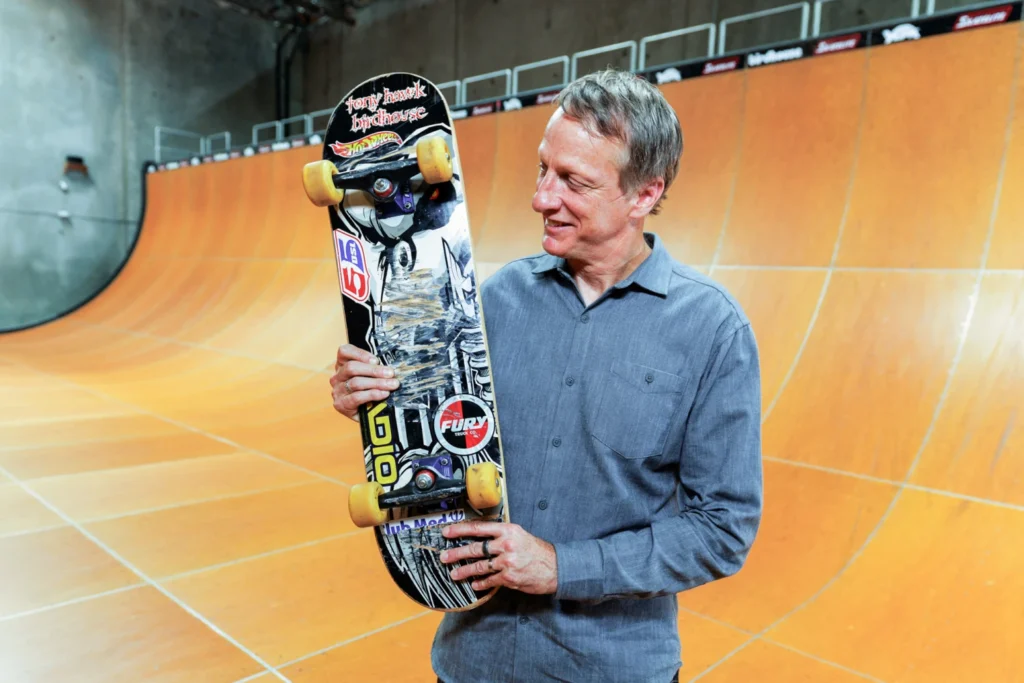
Anthony Frank Hawk, born May 12, 1968, in San Diego, California, is the most famous and commercially successful skateboarder in history and one of the most recognizable athletes of the past four decades. He received his first skateboard at nine, turned professional at 14, and by 16 was widely considered the best competitive skateboarder in the world. He won over 70 competitions and held the National Skateboard Association world championship for 12 consecutive years. The defining moment of his competitive career came at the 1999 X Games, where he became the first skateboarder to land the 900, a trick involving two and a half mid-air rotations, on his final attempt after multiple failures. He retired from professional competition in 2003.
Beyond competition, Hawk built one of the most comprehensive business empires in action sports history: a video game franchise that generated over $1.4 billion in total sales, a skateboard company he co-founded during the sport’s lowest commercial moment, a clothing line, a film production company, and a portfolio of early-stage technology investments. His name has been attached to skateboarding for so long that a generation of people genuinely thought he was named after the video game rather than the other way around.
He has been married four times and has four children. He lives in the San Diego area with his fourth wife, theater and film producer Cathy Goodman, whom he married in 2015. He remains actively involved in the skateboarding world through appearances, content creation, and the Skatepark Project, a foundation he created to help build public skateparks in low-income communities across the United States.
1. Competition Prize Money (1982-2003)
Hawk’s two-decade competitive career generated meaningful prize income across hundreds of competitions, but action sports prize money was modest by the standards of mainstream professional sports throughout this period. A competition win in the early 1980s might pay a few hundred dollars. By the X Games era in the mid-to-late 1990s, gold medal payouts reached $25,000 per event. He won 10 X Games gold medals. His total career competitive prize money, across 70-plus victories spanning amateur and professional events on multiple circuits including the NSA, ESPN X Games, and the Dew Tour, is estimated at approximately $3 million gross across his full competitive career.
As a teenager he was earning over $100,000 per year from prizes and sponsorships combined, enough to buy his family a house during his senior year of high school.
Competition prize money: ~$3M gross.
2. Endorsements and Appearance Fees (1982-2026)
Hawk has held sponsorship deals continuously since age 14. His early career sponsors included Powell Peralta, Vans, Tracker, and Sundek. After co-founding Birdhouse in 1992, he rebuilt his commercial standing during a period when skateboarding had fallen from mainstream appeal, and by the late 1990s he was the face of a cultural revival.
His post-1999 endorsement portfolio reads like a catalogue of brands trying to reach young male consumers: Vans (a multi-decade anchor partnership), Quiksilver, Nixon watches, Jeep, Hot Wheels, Liquid Death, Proto footwear, and dozens of others across a 40-year career. His appearance fees for corporate events, demonstrations, and speaking engagements command $50,000 to $200,000 per engagement depending on format.
- Early career endorsements (1982-1999, 17 years, avg ~$300K/yr rising to $2M by late 1990s): ~$15M
- Peak commercial era (1999-2015, 16 years, avg $4M/yr): ~$64M
- Continued post-peak (2015-2026, 11 years, avg $2M/yr including appearance fees): ~$22M
Career endorsements and appearances: ~$101M gross.
3. Tony Hawk’s Pro Skater Video Game Royalties (1999-2026)
This is the most consequential financial decision of Hawk’s career. When Activision and developer Neversoft approached him in 1998 about a video game bearing his name, they initially offered a one-time payment of $500,000 to buy out all future royalties. Hawk declined. Instead he negotiated an ongoing royalty arrangement that paid him a percentage of every copy sold.
The first game launched in 1999 and became a cultural phenomenon. Three sequels followed in rapid succession. When the fourth game was released in 2002, Hawk was called to lunch by his Activision contact, who handed him a check for $4 million representing his annual royalty on the series. He described the moment as life-changing. Multiple sources confirm his royalty rate subsequently ran at approximately $6 million per year at the franchise’s peak, before the market shifted when EA’s Skate series split the audience and shooter games dominated the industry.
The licensing deal ran from 1999 to 2015, covering 16 years and 18 game titles generating $1.4 billion in total franchise revenue. The 2020 remaster of Tony Hawk’s Pro Skater 1 and 2 with Activision reactivated the commercial relationship, with Tony Hawk’s Pro Skater 3 and 4 released in 2026.
- THPS royalties (1999-2015, 16 years, avg $4M/yr weighted across peak and declining years): ~$64M
- 2020 remaster and THPS 3+4 (2020-2026): ~$3M
Video game royalties: ~$67M gross.
4. Birdhouse Skateboards
Hawk co-founded Birdhouse Projects with fellow professional skateboarder Per Welinder in 1992, taking out a second mortgage on his house to fund it during a period when skateboarding’s mainstream appeal had collapsed. It was a bet on the sport’s eventual recovery, and it paid off. By the late 1990s, Wikipedia confirms, Birdhouse was generating $25 million in annual revenue. The company became one of the most recognized skateboard brands in the world, carried distribution through the Blitz partnership and later operated independently.
Hawk later acquired full ownership of Birdhouse. The company continues to operate as an active skateboard brand. At approximately $10-15 million in current annual revenue with skateboard company profit margins of 15-20%, Hawk receives annual profit distributions in the range of $2-2.5 million per year. Across the business’s productive years since the mid-1990s, cumulative profit distributions to Hawk are estimated conservatively at approximately $40 million, with reinvestment back into the business reducing the cash extraction.
Birdhouse’s current enterprise value as a wholly-owned premium skateboard brand with global distribution: approximately $20 million, based on a 1.5x revenue multiple appropriate for a lifestyle brand in a mature niche market.
Birdhouse distributions received (already in income): ~$40M gross. Current enterprise value (asset): ~$20M.
5. Hawk Clothing, Blitz Distribution, and 900 Films
Hawk Clothing: An apparel line launched in partnership with Kohl’s and later managed through Cherokee Inc., providing licensing fee income across a multi-year arrangement. Career licensing income from the clothing line: approximately $8M.
Blitz Distribution: The skateboard product distribution partnership co-founded alongside Birdhouse. Provided distribution infrastructure income across the peak years. Career income: approximately $5M.
900 Films: A production company Hawk created in 1999, originally to produce video game content and later pivoting to action sports media, documentaries, and branded content. The HBO documentary Tony Hawk: Until the Wheels Fall Off (2022) was produced through this entity. Career income and asset value: approximately $3M.
Total: ~$16M gross across these entities.
6. Technology Investments
Hawk has described himself as an early-stage investor who likes to be on the ground floor of companies where his support matters. He has confirmed investments in Nest Labs, Blue Bottle Coffee, DocuSign, and Black Plague Brewing.
Nest Labs: Acquired by Google in 2014 for $3.2 billion. Hawk was an early investor. His stake was angel-level, invested before significant institutional rounds. Conservative estimated return after capital recovery: approximately $2M.
Blue Bottle Coffee: Nestle acquired a majority stake in 2017 for approximately $425 million. Hawk was among a group of celebrity investors including Bono and Jared Leto. His stake was small. Conservative estimated return: approximately $1M.
DocuSign and other positions: DocuSign IPO in 2018. Returns undisclosed and stake size unknown. Conservative: ~$500K.
Total technology investment returns: ~$3.5M.
7. Total Gross Income
| Source | Amount |
|---|---|
| Competition prize money | $3M |
| Endorsements and appearance fees | $101M |
| Video game royalties (THPS franchise) | $67M |
| Birdhouse distributions received | $40M |
| Hawk Clothing, Blitz, 900 Films | $16M |
| Technology investment returns | $3.5M |
| Total gross | ~$230.5M |
8. Representation
Standard action sports management across a multi-decade career covering competition, endorsements, licensing, and media. Applied blended rate: 15%, reflecting the complex multi-stream nature of his income relative to a single-employer athlete.
Representation (15%): -$34.6M. Post-representation: ~$195.9M.
9. Tax
Hawk has been a California resident in the San Diego area throughout his career. California’s top income tax rate of 13.3% combined with the federal top rate of 37% produces a combined marginal rate approaching 50% for a high earner. His video game royalties and endorsement income are ordinary income subject to these rates. His Birdhouse profit distributions as a business owner flow through at pass-through rates, which in California still attract the personal rate for flow-through income.
Applied blended effective rate: 45%, reflecting California’s dominance across his career with some modest reduction from the business ownership structure and the earlier years when his income was lower and tax rates were different.
Tax (45% of $195.9M): -$88.2M. Net after representation and tax: ~$107.7M.
10. Lifestyle Burn
Hawk has been married four times and has four children from three of those marriages, each requiring financial settlements and ongoing support. He has maintained multiple properties in the San Diego area across his adult life. His car collection, which includes a 1964 Chevrolet Corvette Sting Ray and several other vehicles, reflects the taste of someone who enjoys cars rather than a trophy-collection mentality. He is not a conspicuous luxury spender by any measure of someone with his income profile.
His philanthropy through the Skatepark Project, which has donated over $5.8 million to more than 596 skatepark projects across the country, is consumed spending included here.
- Early career (1982-1999, 17 years, multiple family situations, avg $400K/yr): ~$6.8M
- Peak era (1999-2015, 16 years, $1.5M/yr): ~$24M
- Post-peak (2015-2026, 11 years, $1M/yr): ~$11M
Total lifestyle burn: ~$41.8M. Available to accumulate: ~$65.9M.
11. Real Estate
Hawk bought his first property in 1985 at 17 years old, following his father’s advice, and has maintained a portfolio of San Diego area properties throughout his career. He took out a second mortgage on a Fallbrook home in 1992 to fund Birdhouse. He has lived in the Del Mar and Encinitas areas of San Diego County. Multiple properties are referenced across various sources but no specific purchase prices or sale transaction prices are documented publicly.
Real estate appreciation: $0 documented.
12. Business Assets
Birdhouse Skateboards (wholly owned): Current enterprise value approximately $20M, as calculated above.
Other businesses: Hawk Clothing licensing arrangements, 900 Films, and other ventures are ongoing income generators already captured in the income sections. No additional discrete asset value is attributed here.
Total documented business asset value: +$20M.
13. Wealth Management
No external wealth management arrangement has been publicly documented.
Wealth Management: None reported ($0).
Net Worth Waterfall
| Line Item | Amount |
|---|---|
| Competition prize money (career, 1982-2003) | +$3M |
| Endorsements and appearance fees (career, 1982-2026) | +$101M |
| Tony Hawk’s Pro Skater royalties (1999-2026) | +$67M |
| Birdhouse Skateboards profit distributions (received) | +$40M |
| Hawk Clothing, Blitz Distribution, 900 Films | +$16M |
| Technology investment returns (Nest, Blue Bottle, DocuSign) | +$3.5M |
| Less: representation (15%, multi-stream complexity) | -$34.6M |
| Less: tax (45% blended, California resident, full career) | -$88.2M |
| Less: lifestyle burn (four marriages, four children, philanthropic spending) | -$41.8M |
| Real estate appreciation | $0 |
| Birdhouse Skateboards (current enterprise value, wholly owned) | +$20M |
| Wealth Management | $0 |
| Total Net Worth | ~$85.9M → $85M |
Our calculation: $85 Million.
Why Our Figure Is Below Consensus
Celebrity Net Worth places Hawk at $140 million. Our independent build produces $85 million, and the gap has a clear explanation.
The $140 million figure appears to attribute a much higher value to Birdhouse Skateboards and the investment portfolio than the documented numbers support. Birdhouse is a real and valuable company, but a skateboard brand generating $10-15 million in annual revenue does not carry a $60-70 million enterprise value under standard valuation methods. The Nest and Blue Bottle investments were angel-level positions with undisclosed stake sizes; attributing tens of millions of dollars to returns from stakes of unknown size is not supportable.
California’s 47-50% combined tax rate is also doing significant work here. A 40-year career generating $230 million in gross income sounds like an enormous fortune, but after 15% management fees and 45% effective tax across the California career, the post-cost base is approximately $108 million before lifestyle and before adding the current Birdhouse asset value. That narrows to $85 million on this build.
The $85 million figure is what the independently sourced numbers produce. The $140 million figure would require either a significantly higher Birdhouse valuation or undisclosed investment returns that dwarf what is known about his tech angel stakes.
The 900
Tony Hawk turned down $500,000 in 1999 because he believed in a video game that had not been released yet. The game sold $1.4 billion in copies. The skateboard company he started by remortgaging his house in 1992, during the worst commercial period in the sport’s modern history, is still operating. The foundation he created to build public skateparks has funded nearly 600 of them. He landed the 900 at 31 years old and he is still recognizable enough that people ask him if he is named after the video game that made him famous. The $85 million is the arithmetic. The career is something else entirely.