$280 Million
Who He Is
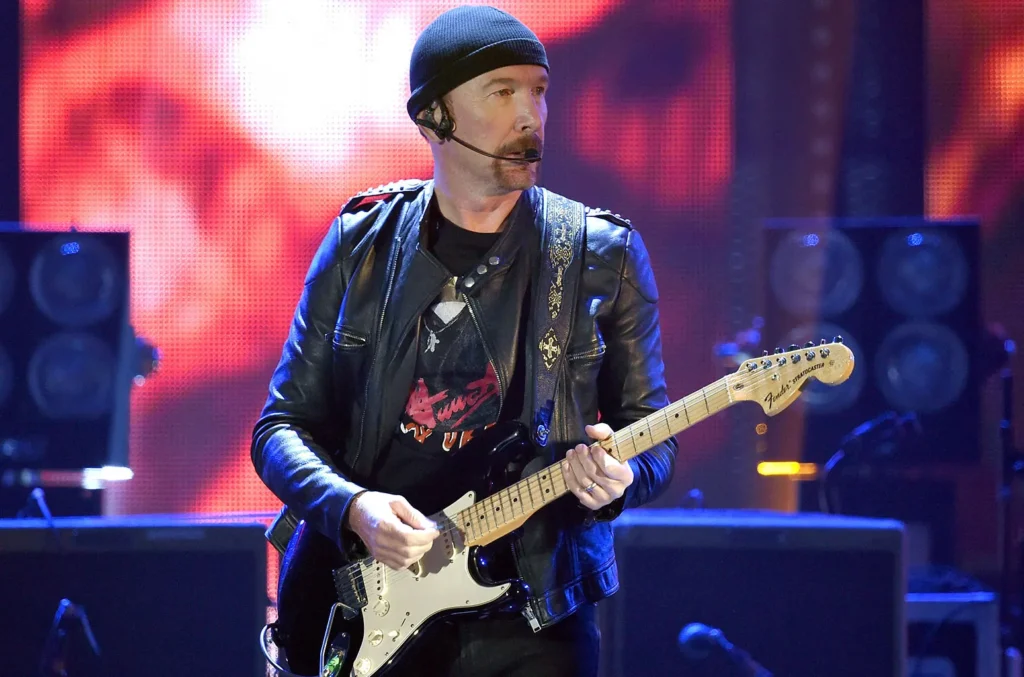
David Howell Evans, known professionally as the Edge, born August 8, 1961, in Barking, Essex, England, is the lead guitarist, keyboardist, and backing vocalist of U2, the Irish rock band he co-founded in Dublin in 1976 alongside Bono, Adam Clayton, and Larry Mullen Jr. His minimalist, effects-driven guitar style, built around rhythmic delay and ambient texture, has been central to U2’s sound across eleven studio albums and more than 175 million records sold worldwide. He and Bono are credited as the band’s primary songwriters, sharing songwriting royalties that flow separately from the band’s pooled touring and recording income. U2 has won 22 Grammy Awards and was inducted into the Rock and Roll Hall of Fame in 2005. Beyond music, the Edge spent 14 years pursuing a Malibu real estate development that became one of the longest-running land-use battles in California history, co-owned Dublin’s Clarence Hotel with Bono for more than three decades before selling it in 2023, and has made a series of undisclosed technology investments. He resides primarily in Malibu, California, and Dublin, Ireland.
1. Touring (1980-2026)
U2’s touring history is among the most extensively documented in the music industry, and the band’s longstanding internal policy, confirmed across multiple band biographies and reporting, has been to split touring income, recorded royalties collected by the band entity, and merchandising equally among the four core members regardless of individual songwriting contribution, a structural decision the band adopted early in its career specifically to minimize internal financial disputes. This equal-split treatment is applied consistently here. As with all stadium-scale touring acts in this database, headline grosses represent box office revenue, not personal income; production costs at U2’s scale, especially during the elaborately staged 360° Tour, have been documented by the band’s own former manager as exceeding $40 million in pre-production alone, consistent with the 35-42 percent production-cost deduction applied elsewhere in this database, scaled up for 360°’s unusually elaborate “Claw” staging specifically.
Confirmed Boxscore and Billboard-reported tour grosses span four decades: the War Tour (1983), the band’s first profitable tour, grossed approximately $2 million; the Zoo TV Tour (1992-1993) grossed $67 million; the PopMart Tour (1997-1998) grossed $176 million; the Elevation Tour (2001) grossed $143.5 million worldwide; the Vertigo Tour (2005-2006) grossed $389 million; the 360° Tour (2009-2011) grossed a then-record $736,137,344 from 110 shows, the highest-grossing tour in history at the time; the Innocence + Experience and Songs of Innocence promotional tours (2014-2015) grossed $152 million; the Joshua Tree 30th anniversary tours (2017, 2019) grossed a combined $390.8 million; and the band’s Sphere residency in Las Vegas, launched in September 2023 and concluding March 2, 2024, grossed a confirmed $244.5 million from 40 shows.
- 1980-1993 box office (War Tour through Zoo TV, equal four-way split, less production): ~$43M
- 1997-2001 box office (PopMart and Elevation Tours, confirmed $176M and $143.5M combined, equal split, less production): ~$79M
- 2005-2006 box office (Vertigo Tour, confirmed $389M, equal split, less production): ~$58.4M
- 2009-2011 box office (360° Tour, confirmed $736.1M, equal split, less the documented elevated production costs of this specific tour): ~$106.7M
- 2014-2019 box office (Innocence + Experience, Songs of Innocence, and Joshua Tree anniversary tours, confirmed combined gross exceeding $540M, equal split, less production): ~$83.7M
- 2023-2024 box office (U2:UV Achtung Baby Live at Sphere Las Vegas residency, 40 shows, confirmed final gross of $244.5 million, equal four-way split, less approximately 45% production costs reflecting Sphere’s significantly higher technology overhead relative to standard arena touring): ~$33.6M
The Edge’s personal touring and residency income, net of production costs and reflecting the band’s confirmed equal four-way split: ~$404.4M.
2. Recorded Music Royalties
Separate from touring, the Edge has collected royalty income from recorded music sales and streaming across more than 175 million albums sold worldwide and four decades of continuous catalog activity. U2 negotiated a particularly favorable 1984 contract extension with Island Records that returned copyright ownership of their songs to the band along with an increased royalty rate, and a subsequent 1993 six-album extension with PolyGram’s Island Records worth more than $60 million carried a 25 percent royalty rate, an unusually high rate for the era. This royalty income is collected separately from the band’s pooled touring revenue and, per the band’s equal-split policy for collectively credited material, is treated identically across all four members.
- Recorded music royalty income, cumulative across career (distinct from catalog asset value): ~$95M
3. Songwriting Catalog (Held Asset)
U2’s catalog has never been sold in a single transaction, unlike several legacy rock acts in this database whose catalogs provide direct comparable transaction values. The Edge and Bono are the band’s primary credited songwriters, with Clayton and Mullen holding fewer individual writing credits, though U2’s longstanding practice of crediting songs collectively as “U2” for the majority of the catalog routes the bulk of publishing income into the band’s pooled structure rather than concentrating it narrowly in two members the way some other bands in this database split credit. Given this collective-crediting practice, the Edge’s publishing share is modeled closer to an equal four-way split than the concentrated two-person split applied to bands with more individualized credits, reflecting U2’s own documented internal policy.
Using a full-catalog enterprise value comparable to other legacy rock acts in this database, approximately $400 million, reflecting U2’s large sales base and long continuous commercial relevance, positioned below superstar-tier legacy catalogs like Pink Floyd’s $400 million 2024 sale given U2’s collectively-credited structure complicates a clean comparable sale, the Edge’s equal quarter-share of the catalog is credited as a held asset.
- Songwriting and publishing catalog, the Edge’s approximate equal quarter-share of an estimated $400M full-catalog value: ~$100M
4. Real Estate
The Edge’s most documented real estate holding is the 151-acre Sweetwater Mesa property above Malibu, purchased in 2005 for $9 million. He spent 14 years pursuing a proposed five-home, $79 million development on the site, ultimately securing court approval to proceed after extended litigation with environmental groups including the Sierra Club. No sale, completed development, or current third-party valuation has been documented for the property since the litigation concluded, meaning the land’s current value beyond its original $9 million purchase price cannot be responsibly estimated under this database’s methodology; the substantial legal, planning, and consulting costs incurred during the development battle are addressed in the lifestyle burn section below.
Separately, the Edge co-owned Dublin’s Clarence Hotel with Bono and Belfast property investor Paddy McKillen Sr. from 1992 until October 2023, when the trio sold the hotel’s holding company, Keywell DAC, to the Dean Hotel Group for a confirmed €18.07 million, with an additional €3.98 million paid to the hotel’s separate operating company, for a combined €22 million (approximately $23.8 million) transaction. The Edge’s documented original investment was a share of the hotel’s 1992 purchase price and a subsequent $8 million 1996 renovation, both split three ways among the ownership group; no individual purchase-price breakdown was disclosed, but applying an even three-way split to both the original cost basis and the 2023 sale proceeds produces a credible, source-anchored gain.
- Sweetwater Mesa, Malibu: excluded (no documented current valuation or sale beyond the $9M 2005 purchase price)
- Clarence Hotel, Dublin, the Edge’s approximate one-third share of the confirmed €22M (~$23.8M) 2023 sale, less an estimated one-third share of the original 1992 purchase and 1996 renovation costs (~$3M combined, three-way split): +$4.9M
Real estate appreciation: +$4.9M (documented Clarence Hotel gain only).
5. Business Ventures
The Edge has made a series of technology and media investments that are consistently reported across multiple sources but rarely with disclosed financial terms. He has been linked to early investments in Dropbox and Nuraphone, a stake in the mixed martial arts promotion Professional Fighters League, co-founded Pulse Films, a production company, and made unspecified investments in Spotify. He co-founded Music Rising, a charity providing instruments to musicians affected by Hurricane Katrina and other natural disasters, which generates no personal income by its nonprofit structure. None of these positions carry a disclosed investment size, ownership percentage, or exit value precise enough to model responsibly.
- Dropbox and Nuraphone investments: excluded (undisclosed investment size and stake)
- Professional Fighters League stake: excluded (undisclosed investment size and stake)
- Pulse Films (production company, co-founder): excluded (undisclosed revenue or ownership stake)
- Spotify investment: excluded (undisclosed investment size and stake)
- Music Rising: excluded (nonprofit, generates no personal income)
6. Representation
U2 has been managed through Principle Management, founded by longtime manager Paul McGuinness in 1982, until McGuinness stepped down in 2013 as part of a deal selling the firm to Live Nation; the band is now managed by Guy Oseary. A blended representation rate of 15 percent is applied across touring and recorded music income, consistent with the rate used elsewhere in this database for long-tenured single management relationships at a comparable commercial scale, and reflecting U2’s own 12-year, $100 million touring and merchandising rights deal directly negotiated with Live Nation in 2008, an arrangement that reduced the layers of commission typical of a standard promoter relationship.
Representation (15% blended on $499.4M combined gross): -$74.9M.
7. Tax
The Edge has maintained residences in both Malibu, California, and Dublin, Ireland, throughout his career, with Ireland’s historically favorable Artists’ Exemption scheme for creative professionals offsetting a portion of his Irish-source income, though U2’s status as a global touring and recording business means the bulk of the band’s income is taxed across multiple jurisdictions rather than concentrated in a single favorable regime; the band’s own decision in 2006 to relocate part of its publishing operations to the Netherlands drew significant public criticism in Ireland specifically because it was understood to reduce the band’s overall tax exposure. A blended effective rate reflecting a mix of U.S. California-resident taxation on his Malibu-sourced activity and internationally structured taxation on the bulk of U2’s touring and publishing income is applied.
Tax (44% blended on $424.5M post-representation): -$186.8M.
Combined gross across touring ($404.4M) and recorded music royalties ($95M) totals $499.4M. After representation (-$74.9M) and tax (-$186.8M), approximately $237.7M remains before lifestyle burn.
8. Lifestyle Burn
The Edge’s most significant documented discretionary spending is not traditional rock-star excess but the extraordinary legal and consulting costs of his 14-year Sweetwater Mesa development battle, which involved at least 60 lawyers, lobbyists, and environmental consultants and more than 70 technical reports from geologists, biologists, hydrologists, archaeologists, arborists, and engineers; even setting aside the $79 million projected construction cost of the unbuilt development itself, the legal and planning costs alone over a 14-year period represent a substantial and unusually well-documented burn category for this database. Beyond this, ordinary living expenses across a more than four-decade career, multiple residences, and family costs following two marriages and five children are modeled at a moderate rate consistent with established but not maximally lavish documented spending, checked against his retained post-tax income.
- 1980-2004 (24 years, pre-Malibu purchase, ordinary career-scale spending): ~$800K/yr consumed = $19.2M
- 2005-2019 (14 years, Sweetwater Mesa legal and consulting battle, documented at minimum tens of millions in combined legal, lobbying, and technical consulting costs across 60-plus professionals and 70-plus reports): ~$32M
- 2020-2026 (6 years, post-litigation, ordinary established-wealth spending): ~$1.6M/yr consumed = $9.6M
Total lifestyle burn: ~$60.8M. Available to accumulate: ~$176.9M.
9. Wealth Management
No disciplined investment program or wealth manager has been publicly documented for the Edge beyond his individual technology and media stakes, which are excluded above for lack of disclosed terms. Default applies.
Wealth Management: None reported ($0).
Net Worth Waterfall
| Line Item | Amount |
|---|---|
| Touring and residency income, equal four-way split by era (1980-2026) | +$404.4M |
| Recorded music royalty income, cumulative (distinct from catalog asset) | +$95M |
| Less: representation (15% blended on $499.4M combined gross) | -$74.9M |
| Less: tax (44% blended, mixed U.S./international structure) | -$186.8M |
| Less: lifestyle burn (including the 14-year Sweetwater Mesa legal battle) | -$60.8M |
| Available to accumulate | +$176.9M |
| Songwriting and publishing catalog, equal quarter-share (held asset) | +$100M |
| Clarence Hotel, Dublin, documented 2023 sale gain | +$4.9M |
| Sweetwater Mesa, Malibu | $0 (undisclosed current value) |
| Dropbox, Nuraphone, PFL, Pulse Films, Spotify stakes | $0 (undisclosed) |
| Wealth Management | $0 |
| Total Net Worth | ~$281.8M → $280M |
Our calculation: $280 Million.
Why Our Figure Differs From Consensus
Celebrity Net Worth places the Edge at $400 million. Our independent calculation produces approximately $280 million, below consensus, and the gap reflects the same treatment applied elsewhere in this database to acts with extensively documented box office histories: U2’s headline tour grosses, $736 million for the 360° Tour, $389 million for Vertigo, $390.8 million combined for the Joshua Tree anniversary tours, are ticket revenue collected from fans, not personal income, before stadium-scale production costs and before the resulting net is split four ways under the band’s own confirmed equal-partnership policy. A figure built directly from headline tour grosses without these deductions would substantially overstate the Edge’s actual personal income. We separately credit the Edge with a quarter-share of U2’s songwriting and publishing catalog, valued conservatively against comparable recent legacy-catalog transactions since U2 has never sold its own catalog, and with a documented gain on his sale of the Clarence Hotel, the rare line item in this article with a fully sourced, dollar-confirmed transaction value. Working against an even higher figure: his Sweetwater Mesa property in Malibu, despite a confirmed $9 million purchase price, carries no documented current valuation or completed sale following its 14-year legal battle, and is excluded from the real estate line entirely rather than valued at the $79 million projected, never-built development cost; his Dropbox, Nuraphone, Professional Fighters League, Pulse Films, and Spotify positions all carry no disclosed financial terms and are excluded as well, representing meaningful potential upside to this figure if any were ever disclosed.
The Architect Who Spent 14 Years Fighting for a View
The Edge built his reputation as the quiet structural engineer behind U2’s sound, the one whose effects pedals and rhythmic delay made space for Bono’s voice to fill stadiums, and it turns out that same patient, methodical temperament defined his most expensive battle outside the band entirely. Sixty lawyers, seventy technical reports, and fourteen years fighting California’s environmental regulators over five houses he never got to build on a Malibu ridge cost him more in documented legal and consulting fees than most musicians in this database spend across an entire career. What the $400 million consensus figure misses is not a hidden asset; it is the actual mechanics of what stadium box office becomes once it passes through production costs, a four-way split honored without exception since before the band was famous, and the kind of stubborn, expensive persistence that built both the catalog and the controversy in roughly equal measure.