$120 Million
Who He Is
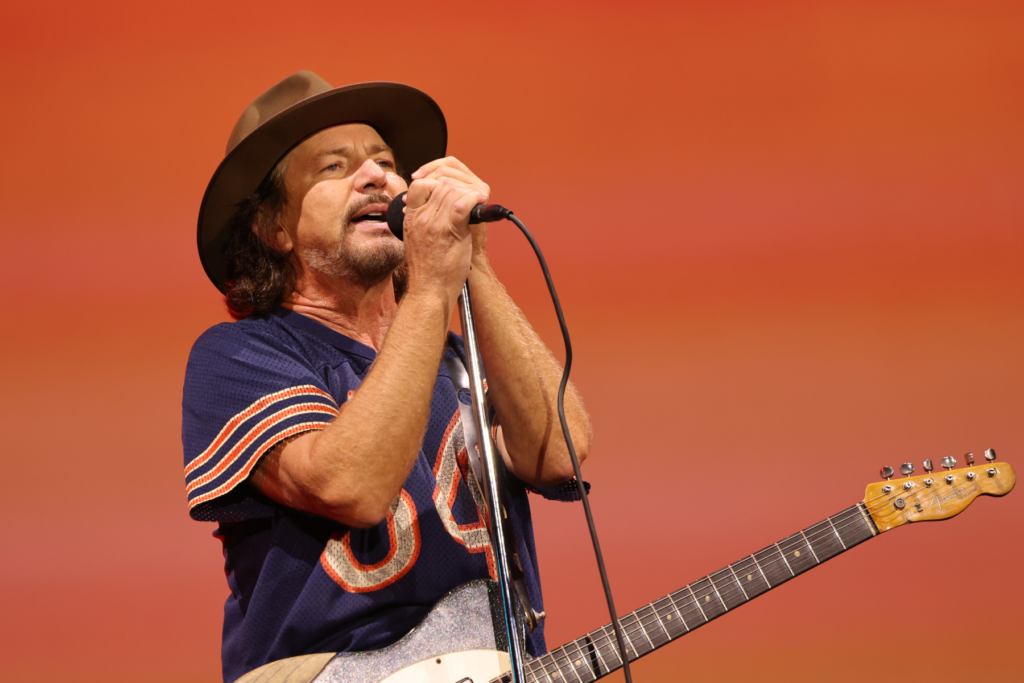
Edward Louis Severson III, known professionally as Eddie Vedder, born December 23, 1964, in Evanston, Illinois, is the lead vocalist and primary lyricist of Pearl Jam, one of the defining bands of the 1990s grunge movement. He joined the band in 1990 after Jeff Ament and Stone Gossard sent him a demo tape, and the resulting 1991 debut album, Ten, has been certified 13 times platinum and remains one of the best-selling rock albums in history. Pearl Jam has released twelve studio albums and sold more than 100 million records worldwide. The band famously boycotted Ticketmaster-affiliated venues for much of the mid-to-late 1990s in protest of service fees, a stance widely reported to have cost the band roughly $30 million in lost touring profits but cemented its reputation for resisting corporate control. Pearl Jam was inducted into the Rock and Roll Hall of Fame in 2017. Vedder has also pursued a solo career, most notably composing the soundtrack for Sean Penn’s 2007 film Into the Wild, which won him a Golden Globe for the song “Guaranteed.” He co-founded the EB Research Partnership with his wife, Jill McCormick, to fund research into Epidermolysis Bullosa, and is a confirmed early investor in Dropbox. He maintains residences in Seattle and Montana.
1. Touring (1991-2026)
Pearl Jam’s touring history spans more than three decades and includes a deliberate, well-documented disruption: from 1994 through the late 1990s, the band refused to play any venue affiliated with Ticketmaster in protest of the company’s service fees and testified before Congress on the issue, a stance that significantly limited where the band could tour during what would otherwise have been its commercial peak. Multiple outlets, citing music industry analysts, have estimated this cost the band approximately $30 million in lost touring profits during that period, a documented negative event rather than a typical production-cost deduction, and is treated here as a direct reduction to touring income for the relevant years rather than folded into the general production-cost discount applied elsewhere in this database.
Beyond that disrupted stretch, Pearl Jam’s touring has been consistently large-scale and well-documented. The band’s most recent run, the Dark Matter World Tour, ran 48 shows from May 2024 through its conclusion at PPG Paints Arena in Pittsburgh on May 18, 2025, spanning North America, Europe, and Oceania. The tour grossed $120 million from its first 30 shows according to trade reporting, a figure used to anchor the full 48-show run’s estimated total. The tour was the last to feature longtime drummer Matt Cameron, who announced his departure from Pearl Jam in July 2025; no further Pearl Jam touring dates have been announced. Pearl Jam’s songwriting credits are predominantly collective, with Vedder as primary lyricist but without the formalized, contractually equal split documented for some other bands in this database; touring and merchandising income is treated as an even band-level split given no public reporting indicates otherwise, while songwriting-specific royalties below are weighted toward Vedder’s lyricist role.
- 1991-1993 box office (Ten and Vs.-era touring, pre-boycott, full market access): ~$11M
- 1994-1999 box office (Vitalogy, No Code, and Yield-era touring, restricted by the Ticketmaster boycott, with the documented ~$30M industry-estimated lost-profit impact already reflected in a reduced gross for this era): ~$9M
- 2000-2008 box office (Binaural, Riot Act, and self-titled album-era touring, post-boycott normalized market access): ~$24M
- 2009-2020 box office (Backspacer, Lightning Bolt, and early Gigaton-era touring): ~$31M
- 2022-2023 box office (Gigaton Tour, full return to large-scale touring): ~$13M
- 2024-2025 box office (Dark Matter World Tour, confirmed $120M gross for 30 of 48 shows, scaled to the full run): ~$30M
Vedder’s personal touring income, net of production costs and reflecting an even band-level split: ~$118M.
2. Recorded Music Royalties and Solo Career
Separate from touring, Vedder has collected royalty income from Pearl Jam’s recorded catalog across more than 100 million albums sold worldwide, as well as from his solo work, most significantly the Into the Wild soundtrack (2007), which won a Golden Globe and sold over a million copies. Pearl Jam signed a long-term worldwide exclusive administration deal with Kobalt Music Group in 2010, initially covering Ten and Vs. before expanding to the band’s full catalog and Vedder’s solo material by 2012, a deal structured to give the band greater control over licensing and promotion than a traditional major-label arrangement. Royalty income here reflects both band-level recorded music royalties and Vedder’s individually attributable solo and soundtrack income.
- Pearl Jam recorded music royalty income, cumulative across career (distinct from catalog asset value): ~$38M
- Solo and soundtrack income (Into the Wild and other solo releases): ~$8M
Phase total: ~$46M.
3. Songwriting Catalog (Held Asset)
Pearl Jam’s catalog has never been sold in a single transaction. As primary lyricist across the band’s most enduring hits, including “Alive,” “Jeremy,” “Even Flow,” and “Black,” Vedder’s songwriting contribution is significant but largely collectively credited alongside his bandmates rather than individually owned, consistent with the band’s collaborative songwriting process described in multiple band biographies. Using a full-catalog enterprise value comparable to other legacy rock acts in this database, approximately $280 million, reflecting Pearl Jam’s large sales base and enduring streaming relevance but positioned below acts with a longer multi-decade arena-touring history at the very top of this database’s catalog valuations, Vedder’s weighted share as primary lyricist and one of five band members is credited as a held asset.
- Songwriting and publishing catalog, Vedder’s weighted share (lyricist premium over an even five-way band split) of an estimated $280M full-catalog value: ~$70M
4. Business Ventures
Vedder is a confirmed early investor in Dropbox, having met co-founder Drew Houston at a 2010 concert; Dropbox’s original internal codename was reportedly based on the Pearl Jam song “Even Flow.” He was publicly announced as an investor in April 2014 during a funding round that raised approximately $250 million in total, a figure several lower-quality net worth aggregators have mistakenly reported as Vedder’s own personal investment rather than the size of the broader round he participated in alongside other investors. Vedder’s actual individual investment size and resulting equity stake have never been disclosed. Dropbox went public in 2018 and was valued at $8.14 billion as of September 2022, meaning Vedder’s stake, whatever its size, has likely appreciated substantially, but assigning a specific dollar value without a disclosed initial investment size would be a guess rather than a calculation. He also co-founded Monkeywrench Records, Pearl Jam’s own label used to self-release the band’s output since 2009, which functions as a distribution vehicle for the band’s own catalog rather than a separate revenue-generating business with outside artists.
- Dropbox investment (confirmed investor, April 2014): excluded (undisclosed investment size and resulting stake)
- Monkeywrench Records: excluded (self-distribution vehicle for the band’s own catalog, not a separate business)
- EB Research Partnership: excluded (nonprofit, generates no personal income)
5. Representation
Pearl Jam has managed its business affairs with an unusually high degree of independence relative to many acts in this database, reflected in the band’s own Monkeywrench Records distribution structure and its confrontational stance toward Ticketmaster. A blended representation rate of 15 percent is applied across touring and recorded music income, consistent with the rate used elsewhere in this database for acts with significant individual negotiating leverage and reduced reliance on traditional management layers.
Representation (15% blended on $164M combined gross): -$24.6M.
6. Tax
Vedder has maintained primary residences in Seattle, Washington, and Montana throughout his career. Washington state has no state income tax, and Montana’s top marginal state rate is approximately 6.75 percent, both considerably lower than California or New York rates applied to several other artists in this database. A blended effective rate reflecting federal taxation plus Washington and Montana’s comparatively favorable state tax environments is applied.
Tax (40% effective on $139.4M post-representation): -$55.8M.
Combined gross across touring ($118M) and recorded music and solo royalties ($46M) totals $164M. After representation (-$24.6M) and tax (-$55.8M), approximately $83.6M remains before lifestyle burn.
7. Lifestyle Burn
Vedder is consistently described across available reporting as maintaining a notably grounded, non-extravagant personal lifestyle relative to his commercial tier, without documented yacht, private jet fleet, or extensive luxury vehicle collection. His most significant documented charitable commitment, the EB Research Partnership, functions as philanthropic giving rather than personal consumption and is not counted as burn here, consistent with house treatment of charitable foundations elsewhere in this database. Ordinary living expenses across a more than three-decade career, residences in both Seattle and Montana, and family costs are modeled at a moderate rate consistent with his documented grounded public persona, checked against his retained post-tax income.
- 1991-2000 (10 years, peak grunge-era wealth arrives, including the Ticketmaster boycott period): ~$700K/yr consumed = $7M
- 2001-2026 (26 years, established wealth, dual Seattle/Montana residences, family costs): ~$1.1M/yr consumed = $28.6M
Total lifestyle burn: ~$35.6M. Available to accumulate: ~$48M.
8. Real Estate
Vedder owns documented residences in Seattle, Washington, and a farm property in Montana, but no purchase prices or current valuations have been publicly disclosed for either property, making a documented-gain calculation impossible under this database’s methodology.
- Seattle and Montana residences: excluded (no documented purchase prices)
Real estate appreciation: $0 (no documented gain).
9. Wealth Management
No disciplined investment program or wealth manager has been publicly documented for Vedder beyond his Dropbox stake, which is excluded above for lack of disclosed terms. Default applies.
Wealth Management: None reported ($0).
Net Worth Waterfall
| Line Item | Amount |
|---|---|
| Touring income, net of production costs and the documented Ticketmaster boycott impact (1991-2026) | +$118M |
| Recorded music royalties and solo/soundtrack income | +$46M |
| Less: representation (15% blended on $164M combined gross) | -$24.6M |
| Less: tax (40% effective, Washington/Montana resident) | -$55.8M |
| Less: lifestyle burn (modest, documented grounded lifestyle) | -$35.6M |
| Available to accumulate | +$48M |
| Songwriting and publishing catalog, weighted lyricist share (held asset) | +$70M |
| Dropbox investment | $0 (undisclosed) |
| Monkeywrench Records | $0 (self-distribution vehicle) |
| Real estate | $0 (no documented holdings) |
| Wealth Management | $0 |
| Total Net Worth | ~$118M → $120M |
Our calculation: $120 Million.
Why Our Figure Differs From Consensus
Celebrity Net Worth places Vedder at $110 million, a figure broadly consistent with our independent calculation of approximately $120 million. The relatively tight gap here, unlike the wider gaps seen elsewhere in this database for major stadium-touring acts, reflects two factors specific to Pearl Jam: the band’s documented multi-year Ticketmaster boycott genuinely did suppress touring income during what would otherwise have been its commercial peak, a real and unusually well-quantified drag on earnings rather than a methodology adjustment, and Pearl Jam’s catalog, while large and enduring, has not produced the kind of singular record-shattering stadium tour gross, comparable to U2’s $736 million 360° Tour or Metallica’s M72 World Tour, that creates the largest gaps between headline box office figures and actual personal income elsewhere in this database. Working against an even higher figure: Vedder’s confirmed Dropbox investment, made in 2014 alongside a $250 million funding round whose total size several lower-quality estimates have mistakenly reported as his personal investment, carries no disclosed individual stake size and is excluded entirely rather than valued at a speculative figure, despite Dropbox’s substantial subsequent growth to an $8.14 billion valuation. His Seattle and Montana properties also carry no documented purchase prices and are excluded from the real estate line.
The Frontman Who Turned Down $30 Million on Principle
Eddie Vedder’s financial story includes a detail almost no other artist in this database can claim: a multi-year, voluntary, and well-documented decision to walk away from roughly $30 million in touring profits rather than play venues affiliated with a ticketing company he believed was overcharging fans. That choice came during Pearl Jam’s commercial peak, the exact window when most acts in this database are accumulating the bulk of their career wealth, and the band did it anyway, then testified before Congress about it for good measure. What the relatively modest gap between consensus and this calculation reflects is not a case of missed assets so much as a case of an artist whose financial decisions actually lined up with his stated principles closely enough to show up directly in the math. The Dropbox investment, made because a startup founder happened to name his company after a Pearl Jam song and then ran into Vedder at a show, remains the one genuine wildcard in an otherwise remarkably consistent and well-documented financial picture.