$75 Million
Who He Is
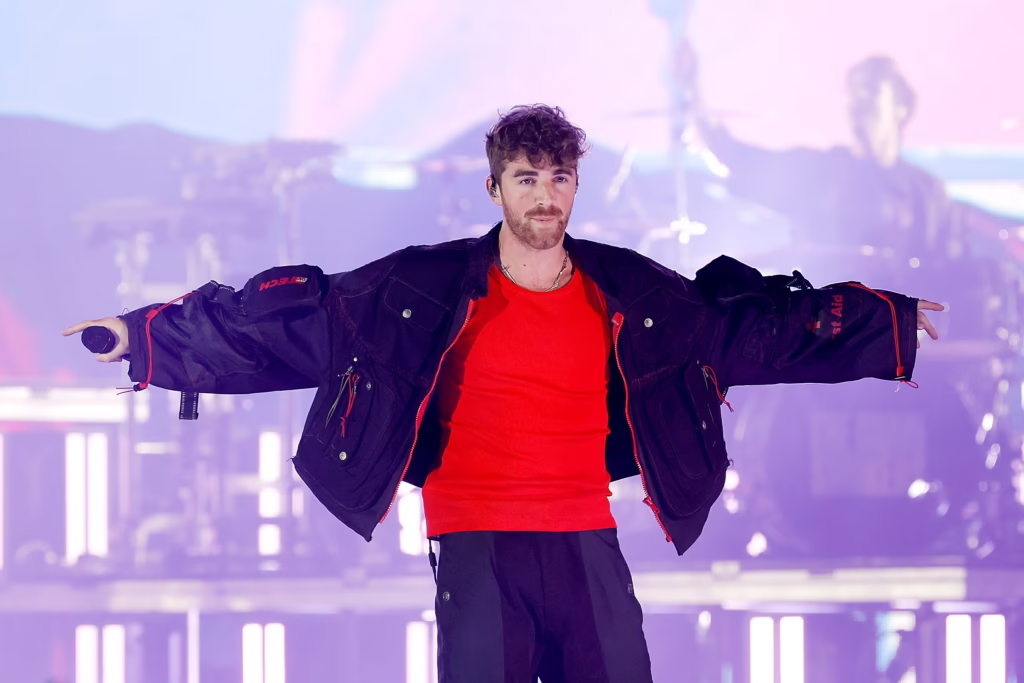
Andrew “Drew” Taggart, born December 31, 1989, in Portland, Maine, is a musician, DJ, and producer best known as one half of the electronic music duo The Chainsmokers, alongside Alex Pall. After studying music business at Syracuse University and interning at Interscope Records, Taggart joined Pall in 2012 through their mutual manager, Adam Alpert, taking on the roles of the group’s primary songwriter, producer, and, on many of their biggest hits, lead vocalist. The duo’s 2014 single “#Selfie” went viral and launched their career, followed by the multi-platinum “Roses,” the Grammy-winning “Don’t Let Me Down,” and the RIAA Diamond-certified “Closer,” one of the best-selling digital singles in history. Their 2017 debut album “Memories…Do Not Open” and the Coldplay collaboration “Something Just Like This” cemented them as one of the highest-grossing electronic acts of the late 2010s. In 2019, alongside Pall and venture capital professionals Milan Koch and Jeffrey Evans, Taggart co-founded Mantis, a Los Angeles-based venture capital firm that has grown into a genuine institutional player, closing its third fund at $100 million in commitments in 2025 and bringing total assets under management to $225 million.
1. Touring and Combined Career Earnings
The Chainsmokers’ touring and overall professional income has been tracked in detail across their peak years: the duo grossed a combined $38 million between June 2016 and June 2017, $45 million the following year, $46 million between June 2018 and June 2019, and $70 million between June 2019 and June 2020, for a four-year total of roughly $199 million. Building out the full career with conservative estimates for the earlier breakout years and the post-2020 period, when the duo pulled back from constant touring to focus on Mantis and more selective releases:
- Early breakout (2014-2016, pre-peak fame): ~$20M combined
- Peak years (2016-2020, confirmed): ~$199M combined
- Post-hiatus era (2020-2026, reduced touring pace, 2022 comeback album “So Far So Good,” continued festival dates): ~$60M combined
Combined career earnings across touring, DJ fees, and general professional income: ~$279M. No public filing documents an unequal revenue split between Taggart and Pall, so a straight 50/50 split is used here for this broad income category, consistent with the treatment applied to other duos in this database absent evidence otherwise.
Taggart’s personal share (one-half of $279M): ~$139.5M.
2. Songwriting and Recording Catalog (Held Asset)
Unlike Pall, Taggart is consistently credited across profiles and industry coverage as the group’s primary songwriter and, increasingly over their career, their lead vocalist on tracks including “Closer,” “Don’t Let Me Down,” and “Roses.” This distinction supports a personal catalog value beyond a strict equal split, separate from the general touring and business income already counted above. The catalog spans roughly a decade of commercially dominant EDM-pop crossover material with enormous streaming volume, placing it in the newer, high-volume tier still building long-term durability.
Songwriting and recording catalog, held asset (9x multiple on ~$2.5M/yr estimated personal share): ~$22.5M.
3. Mantis (Venture Capital Firm)
Taggart co-founded Mantis in 2019 with Pall, Milan Koch, and Jeffrey Evans, deliberately positioning the firm as a serious institutional venture capital operation rather than a typical celebrity consumer fund. The firm has invested in more than 170 companies, including a pre-IPO stake in Coinbase, and focuses on B2B sectors like cybersecurity and fintech infrastructure rather than consumer brands. Mantis closed its third fund at $100 million in July 2025, bringing total assets under management to $225 million, according to Bloomberg and TechCrunch. As a general partner alongside three others, Taggart’s specific ownership percentage or personal share of management fees and carried interest has not been publicly disclosed. Applying standard venture industry economics (a roughly 2 percent annual management fee on assets under management, split among four general partners with a discount reflecting that two partners handle daily operations) produces a conservative estimate of Taggart’s personal annual economics from the firm, valued at a modest multiple given the early-stage, still-largely-unrealized nature of venture fund carry.
Mantis, held asset (6x multiple on ~$1M/yr estimated personal GP economics): ~$6M.
4. Other Business Ventures
Taggart and Pall are described as the largest non-founding investors in JaJa Tequila, an alcohol brand, and jointly operate Kick the Habit Productions, a film, television, and podcast production company with projects in development. Neither venture has a publicly disclosed equity percentage, revenue figure, or valuation, so consistent with the rule that business assets require an arm’s-length valuation to be counted, both are excluded from the waterfall here.
- JaJa Tequila: excluded (no disclosed equity stake or valuation)
- Kick the Habit Productions: excluded (no disclosed revenue or valuation)
5. Representation
A standard music-industry representation rate is applied to Taggart’s combined touring and career income.
Representation (25% on $139.5M combined gross): -$34.875M.
6. Tax
Taggart is based in Los Angeles, California, where the effective tax rate for established entertainment talent using standard loan-out company structures runs approximately 42 percent, below the roughly 50 percent marginal rate that would apply without such planning.
Tax (42% on $104.625M post-representation): -$43.94M.
Combined gross across touring and career income totals $139.5M. After representation (-$34.875M) and tax (-$43.94M), approximately $60.685M remains before lifestyle burn.
7. Lifestyle Burn
Taggart’s consumed spending has scaled with his fame, including the 2018 purchase of an 11,000-square-foot Laurel Canyon estate that he later listed for sale.
- Early career (2012-2016, 4 years, rising fame): ~$200K/yr = $0.8M
- Peak Chainsmokers era (2017-2020, 4 years, major stardom, Laurel Canyon home purchase): ~$1.5M/yr = $6M
- Post-peak, venture-focused era (2021-2026, 6 years): ~$1M/yr = $6M
Total lifestyle burn: ~$12.8M. Available to accumulate: ~$47.885M.
8. Real Estate
Taggart purchased an 11,000-square-foot home in Los Angeles’s Laurel Canyon neighborhood for $12 million in December 2018. He listed the property for sale in February 2021 at an asking price of $14.45 million, but no source confirms the home actually sold, at that price or any other, and its current ownership status remains unclear. He also owns two properties in Sherman Oaks, California, each described only as “acquired for over $2 million” without a specific purchase price. Consistent with the rule that real estate appreciation requires both a confirmed purchase price and a confirmed current value, no gain is claimed for any property, since even the Laurel Canyon home lacks a confirmed sale.
Real estate appreciation: $0 (no confirmed sale price or current value for any property).
9. Wealth Management
No disciplined investment program or wealth manager has been publicly documented for Taggart specifically, separate from his active role at Mantis. Default applies.
Wealth Management: None reported ($0).
Net Worth Waterfall
| Line Item | Amount |
|---|---|
| Touring and combined career earnings, personal share (one-half) | +$139.5M |
| Less: representation (25%) | -$34.875M |
| Less: tax (42%, California) | -$43.94M |
| Less: lifestyle burn (era-scaled, consumed only) | -$12.8M |
| Available to accumulate | +$47.885M |
| Songwriting and recording catalog, held asset (9x multiple) | +$22.5M |
| Mantis, held asset (6x multiple on estimated GP economics) | +$6M |
| JaJa Tequila | $0 (no disclosed valuation) |
| Kick the Habit Productions | $0 (no disclosed valuation) |
| Real estate appreciation | $0 (no confirmed sale or current value) |
| Wealth Management | $0 |
| Total Net Worth | ~$76.385M → $75M |
Our calculation: $75 Million.
Why Our Figure Differs From Consensus
Celebrity Net Worth places Taggart individually at $90 million, already tracking him separately from Pall and citing much of the same underlying data used here, including the confirmed 2016-2020 touring figures and Mantis’s growth to $225 million in assets under management. Our independent calculation produces approximately $75 million, modestly below consensus. The gap traces mainly to two conservative choices rather than missing data. First, Mantis’s economics are genuinely difficult to pin down without a disclosed personal ownership percentage; a $225 million venture fund generates real management fee income, but with four general partners and a portfolio still dominated by unrealized paper gains rather than cash exits, a conservative multiple is applied rather than assuming Taggart’s stake carries the kind of value a mature, cash-flowing business would. Second, his Laurel Canyon home, despite being listed for sale at $14.45 million against a documented $12 million purchase price, was never confirmed to have actually sold, so no appreciation is claimed on a property whose current ownership status remains genuinely unclear. Working in the other direction: his standing as the group’s primary songwriter and increasingly its lead vocalist supports a real, separately valued catalog stake beyond a straight 50/50 touring split with Pall.
The Songwriter Who Became a General Partner
Andrew Taggart wrote hundreds of emails by hand in The Chainsmokers’ early days, personally hustling the group’s way onto the Billboard charts before anyone was paying them to show up. That same instinct for doing the unglamorous work himself shows up again a decade later in the story Alex Pall tells about Mantis: that he and Taggart aren’t just names on the door lending their fame to a fund, but full-time investors who do real diligence on real B2B startups most celebrities wouldn’t bother learning to evaluate. It’s a harder story to put a clean number on than a platinum single or a sold-out arena, precisely because Taggart chose an asset class that rewards patience over splashy headline valuations. The honest math here reflects that patience: real, growing, and genuinely institutional, but not yet the kind of proven cash machine that would justify pricing it like one.