$75 Million
WHO HE IS
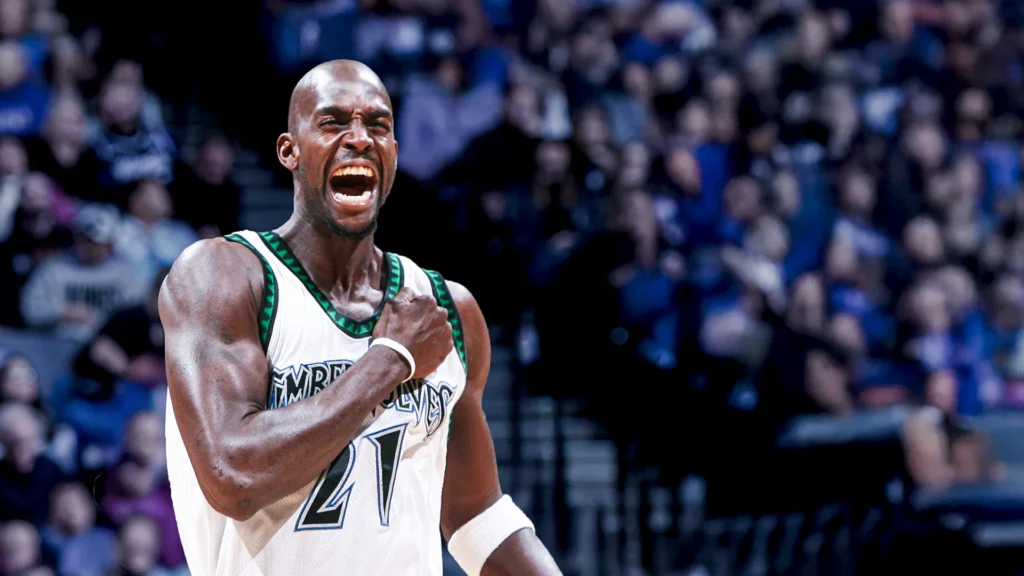
Kevin Maurice Garnett, born May 19, 1976, in Greenville, South Carolina, is one of the most intense and versatile players in NBA history: a 15-time All-Star, the 2004 MVP, and the 2008 Defensive Player of the Year who led the Boston Celtics to a championship that same season. Drafted 5th overall by the Minnesota Timberwolves in 1995 as the first player in two decades to jump straight from high school to the NBA, Garnett played 21 seasons across Minnesota, Boston, and Brooklyn before retiring in 2016 as, at the time, the highest-paid player in NBA history by career earnings.
Garnett’s financial story is unusual among the athletes profiled in this series for a specific reason: unlike a business-building success story, the defining event of his post-career finances is a documented fraud. In 2018, Garnett sued his own accountant, alleging that his longtime financial advisor, Charles Banks IV (already in federal prison for defrauding fellow NBA star Tim Duncan), had systematically stolen $77 million from him over years through a shared investment vehicle called Hammer Holdings LLC, with the accountant allegedly aware and complicit. That case, and what it reveals about how much of his career earnings actually remain, is central to any honest accounting of his current wealth.
1. NBA Career Salary (1995-2016)
Garnett’s 21-season NBA salary is well documented and consistent across sources at $334,304,240, making him the highest-paid player in NBA history at the time of his 2016 retirement, more than $11 million ahead of the next-highest earner, Kobe Bryant. His salary ranged from a rookie deal to a $126 million, six-year extension offered in 1997, up to a peak of roughly $28 million in a single season late in his career.
NBA salary: $334.3M gross.
2. Off-Court Income (1995-2026)
Garnett’s endorsement portfolio never reached the scale of his most commercially dominant peers, but included Nike, Adidas, and later Anta (through his role as a brand ambassador in the Chinese basketball league starting in 2012), reportedly generating around $10M annually at his peak. Since retiring in 2016, his income has come from media appearances (including a memorable supporting role in “Uncut Gems”), consulting work for the Milwaukee Bucks and LA Clippers, a podcast, a published autobiography (“KG: A to Z”), and an ambassador role with the Minnesota Timberwolves.
- 1995-2004 (rookie years through MVP-caliber rise): ~$3M/yr = $27M
- 2004-2016 (established star, Adidas/Anta era): ~$8M/yr = $96M
- 2016-2026 (post-retirement media, consulting, ambassador roles): ~$3M/yr = $30M
Off-court income (1995-2026): ~$153M gross.
3. Representation
We apply the standard capped 4% NBA agent rate to salary and a higher rate reflecting endorsement and media representation to off-court income.
- NBA salary (4% of $334.3M): -$13.4M
- Off-court income (10% of $153M): -$15.3M
Total representation: -$28.7M. Post-representation gross: ~$458.6M.
4. Tax
Garnett’s career spanned Minnesota, Massachusetts, and Brooklyn, all moderate-to-high state tax jurisdictions, with no significant no-tax-state exposure across his 21 seasons.
Tax (45% effective): -$206.4M. Net after representation and tax: ~$252.2M.
5. Lifestyle Burn
Garnett’s real estate history alone points to substantial, sometimes poorly-timed spending: a Los Angeles mansion bought for $6.4M in 2003 that absorbed years of renovation costs (including a reported budget request for $695,000 in windows and doors alone) before selling still unfinished for $16M in 2021, and a Concord, Massachusetts property sold in 2014 at a $3.6M loss after a seven-year hold. He has also spoken candidly about early financial immaturity, including keeping cash under his mattress as a rookie rather than depositing it, before a girlfriend at the time took a significant portion of it.
- 1995-2004 (rookie years, well-documented early financial naivety): ~$2M/yr = $18M
- 2004-2016 (established star, real estate acquisitions and renovations): ~$5M/yr = $60M
- 2016-2026 (retirement): ~$4M/yr = $40M
Total lifestyle burn: ~$118M. Available to accumulate: ~$134.2M.
6. The Charles Banks Fraud: A Documented $77M Loss
This is the single most important line in Garnett’s financial story, and it is not optional to include. Garnett’s primary investment vehicle for years was Hammer Holdings LLC, a 50/50 partnership with his longtime financial advisor, Charles Banks IV. Garnett contributed $57M to the entity; court filings indicate Banks contributed a small fraction of that despite claiming he would match Garnett’s contributions dollar for dollar, and at one point owed Hammer Holdings more than $21.9M in undocumented “loans” to himself. According to Garnett’s 2018 lawsuit, Banks routinely diverted Hammer’s funds toward his own mortgages, credit cards, private jets, and family vacations, and Garnett’s accountant, Michael Wertheim, allegedly knew about the fraud and did nothing, going so far as to help place Garnett on a restrictive personal spending budget while Banks was actively siphoning millions from the very accounts that budget was supposedly protecting.
Garnett only discovered the scale of the fraud in 2017, after Banks was sentenced to federal prison for separately defrauding fellow NBA star Tim Duncan. Garnett’s lawsuit against Wertheim and his firm, Welenken CPAs, was settled in 2019 on undisclosed terms, with both sides agreeing to drop all claims. No public reporting indicates Garnett recovered a meaningful portion of the alleged $77M, and Garnett’s own lawsuit describes many of the entities Banks funneled the money into as “currently illiquid and valueless.” We treat this as a real, largely unrecovered loss rather than omitting it or assuming a quiet, undisclosed full recovery that no source supports.
Charles Banks fraud loss: -$77M (no confirmed meaningful recovery).
Available to accumulate, net of fraud loss: ~$57.2M.
7. Business and Investment Portfolio
Garnett’s remaining business interests are modest relative to the scale of his career earnings, a direct consequence of the capital drained by the Banks fraud during what should have been his prime wealth-building years. Confirmed positions include a minority shareholder stake in Italian football club A.S. Roma, a board role with Wingstop, co-founding Gaming Society (a sports betting media company launched with Players’ Tribune co-founder Jaymee Messler), and Str33t Basketball, a professional 3×3 streetball league he has backed. None of these carry disclosed valuations or stake sizes, so we apply a conservative aggregate estimate.
Business and investment portfolio (conservative aggregate): ~$16M.
8. Real Estate
Given the documented pattern above, a $16M sale on a Los Angeles property that absorbed years of renovation spending, and a Massachusetts property sold at an outright loss, we do not credit meaningful positive real estate appreciation here. We apply a small, conservative estimate reflecting the possibility of some undisclosed gains elsewhere in his broader property holdings (Minnesota, Atlanta) that aren’t as thoroughly documented as the properties above.
Real estate: ~$2M.
9. Wealth Management
The Charles Banks fraud, addressed in full above, is itself the most consequential “wealth management” event in Garnett’s financial life, and it was a catastrophic negative rather than a positive one. Beyond that, no separate wealth management mandate with disclosed positive returns was found in available sourcing.
Wealth Management: Already addressed above (the Banks fraud); no additional positive value ($0).
A Note on Ongoing Legal Exposure
In October 2025, journalist Pablo Torre reported that Garnett was among several former athletes who attended a 2019 private poker game later connected to the Department of Justice’s “Operation Royal Flush” investigation into Mafia-linked rigged poker games, which led to the arrest of Portland Trail Blazers head coach Chauncey Billups and others. According to sourcing close to Garnett, he believed he was attending an afterparty, left the game early once he realized what it was, and has not been contacted by federal authorities. As of this writing, Garnett has not been charged, named in any indictment, or publicly linked to any financial loss or wrongdoing connected to the investigation; available reporting suggests he was, at most, a peripheral, uncharged guest rather than a participant in the scheme. We do not deduct any amount related to this matter, since nothing financially quantifiable has been confirmed, but flag it as a current, developing story worth monitoring.
Net Worth Waterfall
| Line Item | Amount |
|---|---|
| NBA salary (1995-2016) | +$334.3M |
| Off-court income (1995-2026) | +$153M |
| Less: representation (4% NBA / 10% off-court) | -$28.7M |
| Less: tax (45% effective) | -$206.4M |
| Less: lifestyle burn (era-scaled) | -$118M |
| Less: Charles Banks fraud loss (no confirmed meaningful recovery) | -$77M |
| Business and investment portfolio (conservative aggregate) | +$16M |
| Real estate | +$2M |
| Wealth Management | $0 |
| Total Net Worth | ~$75.2M -> $75 Million |
Why Our Figure Differs From Consensus
Celebrity Net Worth and most other trackers place Garnett at $120M, meaningfully above our figure, and the gap traces almost entirely to one thing: the Charles Banks fraud appears to be either unknown to or simply not incorporated into most consensus net worth calculations, despite being extensively documented in federal court filings, major outlets including the Boston Globe and Forbes, and Garnett’s own sworn lawsuit. A generic “career earnings minus taxes minus typical spending” model, the kind that likely underlies most of the $120M estimates in circulation, has no mechanism for capturing a specific, one-time theft of this scale, particularly one that was legally contested and settled on undisclosed terms rather than publicly confirmed as either fully recovered or fully lost. We treat the absence of any public confirmation of recovery as the more defensible assumption than assuming a quiet, unreported restitution that no source supports. If Garnett did privately recover a substantial portion of the $77M through the 2019 settlement, our figure would be too conservative; but crediting an unconfirmed recovery would mean inventing a number no source provides, which we won’t do.
The Cost of Trusting the Wrong Person
Kevin Garnett spent 21 seasons being one of the most intense competitors the NBA has ever seen, the kind of player who treated every defensive possession like a personal insult if he didn’t win it. Off the court, by his own lawsuit’s account, he handed control of a $57 million investment account to a man who used it to pay his own mortgage and charter private jets for his family vacations, then let that same man’s accountant put him on an allowance using his own stolen money as the excuse. The fraud wasn’t a bad stock pick or a startup that didn’t pan out. It was, according to Garnett’s own sworn complaint, a decade of someone he trusted treating his career earnings as a personal slush fund. Nobody boxes out a fiduciary. That’s the one matchup Garnett’s ferocity couldn’t solve for him, and it’s the real reason his net worth looks nothing like the number his salary alone would suggest.