$110 Million
Who He Is
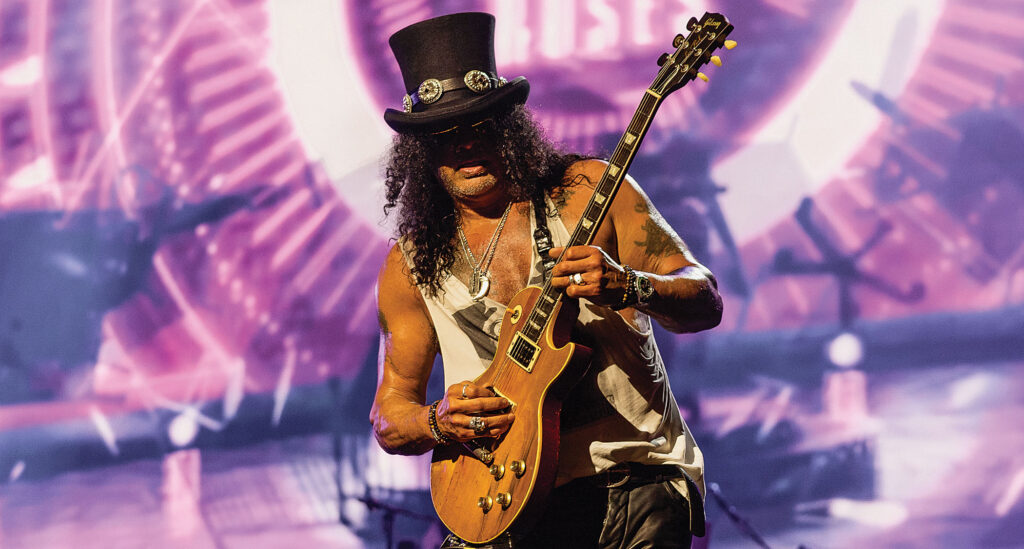
Saul Hudson, known professionally as Slash, born July 23, 1965, in Hampstead, London, is a British-American guitarist best known as the co-founding lead guitarist of Guns N’ Roses, alongside ventures including Slash’s Snakepit, Velvet Revolver, and a solo career. He joined Guns N’ Roses in 1985 and played on the band’s defining run, including Appetite for Destruction (1987), which sold over 28 million copies worldwide and remains the best-selling debut album in U.S. chart history, and the 1991 double release Use Your Illusion I and II. He departed the band in 1996 amid disagreements with Axl Rose, going on to form Slash’s Snakepit and later Velvet Revolver with fellow former Guns N’ Roses members Duff McKagan and Matt Sorum, alongside Stone Temple Pilots vocalist Scott Weiland. Velvet Revolver’s 2004 debut, Contraband, sold 4 million copies worldwide and won a Grammy Award. Slash reconciled with Rose and reunited with Guns N’ Roses in 2016 for the Not in This Lifetime Tour, which grossed $584.2 million across 175 shows. A 2018 divorce court filing confirmed Slash reported more than $45 million in personal income in 2017 alone, with the bulk tied to that tour. He was inducted into the Rock and Roll Hall of Fame with Guns N’ Roses in 2012. He lives in the Los Angeles area.
1. Touring (1985-2026)
Guns N’ Roses’ box office grosses are extensively documented, but these are ticket revenue figures, not personal income; stadium-scale production, staging, and crew costs typically consume approximately 38 percent of gross before any split reaches band members. During the classic lineup’s commercial peak, a 1992 partnership agreement covering the Use Your Illusion era split touring and merchandise revenue among the band’s then-active equity partners at documented rates of 36.3 percent to Axl Rose, 33.3 percent to Slash, and 30.3 percent to Duff McKagan.
After leaving Guns N’ Roses in 1996, Slash’s touring income came through Slash’s Snakepit and later Velvet Revolver, where he held a co-founder’s share rather than a hired-musician’s fee; Velvet Revolver’s Contraband-era touring ran 19 months across multiple continents following the album’s 4-million-copy worldwide sales and a Grammy win, confirming real commercial scale even without a precisely disclosed box office total. When Slash rejoined Guns N’ Roses for the Not in This Lifetime Tour in 2016, his personal income from that tour is directly confirmed: a 2018 court filing from his divorce proceedings showed Slash reported more than $45 million in total personal income for 2017, with Celebrity Net Worth reporting approximately $40 million of that specifically tied to the tour. This is among the most reliably sourced single-year income figures available for any artist, a sworn financial disclosure rather than a media estimate, and it anchors the touring estimate for that era directly rather than working backward from the tour’s total box office.
- 1985-1991 box office (~$150M cumulative, documented 33.3% partnership share, classic lineup): ~$31M
- 1992-1996 box office (~$60M, same partnership structure, final GNR years before departure): ~$12.4M
- 1996-2015 box office (~$160M cumulative across Slash’s Snakepit, Velvet Revolver, and solo touring, co-founder’s share): ~$39.7M
- 2016-2019 (Not in This Lifetime Tour): $40M (court-confirmed 2017 income) plus an estimated $75M across the tour’s remaining three years at a more moderate annual rate: ~$115M
- 2022-2026 box office (~$80M, continued touring with reunited Guns N’ Roses): ~$12.4M
Slash’s personal touring and performance income across eras: ~$210.4M.
2. Recorded Music Royalties
Separate from touring, Slash has collected royalty income from album sales and streaming across more than 30 million copies of Appetite for Destruction, 35 million combined for the Use Your Illusion albums, and additional sales from Velvet Revolver’s catalog and his own solo releases. This is royalty income collected as it flows, distinct from the present-day value of his songwriting and publishing share as a held asset, which is treated separately later in this article.
- Recorded music royalty income, cumulative across career: ~$35M
3. Songwriting Catalog (Held Asset)
Unlike the uncertainty surrounding Axl Rose’s exact publishing share, Slash’s position is directly documented. Performing Rights Organization filings and a publicly reported 2019 interview with the band’s former longtime manager confirm that publishing royalties for Appetite for Destruction and G N’ R Lies were split 25 percent to Axl Rose, 20 percent each to Slash, Izzy Stradlin, and Duff McKagan, and 15 percent to Steven Adler. Industry research into PRO filings indicates the Use Your Illusion albums used a more complex song-by-song calculation but arrived at broadly similar near-equal shares despite differing per-song writing credits, meaning Slash’s musical contributions, even on tracks like “November Rain” and “Estranged” where he received no formal writing credit, still generate him royalty income under the band’s publishing structure.
Guns N’ Roses has never sold its catalog, so no direct transaction value exists. Using the same conservative full-catalog enterprise value framework applied elsewhere in this database, approximately $150 million, reflecting a catalog built primarily around four major albums rather than a multi-decade continuous discography, Slash’s documented 20 percent publishing share produces a clear, source-backed valuation rather than an estimated one.
- Songwriting catalog, documented 20% publishing share of estimated $150M full-catalog value: ~$30M
4. Endorsements
Slash has maintained some of the longest-running endorsement relationships in rock guitar, including a multi-decade partnership with Marshall amplification, for which he has had several signature amplifier models, and Gibson, with more than 30 signature guitar models released under his name across Gibson and Epiphone. In 2023, he added a new amplifier partnership with Magnatone while maintaining his existing Marshall relationship. No total dollar figures for any of these deals have been publicly disclosed; one unverified secondhand account from a gear forum claimed his early Marshall deal paid a 12 percent revenue share on signature amp sales, but this is not corroborated by a primary source and is treated only as directional evidence that these deals carry real but unquantified value.
- Career endorsement income (Marshall, Gibson, Magnatone, and other gear partnerships): ~$12M
5. Film Production
Slash co-founded the horror film production company Slasher Films in 2010 and later founded a second venture, BerserkerGang, in 2023. Both companies have produced a handful of independent horror titles, including Nothing to Fear and The Breach, the latter premiering at Canada’s Fantasia Film Festival. These are small-budget independent genre films distributed through niche horror channels rather than major studio releases, and no box office, revenue, or profit figures have been publicly disclosed for either company or any of their individual projects. Given the scale of independent horror distribution generally and the absence of any disclosed financials, this is excluded as a venture of unknown but likely modest value rather than estimated.
- Slasher Films and BerserkerGang: excluded (undisclosed financials, small-scale independent productions)
6. Representation
Guns N’ Roses and Slash’s subsequent projects have been managed through standard industry representation structures, with management changing hands several times across four decades. A blended representation rate of 15 percent is applied across his combined career earnings, consistent with the rate used elsewhere in this database for acts with significant individual negotiating leverage.
Representation (15% blended on $257.4M combined gross): -$38.6M.
7. Tax
Slash has been based in the Los Angeles area throughout his career, making him a California resident subject to the state’s top marginal rate of 13.3 percent, among the highest in the country, combined with the federal top rate.
Tax (48% effective on $218.8M post-representation): -$105M.
Combined gross across touring, recorded music, and endorsements totals $257.4M. After representation (-$38.6M) and tax (-$105M), approximately $113.8M remains before lifestyle burn.
8. Lifestyle Burn
Slash’s documented personal expenses are more specific than most artists in this database, which allows for a burn figure built from named costs rather than a generic estimate. His 2018 divorce settlement with ex-wife Perla Hudson included a one-time equalization payment of $6,627,352 plus ongoing spousal support of $100,000 per month and child support of $39,000 per month; using the roughly four-year window from the 2014 filing to the 2018 settlement, these documented payments total approximately $13.3 million. He owns a guitar collection reported at $1.92 million in value; this functions as an appreciating asset rather than burn, with only modest insurance and maintenance costs, estimated at $1.5 million across three decades, counted as consumed spending. Beyond these specific, sourced costs, ordinary living expenses across a 40-year career, housing, staff, travel, and family costs not already captured in the documented items above, are modeled at a moderate $600,000 per year, a level consistent with substantial but not extravagant personal spending and checked against his retained post-tax income to avoid overstating consumption relative to what he actually earned.
- Documented divorce settlement and support payments (2014-2018): $13.3M
- Guitar collection insurance and maintenance (not full collection value): $1.5M
- Ordinary living expenses, 40 years at $600K/yr: $24M
Total lifestyle burn: ~$38.8M. Available to accumulate: ~$75M.
9. Real Estate
Slash’s real estate history includes a fully documented transaction: an 11,000-square-foot Beverly Hills estate purchased in 2009 for $7.3 million and sold in 2017 for $8.7 million following his divorce, a confirmed gain of $1.4 million. He subsequently purchased a 9,400-square-foot Encino estate for $6.25 million; no current value or sale has been disclosed for this property, so no further gain is claimed. An earlier Hollywood Hills property, sold in 1994, has no documented purchase price.
- Beverly Hills estate, documented purchase-to-sale gain (2009-2017): +$1.4M
- Encino estate: excluded (held property, no current value disclosed)
- Earlier Hollywood Hills property: excluded (no documented purchase price)
Real estate appreciation: +$1.4M (documented gain only).
10. Wealth Management
No disciplined investment program or wealth manager has been publicly documented for Slash beyond his guitar collection, which functions as a personal asset rather than a financial investment. Default applies.
Wealth Management: None reported ($0).
Net Worth Waterfall
| Line Item | Amount |
|---|---|
| Touring and performance income, court-confirmed and box-office-derived by era (1985-2026) | +$210.4M |
| Recorded music royalty income, cumulative (distinct from catalog asset) | +$35M |
| Endorsements (Marshall, Gibson, Magnatone, and other gear partnerships) | +$12M |
| Less: representation (15% blended) | -$38.6M |
| Less: tax (48% effective, California resident) | -$105M |
| Less: lifestyle burn (documented expenses plus moderate ordinary living) | -$38.8M |
| Available to accumulate | +$75M |
| Songwriting catalog, documented 20% publishing share | +$30M |
| Real estate appreciation (Beverly Hills, documented gain) | +$1.4M |
| Slasher Films and BerserkerGang | $0 (undisclosed) |
| Wealth Management | $0 |
| Total Net Worth | ~$106.4M → $110M |
Our calculation: $110 Million.
Why Our Figure Differs From Consensus
Celebrity Net Worth places Slash at $120 million. Our independent calculation produces approximately $110 million, modestly below consensus, a relatively tight gap reflecting how well-documented Slash’s finances are compared to most artists in this database. His 20 percent publishing share is directly confirmed through Performing Rights Organization filings and his former manager’s own account, rather than estimated from indirect evidence, and his 2017 income is confirmed through a sworn divorce court filing rather than media speculation, both unusually strong sourcing for a net worth calculation. The combined weight of California’s high effective tax rate, real management fees, and documented divorce settlement costs explains most of the modest remaining gap with CNW’s figure. Where this figure could move higher: his current Encino property has appreciated since its 2018 purchase but carries no disclosed current value, his Marshall and Gibson endorsement deals plausibly carry meaningful undisclosed value beyond the conservative estimate used here, and the post-GNR Velvet Revolver and solo touring era is modeled from confirmed album sales and a known multi-continent tour rather than a precise disclosed box office total, since none exists publicly.
The Guitarist Who Got the Riffs and the Receipts
Slash’s financial story is unusually well-lit for a rock musician, not because he has been more forthcoming than his peers, but because a contentious divorce forced his income into a sworn court record, and because Performing Rights Organization filings happen to be public in a way most artists’ internal deal terms are not. The result is a net worth built less on inference than most: a documented 20 percent publishing share on songs he sometimes didn’t even receive formal writing credit for, a confirmed $40 million year from a single tour, and a settlement that priced his guitar collection down to the dollar. What emerges is a guitarist who, departure and reconciliation with Axl Rose aside, kept finding ways to be a co-owner rather than a hired hand, in Velvet Revolver, in his solo career, and in the publishing splits that have quietly paid him for riffs he wrote three decades before half his current audience was born.