$140 Million
Who He Is
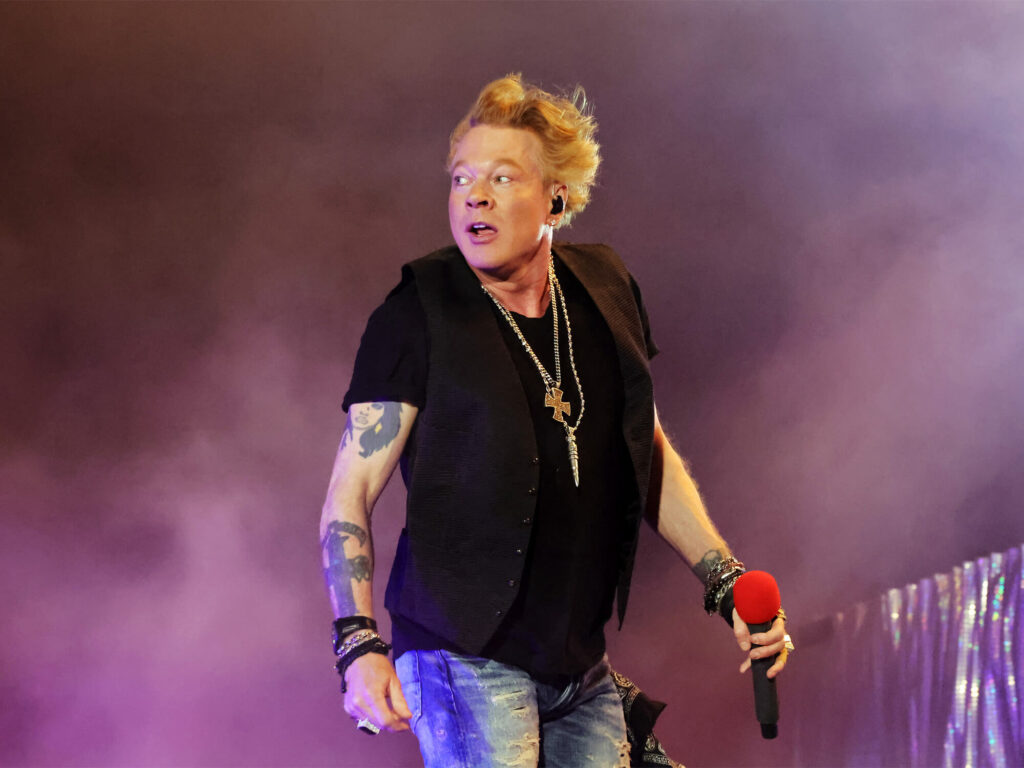
William Bruce Rose Jr., known professionally as Axl Rose, born February 6, 1962, in Lafayette, Indiana, is the co-founder, lead vocalist, and primary lyricist of Guns N’ Roses, and the only member to remain with the band continuously since its 1985 formation. The band’s 1987 debut, Appetite for Destruction, has sold more than 30 million copies worldwide and remains the best-selling debut album in U.S. chart history, driven by singles including “Sweet Child o’ Mine” and “Welcome to the Jungle.” The 1991 double release Use Your Illusion I and II added a combined 35 million copies sold. Guns N’ Roses has sold more than 100 million records worldwide. Following the departures of Slash and Duff McKagan in the mid-1990s, Rose retained control of the Guns N’ Roses name and continued touring and recording with a rotating lineup of hired musicians for nearly two decades, including the 2008 release of Chinese Democracy, reportedly the most expensive rock album ever produced. In 2016, Rose reunited with Slash and McKagan for the Not in This Lifetime Tour, which grossed $584.2 million across 175 shows, the third highest-grossing tour in Billboard Boxscore history at the time. That same year, he also filled in as touring vocalist for AC/DC for two dozen shows after Brian Johnson was ordered to stop performing for health reasons. Rose lives in Malibu, California.
1. Touring (1985-2026)
Guns N’ Roses’ box office grosses across four decades are extensively documented, but these figures are ticket revenue collected from fans, not personal income to Rose. Stadium-scale touring production, staging, crew, and venue costs typically consume approximately 38 percent of gross before any split reaches the band, and the resulting net is then divided among however many people hold an equity stake in a given touring lineup, a number that has varied dramatically across Rose’s career.
During the classic lineup era (1985-1993), touring income was split among the five founding members. After Slash and McKagan’s departures in the mid-1990s, Rose retained the band name and toured for nearly two decades, into the 2000s and early 2010s, with hired musicians who, per longtime industry reporting on the band’s structure, generally worked on salary or fixed-fee arrangements rather than equity stakes, leaving Rose as the primary financial beneficiary of that era’s touring income. When Slash and McKagan rejoined for the Not in This Lifetime Tour in 2016, the classic trio’s economics returned, with Rose’s personal share moderated by the larger cast of equity or high-fee participants in that production. Industry reporting has placed Rose’s personal take from the Not in This Lifetime Tour at approximately $65 million, a figure used here as a calibration point given the difficulty of independently verifying the exact internal economics of a touring operation this large.
- 1985-1993 box office (~$180M cumulative, classic five-member lineup): ~$31.2M
- 1994-2000 box office (~$20M, Rose controls hired-lineup touring): ~$6.8M
- 2001-2015 box office (~$150M, Chinese Democracy Tour era, hired-lineup structure): ~$51.2M
- 2016-2019 box office ($584.2M, Not in This Lifetime Tour, reunited classic trio): ~$65.2M (calibrated to widely reported personal take)
- 2022-2026 box office (~$80M, continued touring and 2026 world tour): ~$9.9M
Rose’s personal touring income, net of production costs and reflecting his actual band-revenue share across eras: ~$164.3M.
Separately, Rose’s fee for filling in with AC/DC during the 2016 Rock or Bust World Tour, which grossed $221.1 million across that run, has never been publicly disclosed in any form. He joined an established band as a temporary replacement vocalist rather than an equity participant, and no per-show fee or total compensation figure exists in public reporting. This is excluded from the waterfall as a real but unquantifiable income event.
- AC/DC Rock or Bust fill-in fee (2016): real, confirmed engagement; no disclosed figure exists to quantify it
2. Recorded Music Royalties
Separate from touring, Rose has collected royalty income from album sales and streaming across a catalog exceeding 100 million units sold worldwide, anchored by Appetite for Destruction’s 30 million and the Use Your Illusion albums’ combined 35 million. This royalty income is collected as it flows and is distinct from the present-day value of the songwriting catalog itself as a held asset, addressed separately below.
- Recorded music royalty income, cumulative across career: ~$60M
3. Songwriting Catalog (Held Asset)
Rose is credited as primary or sole lyricist across virtually the entire Guns N’ Roses catalog, with music composition credits typically shared among Slash, Izzy Stradlin, and other contributing members depending on the album era. This concentration is not merely assumed: in 2006, Slash and Duff McKagan sued Rose over songwriting and publishing credit allocations, a dispute Rose attributed to a clerical error during a publishing administration transition. The lawsuit was settled, but it confirms that publishing income has not been split evenly across band members and that Rose’s lyricist-and-brand-owner position carries real, concentrated value distinct from a simple per-member division.
Guns N’ Roses has never sold its catalog, so no direct transaction value exists to cite. The catalog itself is narrower than legacy acts with decades of continuous output, built primarily around four major studio albums rather than a sprawling discography, but those four albums include some of the best-selling rock records in history. A conservative full-catalog enterprise value of approximately $150 million is used as a reference point, below the $300-500 million range commanded by deeper, longer-running catalogs like Bob Dylan’s or Bruce Springsteen’s given Guns N’ Roses’ narrower output, but real given Appetite for Destruction and the Use Your Illusion albums’ enduring commercial scale.
- Songwriting catalog, Rose’s concentrated lyricist and brand-owner share (45% of estimated $150M full-catalog value): ~$67.5M
4. Endorsements
Rose has not been a frequent brand pitchman across his career, a notable departure from many of his commercial peers. His income from endorsements and licensing has been modest and largely incidental, including voice work for a radio station DJ character in the 2004 video game Grand Theft Auto: San Andreas and limited licensing of his image and the Guns N’ Roses brand.
- Career endorsement and licensing income: ~$5M
5. Representation
Guns N’ Roses has been managed by a series of managers over four decades, including Doug Goldstein during the 1990s and various subsequent representation, with Rose maintaining unusually direct personal control over the band’s business affairs relative to most acts of its commercial scale, a dynamic confirmed by his retention of the band’s trademark and his direct involvement in management changes over the years. A blended representation rate of 15 percent is applied across his combined career earnings, reflecting this direct-control structure.
Representation (15% blended on $229.3M combined gross): -$34.4M.
6. Tax
Rose has been a California resident throughout his career, based in Malibu since the early 1990s. California’s top marginal state rate of 13.3 percent, among the highest in the country, applies to the substantial majority of his career earnings.
Tax (48% effective on $194.9M post-representation): -$93.6M.
Combined gross across touring, recorded music, and endorsements totals $229.3M. After representation (-$34.4M) and tax (-$93.6M), approximately $101.4M remains before lifestyle burn.
7. Lifestyle Burn
Rose’s documented expenses are more limited than most artists in this database, which argues for building this figure from named costs rather than an extended narrative estimate. Two specific legal matters carry confirmed dollar figures: a 2016 lawsuit from former keyboardist Chris Pitman over $125,000 in unpaid wages, settled that November, and an earlier lawsuit from former manager Irving Azoff over unpaid touring fees, also settled, though the settlement terms were not disclosed. His known assets include a documented car collection featuring a Ferrari Enzo and a Porsche Carrera GT, both valued in the low millions individually; these function as appreciating assets rather than ongoing consumed spending, with only modest insurance and maintenance, estimated at $1.25 million across roughly 25 years of ownership, counted as burn. No yacht or private jet ownership has been documented; reported air travel has been via chartered aircraft. Beyond these specific items, ordinary living expenses across a 41-year career are modeled at a moderate $700,000 per year, checked against his retained post-tax income to avoid overstating consumption relative to what he actually earned.
- Documented and estimated legal costs (Pitman settlement, Azoff lawsuit): $625K
- Car collection insurance and maintenance (not full collection value): $1.25M
- Ordinary living expenses, 41 years at $700K/yr: $28.7M
Total lifestyle burn: ~$30.6M. Available to accumulate: ~$70.8M.
8. Real Estate
Rose’s real estate history includes a documented transaction with both purchase and sale prices: a 10-acre property on Geneva Lake, Wisconsin, purchased in 1992 for $3.2 million and sold in 1998 for $3.5 million, a confirmed gain of $300,000. His current primary residence, a Mediterranean-style estate in Malibu’s Latigo Canyon area, has purchase price figures that vary across sources from $2.5 million to $3.6 million depending on the report, with no single figure confirmed by primary real estate records; given this inconsistency, no appreciation gain is claimed on the Malibu property. A Hollywood Hills property was sold in 1992 for $640,000, with no purchase price documented. A Los Angeles property in the Laurel Canyon area, reportedly purchased in the early 1990s for approximately $800,000, also lacks a confirmed primary-source purchase price.
- Geneva Lake, Wisconsin property, documented purchase-to-sale gain (1992-1998): +$300K
- Malibu primary residence: excluded (inconsistent purchase price reporting across sources)
- Hollywood Hills and Laurel Canyon properties: excluded (undocumented purchase prices)
Real estate appreciation: +$300K (documented gain only).
9. Wealth Management
No disciplined investment program or wealth manager has been publicly documented for Rose. Default applies.
Wealth Management: None reported ($0).
Net Worth Waterfall
| Line Item | Amount |
|---|---|
| Touring, personal income net of production costs and band-share by era (1985-2026) | +$164.3M |
| Recorded music royalty income, cumulative (distinct from catalog asset) | +$60M |
| Endorsements and licensing (career) | +$5M |
| Less: representation (15% blended) | -$34.4M |
| Less: tax (48% effective, California resident) | -$93.6M |
| Less: lifestyle burn (documented expenses plus moderate ordinary living) | -$30.6M |
| Available to accumulate | +$70.8M |
| Songwriting catalog, concentrated lyricist and brand-owner share | +$67.5M |
| Real estate appreciation (Geneva Lake, documented gain) | +$300K |
| AC/DC Rock or Bust fill-in fee | $0 (undisclosed) |
| Wealth Management | $0 |
| Total Net Worth | ~$138.6M → $140M |
Our calculation: $140 Million.
Why Our Figure Differs From Consensus
Celebrity Net Worth places Rose at $200 million. Our independent calculation produces approximately $140 million, below consensus, and the gap is best explained by two factors working in the same direction. First, the Not in This Lifetime Tour’s $584.2 million box office figure, frequently cited as evidence of Rose’s wealth, is ticket revenue before stadium-scale production costs and before the resulting net is split among a touring operation involving multiple equity or high-fee participants; widely reported figures place Rose’s actual personal take from that tour at approximately $65 million, a fraction of the headline gross, and that calibration point is used directly in this waterfall rather than assuming a larger personal share. Second, his songwriting catalog, while concentrated and confirmed as such by the 2006 lawsuit Slash and McKagan brought over publishing credits, is conservatively valued against a narrower discography than legacy acts with decades of continuous studio output; Guns N’ Roses has never sold its catalog, so no direct transaction value exists to anchor a higher figure. Working in the other direction: California’s high effective tax rate across his entire career is a real constraint, but his documented personal expenses are limited to a handful of specific items, two settled lawsuits and a known car collection, rather than evidence of extravagant ongoing spending, which keeps his lifestyle burn modest relative to his income. His AC/DC fill-in fee remains genuinely undisclosed and could move this figure higher if ever revealed.
The Frontman Who Kept the Name and Most of the Money
Axl Rose did something almost no rock frontman manages: when his band fell apart in the mid-1990s, he walked away with the name, the trademark, and effective control of the business, while the musicians who built the sound with him left with nothing but the right to start over somewhere else. That decision, controversial then and still disputed in its exact mechanics now, is the single structural fact that explains why his fortune looks the way it does. The $584 million Not in This Lifetime Tour grossed more than almost any rock tour in history, but the number that actually reached Rose was a fraction of that, the natural consequence of stadium economics and a production employing far more people than just him. What’s left, after production costs and taxes, is a catalog he still controls, a relatively contained personal lifestyle by rock-star standards, and a fortune built less on spectacle than on the unglamorous math of who actually owned the company once the screaming stopped.