$240 Million
Who He Is
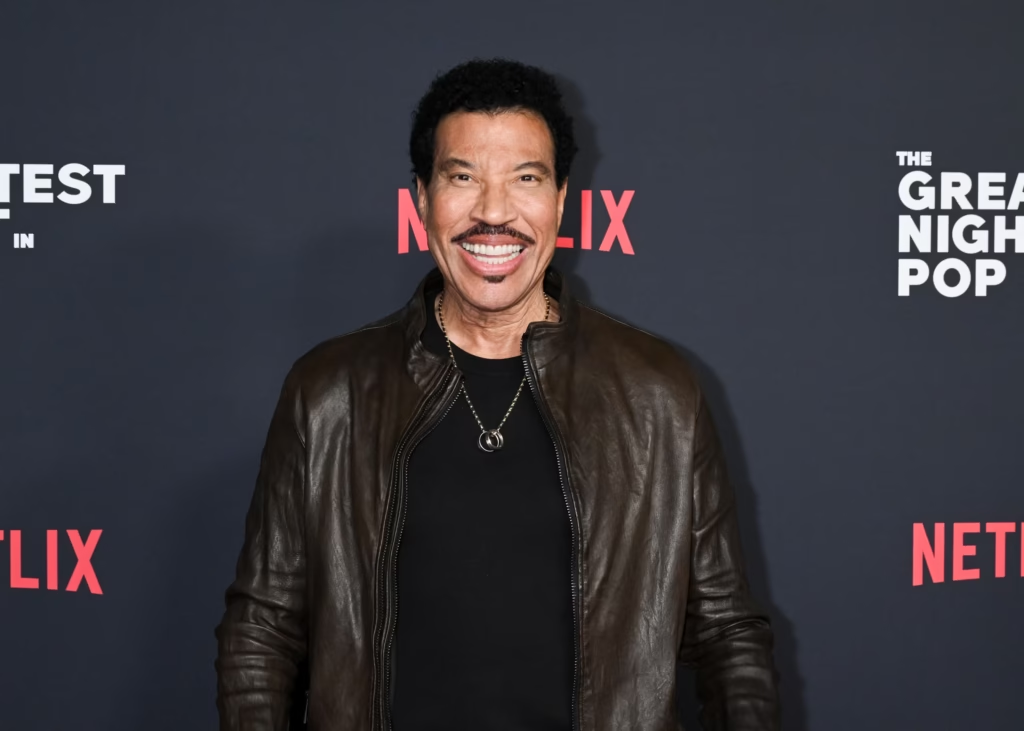
Lionel Brockman Richie Jr., born June 20, 1949, in Tuskegee, Alabama, is an American singer, songwriter, and record producer who first found fame as a founding member of the Commodores, a Motown funk and soul group he helped lead from 1968 through the early 1980s, writing or co-writing hits including “Easy,” “Three Times a Lady,” and “Brick House.” His 1982 solo debut produced the number-one hit “Truly,” and his 1983 sophomore album, “Can’t Slow Down,” became a Diamond-certified, Grammy Album of the Year-winning phenomenon that produced “All Night Long (All Night),” “Hello,” “Stuck on You,” and “Penny Lover.” He wrote or co-wrote a number-one Hot 100 hit for nine consecutive years between 1978 and 1986, and is one of only two songwriters in Grammy history, alongside Paul McCartney, to receive six Song of the Year nominations. In 1985, he co-wrote “We Are the World” with Michael Jackson for the charity supergroup USA for Africa, which raised more than $63 million for famine relief, though Richie earned no personal royalties from the recording itself. He has sold more than 100 million records worldwide and, since 2018, has served as a judge on “American Idol” alongside Katy Perry and later Carrie Underwood, and Luke Bryan.
1. The Commodores Era
Richie’s earnings during his years fronting the Commodores on Motown Records (1968-1982) reflected standard-era group contract terms split among multiple band members, a structurally different position from his later solo career, though his songwriting credits on the group’s biggest hits, including “Easy,” “Three Times a Lady,” and “Brick House,” established the foundation of a catalog that continues generating royalty income today.
Phase total, the Commodores era (1968-1982): ~$20M.
2. The Solo Peak: Can’t Slow Down and Dancing on the Ceiling
Richie’s 1982 solo debut and especially 1983’s Diamond-certified “Can’t Slow Down,” which won the Grammy for Album of the Year and produced four top-ten singles, represent the commercial peak of his career, extended by 1986’s “Dancing on the Ceiling.” This period included extensive touring and record sales at the height of his fame, alongside his 1985 co-writing credit on “We Are the World,” which raised significant charitable funds but generated no personal royalty income for Richie.
Phase total, the solo peak (1982-1987): ~$60M.
3. The 1990s and 2000s
Richie’s output and public profile slowed through the 1990s and 2000s, though he remained active, including a 2012 country-collaboration album, “Tuskegee,” which reached number one on the Billboard 200 by reworking his classic hits with country artists.
Phase total, the 1990s and 2000s: ~$20M.
4. Ongoing Catalog Royalty Collection (2010-2026)
Separate from touring and television income covered in the following sections, Richie’s catalog has continued generating royalty income through streaming, radio play, and synchronization licensing across the 2010s and 2020s, a period during which his earlier-era songs have remained in continuous rotation and use.
Phase total, ongoing catalog royalty collection (2010-2026): ~$15M.
5. 2010s Touring
Richie’s “All the Hits All Night Long” touring cycle spanned much of the 2010s, including a 2016 Las Vegas residency and North American legs in 2014, 2016, and 2019. His 2016 tour grossed a confirmed $22.93 million, and a 2017 co-headlining run with Mariah Carey, “All the Hits Tour,” grossed a confirmed $17.5 million.
Phase total, 2010s touring, personal take (~40% of a combined $60.43M gross, including the 2016 and 2017 confirmed figures plus an estimate for the 2014 and 2019 legs): ~$24.17M.
6. American Idol
Since joining “American Idol” as a judge in 2018, Richie has been directly reported to earn approximately $10 million per season, a figure that has held steady across roughly eight seasons through 2026.
Phase total, American Idol judging (2018-2026), confirmed: ~$80M.
7. Fragrance Line and Recent Business Ventures
Richie launched a fragrance line in 2023 that has reportedly generated approximately $5 million annually.
Phase total, fragrance line and recent business ventures (2023-2026): ~$15M.
8. Endorsements and Other Business
Richie has maintained a modest additional endorsement and licensing profile across his career beyond the ventures already itemized above. No individual deal values have been publicly disclosed for most of these partnerships.
Endorsements and other business: ~$10M.
9. Catalog and Publishing
Richie is a genuine primary songwriter across the overwhelming majority of his catalog, both with the Commodores and as a solo artist, having written or co-written a number-one hit for nine consecutive years in the late 1970s and 1980s. His catalog includes some of the most durable and widely licensed songs in American popular music, including “Easy,” “Three Times a Lady,” “Endless Love,” “All Night Long,” “Hello,” “Say You, Say Me,” and “Dancing on the Ceiling,” alongside his co-writing credit on “We Are the World.” No catalog sale has been publicly disclosed.
Catalog and publishing, held asset (legacy 20x multiple applied to an estimated $5M/yr blended forward personal royalty stream, reflecting a deep, decades-proven primary-songwriter catalog): ~$100M.
Separate from songwriting, Richie is still entitled to a standard performer royalty on his recorded catalog, a right tied to the recordings themselves rather than the compositions, spanning both his Commodores-era and solo-era masters. With more than 100 million records sold across six decades and continued heavy use of “All Night Long,” “Hello,” and “Easy” in film, television, and streaming, this performer royalty stream is a genuine, durable asset independent of the songwriting value already credited above.
Performer royalty on recorded catalog, held asset (standard artist royalty rate applied to an estimated $2M/yr blended forward royalty stream across a 100-million-selling, six-decade catalog): ~$24M.
10. Representation
Richie has been represented by standard industry management structures throughout his career. A standard blended representation rate is applied.
Representation (20% blended on $244.17M combined gross): -$48.83M.
11. Tax
Richie has been a longtime Los Angeles-area resident. A blended effective rate for established entertainment talent using standard loan-out structures runs approximately 42 percent.
Tax (42% on $195.34M post-representation): -$82.04M.
Combined gross across recording, touring, American Idol, and business income totals $244.17M. After representation (-$48.83M) and tax (-$82.04M), approximately $113.30M remains before lifestyle burn.
12. Lifestyle Burn
Richie’s personal spending has been sustained across nearly six decades in the public eye, including maintenance of a substantial Beverly Hills estate and an active real estate management history along Rodeo Drive.
- Commodores through 1990s (1968-2000, 32 years): ~$0.8M/yr = $25.6M
- 2000s through 2026 (26 years): ~$1.2M/yr = $31.2M
Total lifestyle burn: ~$56.8M. Available to accumulate: ~$56.50M.
13. Real Estate
Richie’s real estate history includes two well-documented transactions. Since the 1980s, he owned a portfolio of nine Rodeo Drive properties, selling retail buildings from that portfolio in 2007 for $122 million, reportedly netting approximately $20 million in profit. Separately, in 1999 he purchased a 13,000-square-foot Beverly Hills mansion overlooking the Los Angeles Country Club for $6 million, still his primary residence; the property is widely estimated to be worth $40-60 million today, and during the 2023 US Open, held at the adjacent country club, Richie reportedly rented the home for approximately $1 million per week, or roughly $10 million for the tournament month, a one-time rental windfall rather than a sale and therefore not counted as appreciation here.
- Rodeo Drive portfolio (2007 sale, documented net profit): +$20M
- Beverly Hills mansion (1999 purchase $6M, conservative current-value estimate of $45M): +$39M gain
Real estate appreciation: ~$59M.
14. Wealth Management
No disciplined investment program or wealth manager has been publicly documented for Richie beyond his direct real estate and business holdings, which are captured separately above. Default applies.
Wealth Management: None reported ($0).
Net Worth Waterfall
| Line Item | Amount |
|---|---|
| The Commodores era (1968-1982) | +$20M |
| The solo peak, Can’t Slow Down and Dancing on the Ceiling (1982-1987) | +$60M |
| The 1990s and 2000s | +$20M |
| Ongoing catalog royalty collection (2010-2026) | +$15M |
| 2010s touring, personal take | +$24.17M |
| American Idol judging (2018-2026), confirmed | +$80M |
| Fragrance line and recent business ventures (2023-2026) | +$15M |
| Endorsements and other business | +$10M |
| Less: representation (20% blended) | -$48.83M |
| Less: tax (42%, Los Angeles resident) | -$82.04M |
| Less: lifestyle burn (era-scaled, consumed only) | -$56.8M |
| Available to accumulate | +$56.50M |
| Catalog and publishing, held asset (legacy 20x multiple, primary songwriter) | +$100M |
| Performer royalty on recorded catalog, held asset (standard artist royalty rate) | +$24M |
| Real estate appreciation (Rodeo Drive sale and Beverly Hills mansion) | +$59M |
| Wealth Management | $0 |
| Total Net Worth | ~$239.50M → $240M |
Our calculation: $240 Million.
Why Our Figure Differs From Consensus
Celebrity Net Worth places Lionel Richie at $200 million, with other trackers citing figures ranging up to $220-250 million. Our independent calculation produces approximately $240 million, landing within that broader published range. Several of the largest individual line items in this calculation are hard, directly sourced figures rather than estimates: his American Idol salary has been consistently reported at $10 million per season across roughly eight seasons, his Rodeo Drive property portfolio sale is documented at $122 million with a reported $20 million net profit, and his Beverly Hills mansion’s $6 million purchase price in 1999 is well established. One item deserves a note: some public sources describing Richie’s recent business ventures reference an entity called “Lionel, LLC” acquired by a company called Round 2 in 2026, but that acquisition is of the unrelated model train manufacturer Lionel, not a Richie-owned business, and has been excluded from this calculation accordingly. The primary source of uncertainty in this calculation is the earlier decades of his career, particularly the Commodores era and his 1980s solo peak, for which detailed box office and royalty figures are less comprehensively documented than his more recent, better-tracked touring and television income. Working in favor of a substantial catalog valuation: Richie is a genuine primary songwriter across nearly his entire body of work, having written or co-written a number-one hit for nine consecutive years, a run matched by very few songwriters in pop history, supporting a legacy-tier held-asset multiple on his catalog. On top of that songwriting value, Richie also still earns a standard performer royalty on his own recordings, a separate and durable right tied to the master rather than the composition, credited here on its own line rather than folded into the songwriting figure.
The Man Who Wrote a Number One Every Year for Nine Years
There’s a statistic buried in Lionel Richie’s career that’s almost too strange to be true: from 1978 to 1986, he wrote or co-wrote a number-one hit on the Hot 100 every single year, nine years running, across two different acts, first with the Commodores and then on his own. Only Paul McCartney has matched his six Song of the Year Grammy nominations. Somewhere in the middle of that run, he sat in a room with Michael Jackson and wrote a song that raised sixty-three million dollars for famine relief and personally paid him nothing, and did it anyway, because that was never really the point. Everything that shows up in the numbers here, the American Idol paycheck, the Rodeo Drive real estate, the Beverly Hills mansion he’s owned since 1999, is downstream of a run of songwriting that never really stopped being useful to somebody. “Easy” still plays. “All Night Long” still plays. The catalog doesn’t know it’s forty years old, and neither, by most accounts, does he.