$55 Million
Who He Is
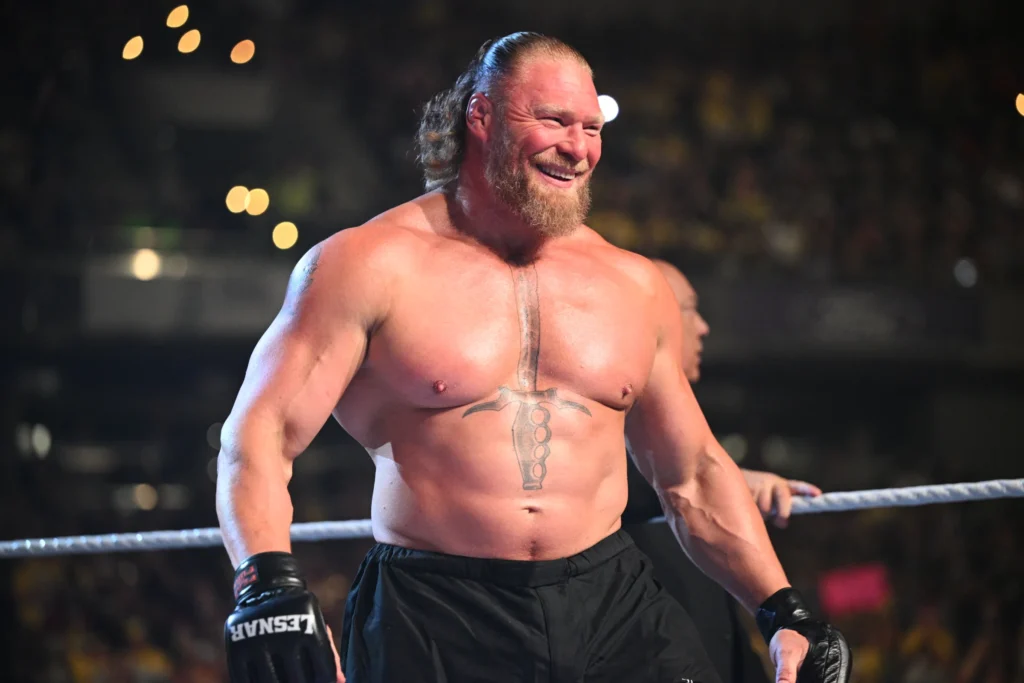
Brock Edward Lesnar, born July 12, 1977, in Webster, South Dakota, is the only person in the history of combat sports to hold the primary heavyweight championships of WWE, UFC, New Japan Pro-Wrestling, the Inoki Genome Federation, and the NCAA simultaneously at various points in his career. He grew up on a farm in rural South Dakota, walked on to the University of Minnesota wrestling team, won the NCAA Division I Heavyweight Championship in 2000, signed with the World Wrestling Federation in 2000, and became the youngest WWE Champion in history at 25 years old in 2002. What followed was one of the most unusual athletic careers ever assembled — two WWE runs separated by a decade, a legitimate UFC Heavyweight Championship, a brief NFL preseason stint with the Minnesota Vikings, a NJPW run in Japan, and a life lived almost entirely away from public view on a farm in Saskatchewan.
His career divides into three chapters. The first was a rocket rise at WWE from 2002 to 2004, then an exit to pursue football and combat sports. The second was a UFC run from 2008 to 2011 that made him the biggest pay-per-view draw in the promotion’s history to that point. The third — and most lucrative — was his return to WWE in 2012 as a part-time premium attraction, a model that fundamentally changed how elite wrestling talent is compensated and later served as the direct template for Roman Reigns’ own contract.
His return to WWE programming was disrupted in early 2024 when he was named in an amended federal lawsuit filed by former WWE employee Janel Grant against Vince McMahon. Lesnar is not a defendant in the lawsuit — Grant alleges McMahon used her to create content intended for Lesnar without her consent, as part of McMahon’s effort to keep Lesnar under contract. Lesnar has never commented publicly on the matter. WWE’s lawyers cleared him to return, and he made his first appearance since 2023 at SummerSlam in August 2025, setting up a feud with Oba Femi. He appeared at Clash in Italy in 2026 and remains active on the roster.
He lives on a large cattle farm near Maryfield, Saskatchewan, Canada, with his wife — former WWE star Sable, real name Rena Greek — and their family. The farm is his primary residence and the clearest statement of who he is away from the ring.
1. Early WWE Career (2000-2004)
Lesnar joined the then-WWF in 2000 through the company’s developmental programme. His rise was extraordinary — first-round domination in OVW, call-up to the main roster in March 2002, and the WWE Championship by August of that year. As the company’s top star he earned escalating fees across a short but commercially intense period.
- 2000-2001 (developmental): ~$100K
- 2002-2003 (WWE Champion, top billing): ~$1M/yr = ~$2M
- 2003-2004 (peak first run): ~$1.2M
Phase total: ~$3.3M gross.
2. NJPW and IGF (2005-2007)
After leaving WWE in 2004 for an ill-fated NFL preseason with the Minnesota Vikings — he made the final roster cuts with the team before being released — Lesnar signed with New Japan Pro-Wrestling in 2005. He won the IWGP Heavyweight Championship and transitioned to the Inoki Genome Federation, where he was promoted as champion through 2007. Japanese wrestling deals for international stars at that level run approximately $700K-$1.5M per year in guaranteed money plus appearance fees.
Phase total: ~$3M gross (3 years at ~$1M/yr).
3. UFC (2008-2011 and 2016)
Lesnar entered the UFC in February 2008 at UFC 81, losing to Frank Mir in the first round. He came back, went on a run that produced the UFC Heavyweight Championship, and became the biggest pay-per-view draw in the promotion’s history at the time. UFC 100 — Lesnar vs. Frank Mir II — drew 1.6 million pay-per-view buys, then a UFC record. His disclosed fight purses across eight bouts total approximately $5.15M in base pay. PPV revenue sharing — a standard component of Lesnar’s deals given his draw — is estimated at approximately $18-19M across his headline fights, giving a total UFC career figure of approximately $24M.
His final UFC appearance was at UFC 200 in July 2016, a one-off return while under WWE contract. He beat Mark Hunt but the result was later overturned to a no contest after Lesnar tested positive for a banned substance. His base pay for that fight was $2.5M; he was later fined $250,000 by USADA.
Disclosed UFC purses: ~$5.15M. Estimated total including PPV shares: ~$24M gross.
4. WWE Second Run (2012-2020)
Lesnar returned to WWE on April 2, 2012, in what became the defining financial chapter of his career. His initial return deal was reported at $2.5M per year for a severely limited dates schedule — approximately 20-30 appearances per year versus the 200+ dates a full-time performer works. The model was unprecedented in scale and became the template for all subsequent elite part-time deals in wrestling.
As his drawing power proved itself — most visibly through ending The Undertaker’s legendary 21-0 WrestleMania undefeated streak in 2014, one of the most shocking moments in the company’s history — his salary escalated sharply.
- 2012-2014 (return deal, ~$2.5M/yr avg): ~$7.5M
- 2015-2018 (~$6-8M/yr, confirmed range): ~$28M
- 2019-2020 (peak ~$10-12M/yr): ~$22M
- 2020 (off-contract per Wikipedia; left after WrestleMania 36): $0
Phase total: ~$57.5M gross.
5. WWE Third Run (2021-2026)
Lesnar confirmed in March 2022 that he had retired after WrestleMania 36 until deciding to return in 2021. His third run operated on a restructured part-time deal similar to his previous arrangement.
- 2021-2023 (~$10M/yr including merch royalties and Saudi Arabia appearances): ~$20M
- 2024 (named in lawsuit, absent from programming but Sports Illustrated confirmed still earning “between seven and eight figures” annually — minimum $5M paid per contract): ~$5M
- 2025-2026 (returned at SummerSlam August 2025; current active run): ~$6M/yr x 1.5 years = ~$9M
Phase total: ~$34M gross.
6. Career Combat Earnings Total
| Phase | Gross |
|---|---|
| Early WWE (2000-2004) | ~$3.3M |
| NJPW and IGF (2005-2007) | ~$3M |
| UFC career (2008-2016, incl. PPV shares) | ~$24M |
| WWE second run (2012-2020) | ~$57.5M |
| WWE third run (2021-2026) | ~$34M |
| Career combat total | ~$121.8M |
7. Endorsements
Lesnar maintains one of the smallest personal endorsement portfolios of any athlete at his career income level. He is famously private, does not seek media appearances, and has described himself as someone who prefers a farm to a film set. His commercial activity has been limited to Death Clutch (his own apparel and lifestyle brand), Dymatize Nutrition (supplement company), and periodic WWE-adjacent licensing. Slim Jim briefly used him through their WWE sponsorship.
Career endorsements: ~$500K/yr average x 24 years = ~$12M gross. This is a generous estimate given how rarely he has engaged with brand work.
8. Total Gross Income
| Source | Gross |
|---|---|
| Career combat earnings | ~$121.8M |
| Endorsements | ~$12M |
| Total gross | ~$133.8M |
9. Representation
Lesnar’s business affairs are handled through a close personal structure with minimal external representation. Paul Heyman served as his on-screen advocate and has historical ties to his management, but Lesnar’s deal structures have largely been negotiated directly. Standard wrestling rate: 5%.
Representation (5% of $133.8M): -$6.7M. Net post-representation: ~$127.1M.
10. Tax
Lesnar is a Canadian resident living in Saskatchewan. Canada taxes its residents on worldwide income. The combined federal and provincial top rate in Saskatchewan is approximately 47.5% (33% federal + 14.5% Saskatchewan provincial on income over ~$250K CAD). This applies to all worldwide income, including his WWE and UFC earnings from the United States.
US withholding tax on US-source income does apply and generates foreign tax credits in Canada, partially reducing the double-taxation burden. The net effective blended rate for a high-income Canadian resident with primarily US-source income — after foreign tax credits and deductions — runs approximately 44%.
This is one of the most important and least-noted facts about Lesnar’s financial profile. Living on a Saskatchewan farm rather than relocating to a US no-tax state like Florida or Texas costs him approximately 7 percentage points of effective tax rate versus a comparable US-based earner. On $127M post-representation income, that differential represents approximately $9M in additional lifetime tax versus a Florida residency.
Tax (44% of $127.1M): -$55.9M. Net after representation and tax: ~$71.2M.
11. Lifestyle Burn
Lesnar is almost certainly the most frugal elite athlete on this site’s roster. He raises cattle in rural Saskatchewan. He drives pickup trucks. His entertainment expenses are his farm. His wife Sable is his own former industry colleague with a modest commercial profile of her own. Four children.
- 2000-2011 (12 years at ~$300K/yr consumed): ~$3.6M
- 2012-2026 (14 years at ~$800K/yr consumed — farm operations, family, trucks, minimal travel): ~$11.2M
Total lifestyle burn: ~$14.8M. Available to accumulate: ~$56.4M.
12. Real Estate
Lesnar purchased a 43-acre estate in Maple Plain, Minnesota in 2003 for $783,500, sold it in 2014 for $750,000 — a confirmed small loss of approximately $33,500. He owned a second Minnesota property in Alexandria, listed at $850,000 in 2020; no confirmed sale price in the public record. His Saskatchewan farm is his primary residence; no purchase price is documented publicly.
No net real estate gain is calculable from public data.
Real estate appreciation: $0.
13. Business Assets
Death Clutch: Lesnar’s personal apparel and lifestyle brand. Active but small. No disclosed revenue or valuation. Excluded.
Business equity: $0.
Net Worth Waterfall
| Line Item | Amount |
|---|---|
| Early WWE career (2000-2004) | +$3.3M |
| NJPW and IGF (2005-2007) | +$3M |
| UFC career including PPV shares (2008-2016) | +$24M |
| WWE second run (2012-2020) | +$57.5M |
| WWE third run (2021-2026) | +$34M |
| Endorsements (Death Clutch, Dymatize, career) | +$12M |
| Less: representation (5%) | -$6.7M |
| Less: tax (44% blended, Saskatchewan + federal) | -$55.9M |
| Less: lifestyle burn (farm life, era-scaled) | -$14.8M |
| Real estate appreciation | $0 |
| Business equity | $0 |
| Total Net Worth | ~$56.4M → $55M |
Our calculation: $55 Million.
Why Our Figure Is So Much Higher Than Consensus
Celebrity Net Worth places Lesnar at $10M — a figure so low it does not survive basic arithmetic. In 2019 alone, Lesnar’s WWE salary was estimated at $10-12M. The $10M CNW figure appears to be a long-outdated placeholder that was never updated to reflect over a decade of elite part-time WWE earnings.
The more credible consensus cluster sits at $17-20M. Even that understates the picture by a wide margin. Lesnar’s WWE earnings across two returns — from 2012 through 2026, with only a brief gap in 2020-21 — total approximately $91.5M in gross base salary and bonuses before any UFC, NJPW, or endorsement income is added. After Saskatchewan’s 44% combined tax rate and modest lifestyle costs, the post-tax accumulation from WWE alone exceeds $40M. Adding $24M in UFC earnings (net: roughly $13M after tax) and $12M in endorsements (net: roughly $7M after tax) produces the $55M figure. It is not a remarkable number for a person who has been paid as one of the top three earners in professional wrestling for thirteen consecutive years. It is simply what the numbers produce when the full career timeline is run honestly.
The Beast Who Chose the Farm
Brock Lesnar has earned more from professional wrestling than almost any performer in the sport’s history outside of the McMahon family. He has also spent almost none of it. He lives on a cattle farm in a part of Saskatchewan that barely shows up on maps, drives the same kind of truck his neighbors drive, and has been quoted saying he does not miss the road. The part-time premium model he pioneered in 2012 — show up for the biggest events, collect eight figures, disappear back to the farm — turned out to be not just a lifestyle preference but a genuinely efficient financial structure. He worked a fraction of the dates of a full-time performer, avoided the accumulated physical cost of a 200-date schedule, and extended a career that would otherwise have broken down years earlier. The Saskatchewan tax bill is real and substantial. But the farm runs, the cattle are his, and the $55M he has accumulated is the product of a man who figured out how to be the highest-paid part-time employee in entertainment while preferring to be somewhere no one could find him.