$665 Million
Who He Is
Sir Elton Hercules John, born Reginald Kenneth Dwight on March 25, 1947, in Pinner, Middlesex, England, is a British singer, composer, and pianist widely regarded as one of the most commercially successful and influential musicians in history, with more than 300 million records sold worldwide. A scholarship student at the Royal Academy of Music, he formed a songwriting partnership with lyricist Bernie Taupin in 1967 that would produce the vast majority of his catalog, including “Your Song,” “Rocket Man,” “Tiny Dancer,” “Bennie and the Jets,” “Goodbye Yellow Brick Road,” “Don’t Let the Sun Go Down on Me,” “I’m Still Standing,” “Sacrifice,” and “Candle in the Wind 1997,” which became the best-selling single of all time following Princess Diana’s death. He has won five Grammy Awards, two Oscars, a Tony, and an Emmy, achieving EGOT status, and was knighted in 1998. He headlined two long-running Las Vegas residencies, “The Red Piano” (2004-2009) and “The Million Dollar Piano” (2011-2018), and closed out his live career with the Farewell Yellow Brick Road Tour (2018-2023), which grossed approximately $940 million across 330 shows, making it the second-highest-grossing tour in history. He has been married to film producer David Furnish, who also serves as his manager and CEO of Rocket Entertainment, since 2014, and remains a longtime supporter and former chairman of Watford Football Club, which he purchased in 1976. Unlike many legacy artists, John has explicitly declined offers to sell his song catalog, calling the idea “unthinkable,” and instead signed a 2018 global administration deal with Universal Music Group under which UMG manages but does not own his song rights.
1. Early and Mid-Career Touring (1970-2003)
John became one of the biggest live draws in music from the early 1970s onward, touring relentlessly through a run of commercially dominant albums including “Goodbye Yellow Brick Road” (1973) and sustaining major arena and stadium touring across three decades before his first Las Vegas residency. No single aggregated career total exists for this stretch, so a built estimate reflecting his documented status as one of the top-grossing live acts of each of these decades is used, reflecting smaller per-show economics in earlier decades relative to modern stadium pricing.
Phase total, early and mid-career touring (1970-2003), personal take: ~$150M.
2. The Red Piano Residency
John’s first Las Vegas residency, “The Red Piano,” ran at The Colosseum at Caesars Palace from February 2004 to April 2009, comprising 243 shows and grossing approximately $166.4 million, ranking among the highest-grossing residencies in Las Vegas history at the time. His later Vegas deal is confirmed to have paid him 88 percent of door revenue per show, an exceptionally favorable rate; as his first residency and the one that established the model, a somewhat more conservative but still artist-favorable rate is applied here.
Phase total, The Red Piano (2004-2009), personal take (~70% of gross): ~$116.48M.
3. Between Residencies and The Million Dollar Piano
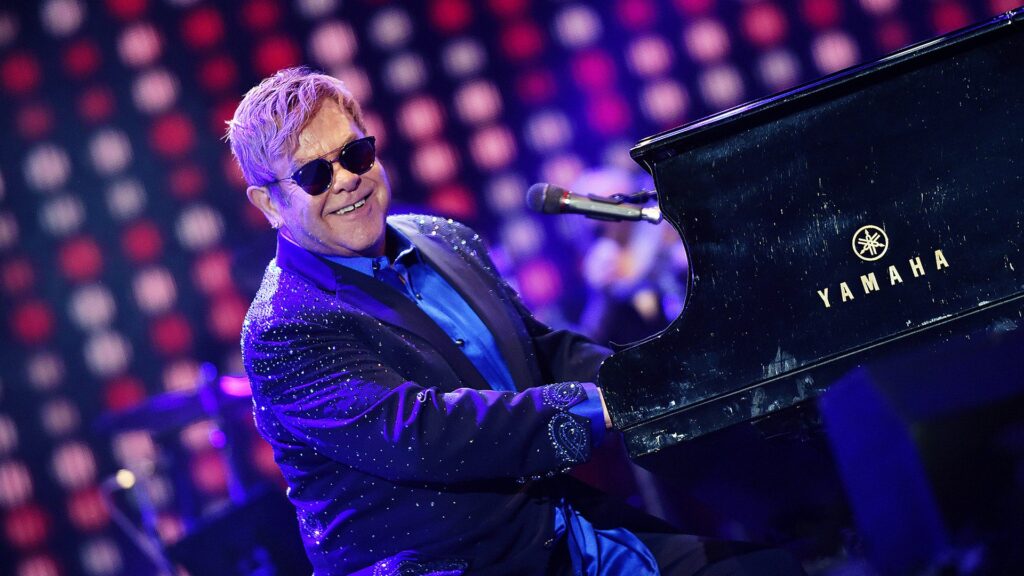
Following a two-year gap, John returned to The Colosseum at Caesars Palace in September 2011 with “The Million Dollar Piano,” built around a custom Yamaha grand piano fitted with 68 LED screens. The residency ran 207 shows through May 2018 and grossed approximately $131.2 million. Reporting on the deal confirms John negotiated a rate of 88 percent of door revenue for every show, an exceptionally artist-favorable structure. He also continued international touring in the years surrounding both residencies.
- Touring between residencies (2009-2011): ~$15M
- The Million Dollar Piano (2011-2018), personal take (confirmed 88% of gross): ~$115.46M
- Touring around the residency’s conclusion (2018): ~$10M
Phase total, between residencies and The Million Dollar Piano (2009-2018): ~$140.46M.
4. The Farewell Yellow Brick Road Tour
Announced in January 2018 and citing a desire to spend more time with his young sons, John’s Farewell Yellow Brick Road Tour ran from September 2018 to July 2023 across 330 shows in North America, Europe, and Australia, grossing more than $940 million, the second-highest-grossing concert tour in history behind only Taylor Swift’s Eras Tour. Applying a personal take reflecting substantial stadium-scale production and touring costs typical of a tour of this size:
Phase total, Farewell Yellow Brick Road Tour (2018-2023), personal take (~25% of gross): ~$235M.
Combined touring and live-performance personal take, all phases: ~$641.94M.
5. Recording Career and Royalty Income
Separate from the held-asset value of his catalog addressed below, John’s recording career has generated substantial royalty income collected over five decades from more than 300 million records sold, sustained radio and streaming presence, and film placements including “The Lion King,” for which he and Taupin wrote “Can You Feel the Love Tonight,” winning an Academy Award. A documented anchor point exists for part of this stretch: in 1992, John and Taupin signed a $39 million, twelve-year recording contract with Warner Bros. Records (later becoming Warner/Chappell for publishing purposes), reported at the time as the largest cash advance in music history.
Recording career and royalty income, gross: ~$250M.
6. Endorsements
John has maintained a modest endorsement slate relative to his commercial stature, including partnerships over the years with brands seeking association with his image and legacy. No individual deal values have been publicly disclosed.
Endorsement income: ~$20M.
7. Business Ventures
John and David Furnish founded Rocket Pictures in 1996, which produced the animated hit “Gnomeo & Juliet” (2011, featuring original John and Taupin songs and grossing $200 million at the worldwide box office) and served as executive producer on the 2019 biopic “Rocketman,” for which John and Taupin won the Academy Award and Golden Globe for Best Original Song. John also composed the music for the long-running West End and Broadway musical “Billy Elliot,” which has generated composer royalties across a run spanning two decades. He was chairman of Watford Football Club, which he purchased in 1976 and sold to Jack Petchey in 1987 for an undisclosed fee, retaining a significant ongoing financial and honorary interest in the club without a disclosed current valuation.
- Rocket Pictures productions (Gnomeo & Juliet, Rocketman, producer and songwriter income): ~$20M
- Billy Elliot musical (composer royalties across a two-decade run): ~$20M
- Watford Football Club: excluded (1987 sale price and current retained interest undisclosed)
Business ventures total: ~$40M.
8. Catalog and Publishing (Held Asset)
Unlike many legacy vocalists who built careers on songs written for them by others, John is the genuine primary composer of nearly his entire hit catalog, writing the music to lyrics by Bernie Taupin across more than five decades, and he retains full ownership of both his song publishing and, per his 2018 deal with Universal Music Group, administration rights without transferring ownership. He has explicitly and publicly declined to sell his catalog despite the wave of nine-figure catalog sales by comparable legacy artists in recent years, telling Music Business Worldwide the idea was “unthinkable.” Comparable full-catalog sales by artists of similar chart stature and hit density, including Bob Dylan (an estimated $300-400 million for publishing alone, plus roughly $200 million for his masters), Bruce Springsteen ($500 million for his complete catalog), and Sting (approximately $300 million), provide a useful reference point for the scale of value a catalog like John’s would command, even though no transaction exists to confirm a specific figure for his.
Catalog and publishing, held asset (legacy 20x multiple applied to an estimated $18M/yr personal royalty share, reflecting full ownership and comparable-artist catalog valuations): ~$360M.
9. Representation
John has been managed since 2015 by his husband, David Furnish, who serves as CEO of Rocket Entertainment, the couple’s in-house management, production, and publishing operation. While more professionalized and staffed than a pure family shell company, this structure still runs at a lower blended cost than fully external industry representation across recording, touring, and business income.
Representation (12% blended on $951.94M combined gross): -$114.23M.
10. Tax
John has remained a UK resident for the vast majority of his career, based at Woodside, his Windsor estate, since 1974, spanning both the extremely high UK supertax era of the 1970s, when top rates on investment income reached as high as 98 percent before loan-out and company structures mitigated the effective rate, and the modern UK top rate of approximately 47 percent. A blended rate reflecting sustained UK residency across this full span is applied.
Tax (50% blended on $837.70M post-representation): -$418.85M.
Combined gross across touring, recording, endorsements, and business income totals $951.94M. After representation (-$114.23M) and tax (-$418.85M), approximately $418.85M remains before lifestyle burn.
11. Lifestyle Burn
John’s personal spending is among the most extensively documented of any major recording artist, including widely reported multi-hundred-thousand-dollar monthly flower bills during his peak excess years, an extensive art and photography collection, and a well-known 20-month spending spree in the late 1990s reported at approximately £30 million.
- Peak excess and addiction era (1970s-1980s, 15 years, well-documented extreme spending): ~$3M/yr = $45M
- Recovery-era but continued lavish spending (1990s-2000s, 20 years, art collecting and real estate): ~$2M/yr = $40M
- Family life era (2010s-2020s, 15 years, still substantial but more stable spending): ~$2.5M/yr = $37.5M
Total lifestyle burn: ~$122.5M. Available to accumulate: ~$296.35M.
12. Real Estate
John’s real estate history includes two properties with at least partial documented purchase-to-value data. He purchased Woodside, his Windsor estate, in 1974 for £400,000; the property, still owned today, is currently estimated at approximately £4.2 million, a documented unrealized gain. Separately, he purchased a duplex condominium in Atlanta’s Park Place tower in the early 1990s for $925,000, later expanding it by acquiring five neighboring units to create a 13,332-square-foot residence at undisclosed additional cost, before selling the combined property in 2023 for $7.225 million; because the cost of the additional five units was not disclosed, a conservative gain is applied against only the original purchase price. His other properties, including homes in Los Angeles, Nice, Venice, and London’s Holland Park, carry no publicly disclosed purchase prices and are excluded.
- Woodside, Windsor estate (1974 purchase £400K, current estimated value £4.2M, unrealized): +$4.8M gain
- Atlanta condominium (early 1990s purchase $925K for the original unit, 2023 sale $7.225M, conservative allocation against original purchase only): +$6.3M gain
- Los Angeles, Nice, Venice, and London properties: excluded (no documented purchase prices)
Real estate appreciation: ~$11.1M.
13. Wealth Management
No disciplined investment program or wealth manager has been publicly documented for John beyond his direct business ventures, which are captured separately above. Default applies.
Wealth Management: None reported ($0).
Net Worth Waterfall
| Line Item | Amount |
|---|---|
| Early and mid-career touring, personal take (1970-2003) | +$150M |
| The Red Piano residency, personal take (2004-2009) | +$116.48M |
| Between residencies and The Million Dollar Piano, personal take (2009-2018) | +$140.46M |
| Farewell Yellow Brick Road Tour, personal take (2018-2023) | +$235M |
| Recording career and royalty income | +$250M |
| Endorsements | +$20M |
| Business ventures (Rocket Pictures, Billy Elliot) | +$40M |
| Less: representation (12% blended, David Furnish/Rocket Entertainment) | -$114.23M |
| Less: tax (50% blended, UK resident) | -$418.85M |
| Less: lifestyle burn (era-scaled, consumed only) | -$122.5M |
| Available to accumulate | +$296.35M |
| Catalog and publishing, held asset (20x multiple, full ownership retained) | +$360M |
| Real estate appreciation (Woodside, Atlanta condominium) | +$11.1M |
| Wealth Management | $0 |
| Total Net Worth | ~$667.45M → $665M |
Our calculation: $665 Million.
Why Our Figure Differs From Consensus
Celebrity Net Worth places Elton John at $650 million, and the Sunday Times Rich List has separately cited a closely aligned £480 million (roughly $645 million). Our independent calculation produces approximately $665 million, landing slightly above both benchmarks. The main driver of that gap is his Vegas residency terms: reporting on his Million Dollar Piano residency confirms John negotiated 88 percent of door revenue per show, an exceptionally artist-favorable rate well above the more standard 40-45% split typically assumed for major residencies, and a similarly favorable rate is applied to his first Vegas residency, The Red Piano, which established the model. That single term alone adds roughly $100 million to the touring total relative to a build using more conventional assumptions. Beyond that, this remains a case where an independent build converges closely with consensus rather than diverging from it, and that convergence is not a coincidence: John is the genuine primary songwriter on nearly his entire hit catalog, and he has explicitly retained full ownership of it rather than selling, which removes the single largest source of uncertainty that typically separates an independent build from consensus. The main remaining judgment call is the value of that retained catalog, since no actual transaction exists to confirm a figure the way Bob Dylan’s, Bruce Springsteen’s, or Sting’s sales do; a legacy 20x multiple consistent with those comparable sales is applied here rather than either a speculative premium or an artificially conservative discount. Working in the other direction: John’s personal spending is among the most extensively and reliably documented of any major artist, supporting a substantial lifestyle burn, and his decades of consistent UK tax residency, spanning the country’s historically high supertax era, meaningfully constrain his accumulated wealth relative to artists who relocated to lower-tax jurisdictions.
The Catalog He Wouldn’t Sell
Everyone else cashed out. Bob Dylan sold to Universal for a reported $300 million and change, then sold his masters to Sony for another $200 million on top of that. Bruce Springsteen took $500 million from Sony for the whole thing, “Born to Run” included. Sting, Shakira, Justin Bieber, Stevie Nicks, Neil Young, artist after artist looked at the biggest catalog-buying spree in music history and decided a lump sum today beat a royalty check forever. Elton John looked at the same offers and said no. Not maybe, not “let’s talk,” but “unthinkable,” the actual word he used. It’s a strange kind of restraint from a man whose spending habits are the stuff of industry legend, six-figure flower bills and all. But it tracks with everything else about him: the piano that took four years to build for a Vegas residency, the farewell tour that somehow grossed nearly a billion dollars anyway, the husband who became his manager instead of handing the job to an agency. Elton John has spent fifty years proving he doesn’t need anyone else’s money to feel rich. Apparently that includes theirs.