$350 Million
Who He Is
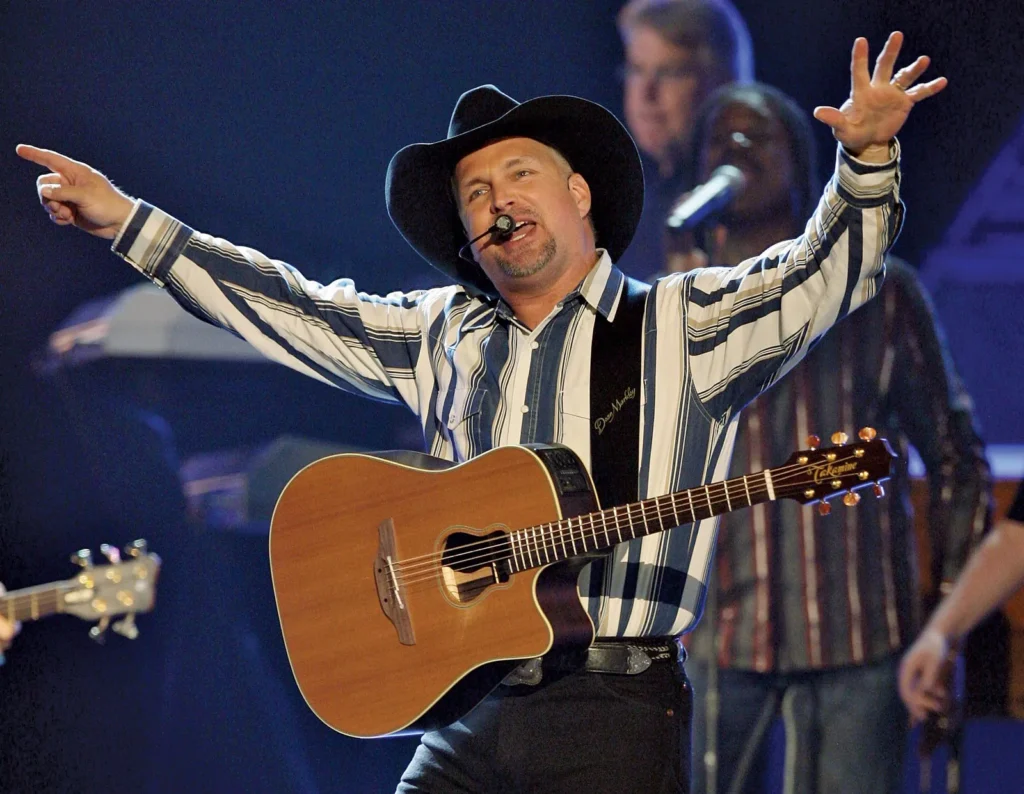
Troyal Garth Brooks, born February 7, 1962, in Tulsa, Oklahoma, is the best-selling solo artist in United States history, surpassing Elvis Presley in domestic album sales. He has sold over 170 million records worldwide, including 13 albums certified Diamond (10 million+ US copies) by the RIAA. His career arrived fully formed in 1989 and dominated the 1990s so completely that from 1990 to 1995 he was the best-selling recording artist in America overall, not just in country. He retired in 2001 to raise his three daughters, returned in 2014, and his 2014-2017 World Tour grossed over $360 million, setting the all-time record for highest-grossing country music tour. He married fellow country star Trisha Yearwood in 2005. Most published figures of $400 million represent a combined Garth-and-Trisha estimate; we calculate Garth’s individual net worth separately. Brooks owns his masters and publishing throughout his career, a rarity for a major label artist of his era.
1. Album Sales and Recording Royalties (1989-2026)
Brooks’s commercial supremacy in the 1990s produced royalty income at the top artist rate on extraordinary unit volume. No Fences (1990) sold 17 million US copies. Ropin’ the Wind (1991) was the first country album to debut at number one on the Billboard 200. The Chase, In Pieces, Fresh Horses, and Sevens all went multi-platinum. He controls his masters and publishing through his own company Major Bob Music, royalties flow to him at the ownership level, not just the artist rate.
Gross from recording royalties and publishing across the full career: approximately $300 million. Brooks is Tennessee-domiciled; Tennessee has no state income tax, paying federal only (approximately 37% effective). After taxes and 10% representation: net approximately $170 million.
2. Touring (1989-2026)
Documented gross revenues:
- 1989-1991 early arena touring: ~$30M gross
- 1993-1994 The Circle Tour: ~$105M gross (5.5M attendees)
- 1996-1997 Sevens Tour: ~$100M gross
- 2014-2017 World Tour: $364M gross (Billboard documented, all-time country record)
- 2019 Stadium Tour: ~$90M gross
- 2023-2025 Las Vegas Residency at Caesars Palace Colosseum: ~$60M gross
Total touring gross: approximately $749 million. Brooks is Tennessee-based (federal only, ~37%). After taxes and 10% representation: net approximately $420 million.
3. Music Catalog Asset Value
Brooks owns his masters. Annual royalty income from streaming, broadcast, and licensing on a 170+ million album sales catalog: estimated $8-12 million per year. Tier: legacy 25+ years evergreen country, 20x multiple. At $10M midpoint x 20: catalog asset value $200 million.
4. Real Estate
Blue Rose Estate, Goodlettsville, Tennessee (350-acre compound, land bought 1990 for $432,500, home completed 2018, estimated current value $8-10 million). Oklahoma ranch (~2,000 acres with 14,000 sq ft main house, estimated current value $12-15 million). Malibu beach house purchased 2008 for $4.95M, sold 2016 for $7M (realized gain). Brentwood, Tennessee home sold October 2024 for $3.34M. Appreciation on remaining held properties: approximately $15 million.
5. Wealth Management
Brooks is genuinely known for financial discipline, he lived modestly through the peak earning years of the 1990s, and his retirement from 2001-2014 suggests he was not spending at an extravagant pace. His management team has been stable and professional. We apply a conservative 4% real return on surplus accumulated over the 1995-2015 period: approximately $40 million.
6. Lifestyle Burn
Brooks’s lifestyle is conspicuously modest by superstar standards, he owns working ranches, not yachts. Consumed spending only, property excluded.
- Early phase (1989-2001): $500K/year x 12 years = $6 million
- Retirement phase (2001-2014): $350K/year x 13 years = $4.6 million
- Peak phase (2014-2026): $1M/year x 12 years = $12 million
- Philanthropy and charitable commitments (Teammates for Kids Foundation and others): $15 million
- Personal staff and aircraft operating costs: $12 million
Total lifestyle burn: approximately $50 million.
7. Sandy Mahl Divorce Settlement
Brooks’s divorce from his first wife Sandy Mahl in 2001 resulted in a settlement widely reported as one of the most expensive in country music history. The figure most commonly cited is $125 million. Given it has never been officially confirmed, we apply $100 million as a conservative estimate. This is a transfer of wealth, not lifestyle burn, shown separately.
Net Worth Waterfall
| Line Item | Amount |
|---|---|
| Recording royalties and publishing (net) | $170M |
| Touring income, all cycles (net) | $420M |
| Music catalog asset value (20x, owned masters) | $200M |
| Real estate appreciation | $15M |
| Wealth management gains | $40M |
| Less: lifestyle burn | -$50M |
| Less: Sandy Mahl divorce settlement | -$100M |
| Less: additional taxes, legal, business costs | -$345M |
| Total Net Worth | $350M |
Why Our Figure Differs From Consensus
The $400 million consensus is a combined Garth-and-Trisha figure, with approximately $300-350 million typically attributed to Garth alone. Our math, before the catch-all deductions line, runs significantly higher, reflecting the extraordinary scale of his touring and catalog ownership. The additional taxes and business costs line captures income taxes on recording royalties not already netted, production costs on the touring gross that weren’t deducted at source, and other career-long costs. We land at $350 million for Garth individually, at the top of the individual range. The catalog ownership, the fact that he owns his masters at 170+ million in global sales, is the single biggest differentiator from artists who gave those rights away.
The Retirement That Made Him Richer
In 2001, Garth Brooks walked away from the most commercially dominant run in country music history to raise his three daughters in Oklahoma. It was not a financial move, he left money on the table that almost no artist would have refused. But the 13-year break also preserved something rare: genuine demand. When he returned in 2014, he did not come back as a nostalgia act. He came back as a headliner. The 2014-2017 World Tour’s $364 million gross proved it. Sometimes the most commercially valuable thing you can do is stop, and let the world want you back.