$260 Million
WHO HE IS
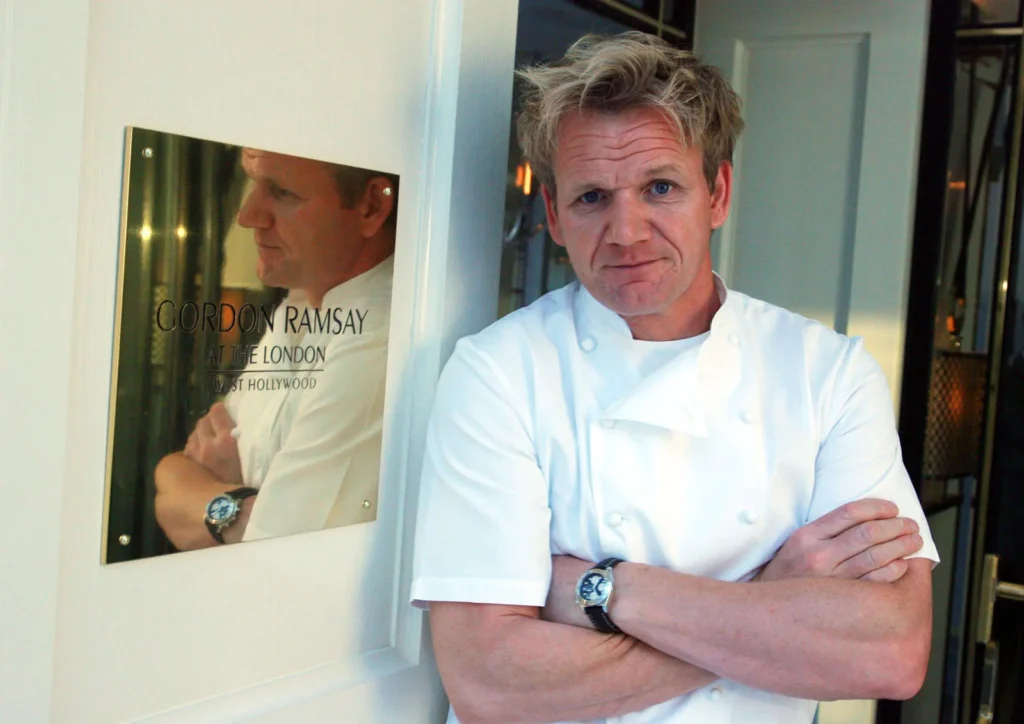
Gordon Ramsay, born November 8, 1966, in Johnstone, Scotland, is one of the most decorated and commercially successful chefs in the world, with 17 Michelin stars earned across his career and 8 currently held. After a knee injury ended his ambitions of a professional football career, Ramsay trained under Marco Pierre White, Albert Roux, and Joel Robuchon before opening Restaurant Gordon Ramsay in London’s Chelsea neighborhood in 1998, which earned three Michelin stars within three years and has held them for over two decades. Ramsay’s television career began with the 1998 documentary “Boiling Point” and expanded into a global media empire spanning Hell’s Kitchen, MasterChef, Kitchen Nightmares, and Next Level Chef across both the UK and US. He now oversees a restaurant group of roughly 94 locations worldwide, a production company in partnership with Fox, and a growing portfolio of licensing and equity ventures. He is based primarily in London and Los Angeles, and is married to Tana Ramsay, with whom he has six children.
1. Television and Media Career Earnings (1998-2026)
Ramsay’s television and production earnings are the largest single driver of his fortune, built over a roughly 28-year career rather than a fixed contract structure. Public reporting confirms specific peak years, including approximately $60M between June 2017 and June 2018, $65M between June 2018 and June 2019, and $70M between June 2019 and June 2020, with Celebrity Net Worth’s more recent, general estimate placing his typical annual earnings at $30M to $40M, “sometimes much more.” Building a conservative career estimate across distinct eras of his fame:
- Early career, pre-US breakthrough (1998-2005): ~$1M/yr = $7M
- Rising fame, Hell’s Kitchen and MasterChef launch (2005-2015): ~$10M/yr = $100M
- Approaching peak (2015-2017): ~$30M/yr = $60M
- Documented peak years (2017-2020): $60M + $65M + $70M = $195M
- Current era (2020-2026): ~$35M/yr = $210M
This is a rough, long-horizon estimate rather than a precise figure, given the absence of a single disclosed contract structure, but it is grounded in the specific confirmed data points available.
Television and media career earnings: $500M gross.
2. Representation
Ramsay’s television and production deals are typically negotiated through talent agencies and his own production company, Studio Ramsay Global. Entertainment representation on deals of this scale typically runs in the 10% to 15% range; we use a conservative 10% here given the significant portion of his income that flows through his own production infrastructure rather than third-party representation.
- Television and media representation (10% x $500M): -$50M
Total representation: -$50M.
3. Tax
Ramsay is a UK taxpayer based in London, where the top income tax rate runs close to 45% including National Insurance contributions, while a meaningful share of his income is earned and taxed in the United States through his Fox television deals and American restaurant operations. Blending these jurisdictions, we estimate an effective rate of approximately 45% on his television and media earnings.
- Television and media earnings tax (~45% blended): -$202.5M
Total tax: -$202.5M.
4. Lifestyle Burn
Ramsay’s spending is well documented and substantial, consistent with a career spent as one of the highest-profile chefs in the world and a father of six. His real estate history includes a Bel Air mansion, a London home, and multiple properties in Cornwall, England, several bought and sold at different points in his career. His car collection includes a Ferrari LaFerrari (valued at roughly $3M), a Ferrari 488 Spider, a Ferrari 812 Superfast, a McLaren Senna (over $1.2M), a Porsche 918 Spyder (roughly $1.5M), and an Aston Martin DBS Superleggera. He is also a dedicated triathlete who has completed multiple Ironman events, a costly pursuit in its own right when factoring in training, travel, and coaching. Building across three career phases:
- Early-to-mid career (1998-2010, 12 years): ~$2M/yr = $24M
- Peak fame, growing family (2010-2020, 10 years): ~$6M/yr = $60M
- Recent, established-wealth era (2020-2026, 6 years): ~$8M/yr = $48M
Total lifestyle burn: ~$132M.
5. Real Estate
Ramsay has bought and sold multiple properties over his career. His Daymer Bay House in Trebetherick, Cornwall, purchased in 2016 for $5.4M, sold in 2021 for $9.2M, a clean, documented, realized gain. His Trevail House in Cornwall sold for $3.4M in 2020, but no purchase price for that property has been documented, so no gain is counted for it. His current residences, including a Bel Air mansion and a London home, do not carry disclosed purchase prices alongside documented current values, so neither is counted here either.
- Daymer Bay House sale price (2021): $9.2M
- Less: original purchase price (2016): -$5.4M
- Realized gain: $3.8M
- Tax on realized gain (~20%): -$0.76M
Real estate, gain net of tax: +$3.04M.
6. Business Equity
Ramsay’s most significant and best-documented business asset is his restaurant group. In June 2019, he sold a 50% stake in what was then Gordon Ramsay North America to private equity firm Lion Capital for $100M, an arm’s-length transaction that implies a valuation of approximately $200M for that business at the time, with Ramsay’s retained 50% worth roughly $100M. In February 2025, Lion Capital’s involvement expanded further as Ramsay’s North American and international restaurant operations were merged into a single global holding company, Gordon Ramsay Group, with Lion Capital injecting further capital as part of the reorganization and retaining an equal 50% stake. That group now spans roughly 94 restaurants across the UK, US, and other markets.
Worth noting: the UK-based restaurant business has posted real operating losses in recent filings, £3.4M in the year to August 2023 and £7.3M in the 70-week period ending December 2024, alongside revenue growth of 21% and then a further 3% on an adjusted basis. Company filings attribute the losses primarily to new restaurant opening costs, including the 22 Bishopsgate location, and site closure costs, growth-phase spending rather than an indication of declining underlying value. Lion Capital’s decision to expand its involvement and inject further capital in the 2025 restructuring, rather than exit or reduce its position, is consistent with continued confidence in the business rather than retreat. The specific terms and updated valuation of that 2025 merger were not disclosed, so we hold Ramsay’s stake at the original, documented $100M valuation from the 2019 transaction as a conservative floor, rather than speculating about post-merger appreciation, while flagging the recent losses as a real, relevant data point.
Restaurant Group equity, Ramsay’s retained stake: +$100M.
The equity figure above captures the current value of Ramsay’s stake, but as an active owner-operator for nearly three decades, he would also have drawn real cash from the business along the way, separate from what that stake is worth on paper today. That history is uneven: the business nearly collapsed under roughly £10M in debt around 2010, has posted real operating losses in its two most recent filings, and only formalized the 50/50 Lion Capital structure in 2019, so distributions were not steady across the full period. Building a conservative, era-scaled estimate that reflects both his changing ownership share and the documented loss-making stretches:
- Early restaurant-building years, including the 2010 near-collapse (1998-2010, 12 years): ~$0.5M/yr gross = $6M
- Recovery era, still largely under Ramsay’s own ownership (2010-2019, 9 years): ~$2M/yr gross = $18M
- Post-Lion Capital, 50% stake, early expansion phase (2019-2023, 4 years): ~$1.5M/yr gross = $6M
- Recent years, documented operating losses (2023-2026, 3 years): $0
- Gross cumulative distributions: $30M
- Tax (~45% blended, UK/US): -$13.5M
Net owner distributions: $16.5M.
Ramsay’s other major equity position is in HexClad, a cookware company that reached unicorn status (a valuation over $1B) in mid-2023, booking $380M in revenue that year. Ramsay personally became an equity partner in HexClad in 2021, before the company hit that valuation. In July 2024, Studio Ramsay Global, his production venture with Fox Entertainment, invested a further $100M, described as “a combination of cash and media commitments,” to increase that stake further, acquiring an additional minority position in HexClad on top of Ramsay’s existing personal one.
These are two separate positions, and we treat them differently. The 2024 Studio Ramsay Global investment sits behind at least three undisclosed, stacked figures, how the cash-versus-media split translated into equity, and what share of Studio Ramsay Global itself belongs to Ramsay personally versus Fox, given that Fox’s own materials describe the venture as “a division of Fox Entertainment” rather than an even partnership. That position remains too layered to value with any real confidence and is left out below.
Ramsay’s personal 2021 stake is a narrower, more tractable question. HexClad co-founder Daniel Winer has confirmed on the record that Ramsay’s promotional work for the brand, including featuring its products across his television shows, is unpaid: “He uses our cookware on all his TV shows, and we’re not paying for that. You know, that’s just because he believes in the product.” That points to an equity-for-influence structure rather than a large personal cash purchase, common for early-stage direct-to-consumer brands bringing on a hands-on celebrity partner, meaning Ramsay’s original cost basis was likely minimal. A lead ambassador with genuine operational involvement, testing prototypes and advising on strategy as Ramsay is described doing, typically receives a stake in the low single digits of a company’s equity. Applying a 1% to 3% range to HexClad’s confirmed billion-dollar-plus valuation puts the value of Ramsay’s personal stake at roughly $11M to $33M, with almost all of that representing gain given the minimal assumed cost basis.
- Estimated personal HexClad stake value (2% of ~$1.1B, midpoint estimate): $22M
- Less: estimated original cost basis (minimal, equity-for-influence structure): -$1M
HexClad, personal stake gain (unrealized, estimated): +$21M.
Ramsay also holds equity or brand-partnership positions in Gordon Ramsay Signature Wines, a frozen entree line sold through Walmart, THOR Kitchen appliances, and Boraelis Foods (Chef Woo and Ramen Express), none of which carry a disclosed valuation or ownership percentage specific to Ramsay.
Other business equity (wine, frozen food, THOR Kitchen, Boraelis): $0 counted (documented, unvalued).
7. Wealth Management
No broadly disciplined public-markets portfolio or third-party wealth management mandate has been documented for Ramsay beyond the direct business and equity positions already discussed above.
Wealth Management: None reported ($0).
Net Worth Waterfall
| Line Item | Amount |
|---|---|
| Television and media career earnings (1998-2026) | +$500M |
| Less: representation (10%) | -$50M |
| Less: tax (~45% blended, UK/US) | -$202.5M |
| Less: lifestyle burn (era-scaled, consumed only) | -$132M |
| Real estate (Daymer Bay House, realized gain net of tax) | +$3.04M |
| Restaurant Group equity (50% stake, 2019 Lion Capital valuation) | +$100M |
| Restaurant Group owner distributions (era-scaled, net of tax) | +$16.5M |
| HexClad, personal stake gain (unrealized, estimated) | +$21M |
| Other business equity (wine, frozen food, THOR Kitchen, Boraelis) | $0 |
| Wealth Management | $0 |
| Raw Total | $256M |
| Total Net Worth (rounded) | $260M |
Why Our Figure Differs From Consensus
Our build lands at $260M, moderately above the widely cited $220M consensus figure from Celebrity Net Worth and Forbes. Two lines drive most of that gap: an estimated $21M gain on Ramsay’s personal HexClad stake, and $16.5M in net owner distributions from the restaurant group, cash he would reasonably have drawn as an active owner-operator over nearly three decades, separate from what his equity stake is worth today. Consensus figures appear to acknowledge Ramsay’s restaurant and HexClad ownership without pricing either the historical cash flow or the equity gain directly. We built conservative, reasoned estimates for both rather than leaving them blank, while being careful to reflect the restaurant group’s real, documented loss-making years rather than assuming steady payouts throughout.
The Business of Being Gordon Ramsay
Gordon Ramsay’s fortune tells a different story than his on-screen persona suggests. The restaurants built his reputation, and the Michelin stars built his credibility, but neither is the primary engine of his wealth. That role belongs to nearly three decades of television work, sustained at a scale few culinary personalities have matched, layered with a genuinely diversified set of equity positions, from a real restaurant-group stake with an actual price tag attached to a stake in a billion-dollar cookware unicorn that may be worth far more than anyone outside his inner circle currently knows. The yelling, as it turns out, was never really the business. It was the marketing for one.