$1.6 Billion
WHO HE IS
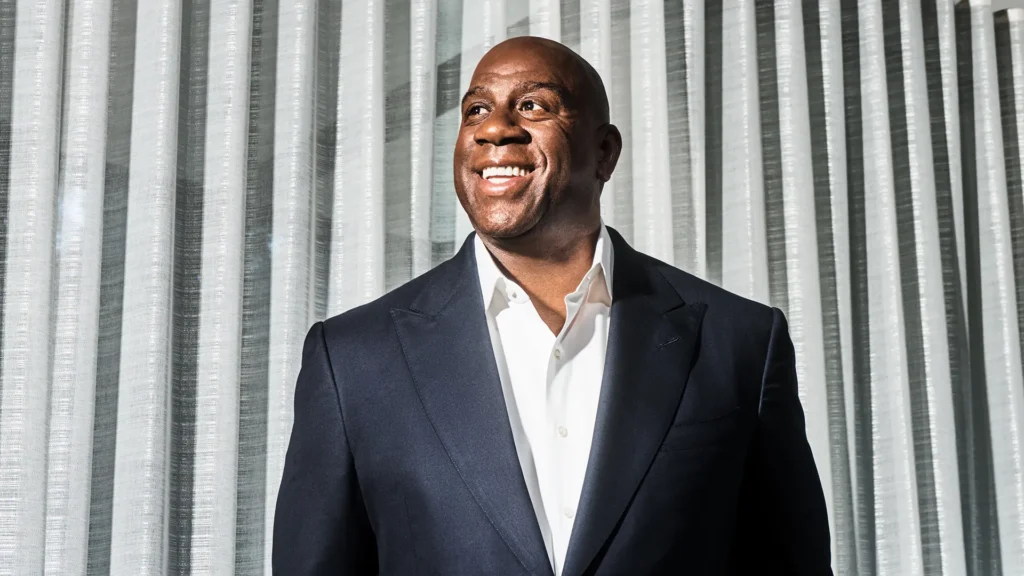
Earvin “Magic” Johnson, born August 14, 1959, in Lansing, Michigan, is a five-time NBA champion, three-time MVP, and widely regarded as the greatest point guard in basketball history. Drafted first overall by the Los Angeles Lakers in 1979, Johnson led the “Showtime” Lakers through the 1980s before retiring in 1991 after announcing his HIV diagnosis, with brief comebacks in 1992 and 1996. Unlike nearly every athlete in this series, Johnson’s fortune is overwhelmingly a post-playing-career story. His NBA salary was modest even by the standards of his own era, and the wealth that followed was built almost entirely through Magic Johnson Enterprises, the investment company he founded in 1987 that has owned pieces of Starbucks, the Lakers, the Dodgers, the Washington Commanders, and, most significantly, a controlling stake in a multibillion-dollar insurance company most fans have never heard of. He is based in Beverly Hills, California.
1. NBA Career Earnings (1979-1996)
Johnson’s NBA playing career earnings were unusually structured for a player of his stature. He signed a landmark 25-year, $25M contract extension in 1981, the first of its kind in professional sports, paying him $1M annually through 2009 regardless of when he stopped playing. Combined with his standard playing salary across 13 active seasons, his total on-court earnings are documented at approximately $40M, all of it fully paid out by the time the annuity concluded in 2009.
NBA career earnings: $40M gross.
2. Representation and Tax
Johnson’s NBA-era agent fees are estimated at a standard 5% of playing income for the period. As a California resident throughout his playing career, his effective tax rate, blending the state’s high marginal rate with federal tax, runs close to 45%.
- Representation (5% x $40M): -$2M
- Tax (~45% blended, California resident): -$17.1M
Net NBA earnings: $20.9M.
3. The Lakers Stake
In 1994, Lakers owner Jerry Buss sold Johnson a stake in the team for $10M. Johnson held the stake for 16 years, selling his interest to now-Lakers owner Patrick Soon-Shiong in October 2010. Forbes’ own reporting, drawn from direct interviews for its 2023 billionaire profile of Johnson, puts the sale price at $29M, a figure we use here over other unconfirmed estimates that have circulated as high as $60M.
- Sale price (2010, per Forbes): $29M
- Less: original purchase price (1994): -$10M
- Realized gain: $19M
- Tax on realized capital gain (~20%): -$3.8M
Lakers stake, gain net of tax: +$15.2M.
4. The Starbucks Partnership
In 1998, Johnson approached Starbucks CEO Howard Schultz with a proposal to bring the coffee chain into underserved urban neighborhoods, a pitch that became the Urban Coffee Opportunities partnership, a 50/50 joint venture between Johnson Development Corporation and Starbucks. The venture eventually grew to roughly 125 stores. In October 2010, Starbucks bought out Johnson’s remaining interest, and Forbes’ reporting puts his net profit from the exit at $75M, a figure independently confirmed by Fortune and CBS News. This is treated here as realized business proceeds rather than a capital gain on a fixed cost basis, since the venture was built through years of joint operating capital rather than a single upfront purchase.
- Realized profit (2010, per Forbes): $75M
- Tax on realized gain (~20%): -$15M
Starbucks partnership, net of tax: +$60M.
5. Real Estate
Johnson’s Bel-Air estate, his home from 1981 through 1990, was purchased for $600K the year after his first NBA championship and sold for $2M, a fully realized, documented transaction.
- Sale price: $2M
- Less: original purchase price: -$600K
- Realized gain: $1.4M
- Tax on realized capital gain (~20%): -$280K
Bel-Air estate, gain net of tax: +$1.12M.
Johnson’s current residences, a Beverly Park estate in Beverly Hills and a Tuscan-style beach house in Dana Point, do not carry publicly disclosed purchase prices alongside a documented current value, so neither is counted in the waterfall below.
6. Sports Franchise Stakes
Johnson joined the Guggenheim-led ownership group that purchased the Los Angeles Dodgers in 2012, personally investing $50M for a 2.3% stake, which he has described as the largest check he had ever written. Forbes currently values the Dodgers at $4.8B, putting the current value of his stake at approximately $110.4M, a figure that closely matches Forbes’ own independent estimate of roughly $110M for the same stake.
- Current stake value: $110.4M
- Less: original investment (2012): -$50M
Dodgers stake, gain over cost basis: +$60.4M.
In 2023, Johnson joined Josh Harris’s ownership group for the Washington Commanders, investing $242M for a 4% stake in the then-record $6.05B sale. Forbes’ most recent valuation puts the Commanders at $7.6B, putting the current value of his stake at approximately $304M.
- Current stake value: $304M
- Less: original investment (2023): -$242M
Commanders stake, gain over cost basis: +$62M.
Johnson also holds minority stakes in the WNBA’s Los Angeles Sparks and MLS’s Los Angeles FC, both acquired in 2014, and in esports through aXiomatic’s ownership of Team Liquid. None of these carry a disclosed investment amount or ownership percentage specific to Johnson, so none are counted here, despite being real and reported positions.
7. Business Equity
The largest piece of Johnson’s fortune is his 60% controlling stake in EquiTrust Life Insurance, acquired in 2015 for an undisclosed amount from Guggenheim Partners. That purchase was funded in part by the sale of Simply Healthcare, a Florida Medicaid plan Johnson had taken a stake in back in 2012; when Simply Healthcare sold to Anthem for $1B in 2015, Johnson used the proceeds to help finance the EquiTrust deal. His specific ownership percentage in Simply Healthcare, and therefore his exact proceeds from that sale, were not disclosed, so no standalone figure for that transaction is used here.
No purchase price for the EquiTrust stake was ever disclosed, so unlike the Dodgers or Commanders stakes, we cannot calculate a gain over cost basis. Instead, we build a current valuation from EquiTrust’s actual statutory financials. Independent insurance rating agency Weiss Ratings reports EquiTrust’s most recent filing (November 2025) at $33.58B in total assets, $2.76B in statutory capital, and $192.88M in net income, with Weiss citing “excellent profitability” and strong capitalization. Life and annuity insurers with that profile typically trade in private transactions at 0.85x to 1.0x book value, or roughly 10x to 13x earnings; both methods converge on a total company value in the $2.3B to $2.7B range. We use a moderate estimate of $2.5B for the full company.
- Total company value (moderate estimate, per statutory financials): $2.5B
- Johnson’s ownership stake: 60%
EquiTrust stake, estimated current value: +$1.5B.
Johnson also holds a 51% controlling interest in SodexoMAGIC, a food services joint venture with Sodexo, and leads investments through JLC Infrastructure, which has backed public projects including the LaGuardia and Denver International Airport redevelopments. He previously built and sold Magic Johnson Theatres and a chain of 24-Hour Fitness health clubs, and sold the healthcare company Simply Healthcare to Anthem for a reported 16 times his original investment, though the absolute dollar figures involved were not disclosed. None of these carry a specific, disclosed valuation tied to Johnson’s ownership stake, so none are counted in the waterfall, despite representing real and substantial additional wealth.
8. Lifestyle Burn
Johnson’s spending has scaled with his fortune across a 47-year adult and public life, from a relatively modest NBA-era budget through decades of building a business empire to his current standing among the wealthiest former athletes in the world. He is also a significant, long-documented philanthropist through the Magic Johnson Foundation, which he founded in 1991 to fund HIV/AIDS education and community health initiatives, among other causes. Building across three career phases:
- Playing career and early business building (1979-1994, 15 years): ~$1M/yr = $15M
- Business expansion era (1994-2015, 21 years): ~$3M/yr = $63M
- Mogul era (2015-2026, 11 years): ~$6M/yr = $66M
Total lifestyle burn: ~$144M.
Net Worth Waterfall
| Line Item | Amount |
|---|---|
| NBA career earnings (1979-1996, fully paid) | +$40M |
| Less: representation (5%) | -$2M |
| Less: tax (~45%, California) | -$17.1M |
| Net NBA earnings | $20.9M |
| Lakers stake (gain, net of tax) | +$15.2M |
| Starbucks partnership (net of tax) | +$60M |
| Bel-Air estate (gain, net of tax) | +$1.12M |
| Dodgers stake (gain over cost basis) | +$60.4M |
| Commanders stake (gain over cost basis) | +$62M |
| EquiTrust stake (60% of $2.5B estimated company value) | +$1,500M |
| Less: lifestyle burn (47-year career, consumed only) | -$144M |
| Raw Total | $1,575.6M |
| Total Net Worth (rounded) | $1.6B |
Why Our Figure Differs From Consensus
Consensus figures for Johnson, including Forbes’ own billionaire designation, place him between $1.2B and $1.6B. Our build, based on Johnson’s documented realized transactions plus a fundamentals-based valuation of his EquiTrust stake using the company’s actual statutory financials, lands at $1.6B, right at the top of that range. That convergence is a useful check: rather than borrowing a net worth figure from another outlet, we independently arrived at a similar number by valuing EquiTrust the way an insurance analyst would, off its real capital and earnings, which suggests the widely cited $800M-to-$1B range some outlets use for Johnson’s stake specifically may understate it. We still exclude several real, reported ventures, including his LAFC and Sparks stakes, his SodexoMAGIC interest, his JLC Infrastructure carry, and his undisclosed proceeds from the Simply Healthcare sale, because none carry a disclosed valuation specific to his ownership position. Including any of them would push our figure higher still.
The Second Act
Magic Johnson’s basketball career made him a legend, but it made him, by his own account, only about $40M. Everything else, the Starbucks stores in neighborhoods other chains ignored, the Dodgers and Commanders stakes, and above all a controlling interest in an insurance company with $2.76B in statutory capital, was built after the game stopped. It is a rare example of an athlete’s post-career business acumen dwarfing the on-court earnings that made him famous in the first place, and it is still growing. Whatever the exact number, Johnson’s fortune stands as one of the clearest arguments in sports history for what a great point guard can do once he stops looking for the open man and starts looking for the open market.eginning.