$60 Million
WHO HE IS
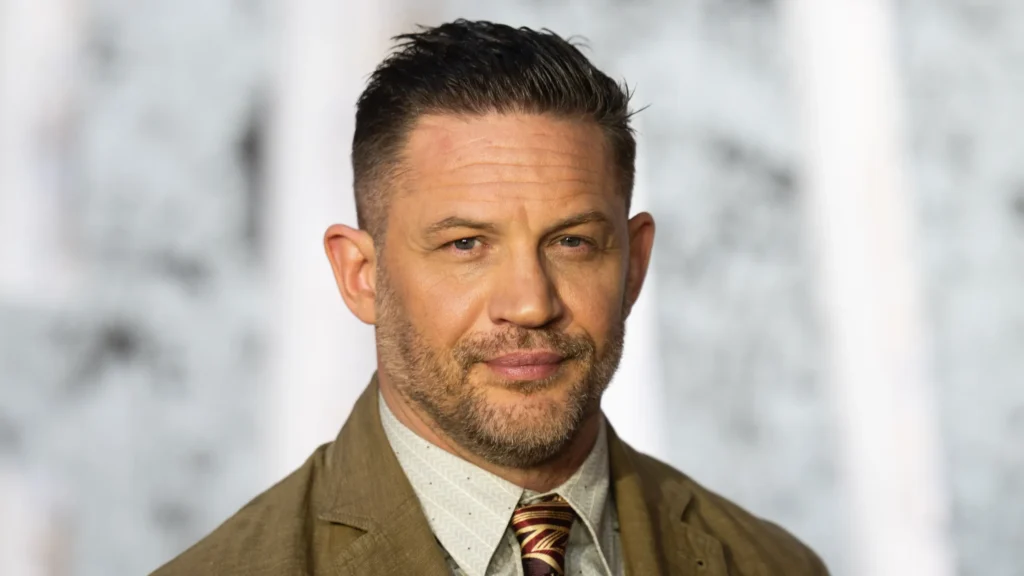
Born September 15, 1977, in Hammersmith, London, Edward Thomas Hardy trained at the Drama Centre London, built his early reputation through British television and independent film, and spent the first years of his professional life working through what he has described as a serious problem with drink and drugs. That he emerged from his twenties as not just a working actor but one of the most physically committed performers of his generation is, by any honest account, a harder story than his filmography suggests. International breakthrough came with Bronson in 2009, followed by Inception, The Dark Knight Rises, Locke, Mad Max: Fury Road, The Revenant (for which he received an Academy Award nomination for Best Supporting Actor), Dunkirk, and a Venom franchise that collectively grossed over $1.4 billion across three films. He co-created Taboo with Steven Knight and his father Edward ‘Chips’ Hardy for the BBC and FX, and in 2025 starred in both Havoc (Netflix) and MobLand (Paramount+, with Pierce Brosnan and Helen Mirren), the latter earning him a spot on Forbes’ list of the world’s highest-paid actors for 2025 at approximately $21 million for the year. He co-founded the production company Hardy Son & Baker in 2012 with partner Dean Baker, a first-look deal with NBCUniversal International giving it commercial reach. He was awarded a CBE in 2018. Hardy is deeply private and his financial life is accordingly difficult to document in detail; what is clear is that his balance sheet is defined almost entirely by acting fees, that the United Kingdom is his primary tax jurisdiction, and that UK law substantially limits his ability to reduce that burden compared to a California-based peer.
1. CAREER ACTING EARNINGS
Hardy has been a working professional actor for more than two decades, with earnings accelerating significantly through the Venom franchise and continuing to rise through his recent television work.
Representative film and television paydays:
- Early television and building-period credits (2001 to 2008), including Band of Brothers (HBO): approximately $3M combined
- Bronson (2009): approximately $300K (British independent)
- Inception (2010): approximately $2M
- The Dark Knight Rises (2012): approximately £2.5M ($3M); a confirmed figure from multiple sources — he was playing the villain, not the lead
- Locke (2013): approximately $1M (virtually a one-man film)
- Legend (2015): approximately $5M (dual role as the Kray twins, significant British studio film)
- The Drop (2014): approximately $3M
- Mad Max: Fury Road (2015): approximately $7M
- The Revenant (2015): approximately $4M (significant supporting role)
- Taboo (BBC/FX, 2017): co-created and starred; total package including producing approximately $5M
- Dunkirk (2017): approximately $3M
- Peaky Blinders (recurring, across series 1–6): approximately $5M total
- Tenet (2020): approximately $4M (Christopher Nolan ensemble)
- Venom (2018): $7M base; backend participation on $856M gross; total estimated at $10M
- Venom: Let There Be Carnage (2021): $17M (confirmed)
- Venom: The Last Dance (2024): $20M (confirmed; career high at the time of filming)
- The Dirty War (Netflix, 2023): approximately $5M
- Havoc (Netflix, 2025): approximately $8M
- MobLand (Paramount+, 2025): approximately $15M (the primary driver of his $21M Forbes year)
Additional television and film work across the period: approximately $8M
Total lifetime acting earnings: approximately $148M
2. HARDY SON & BAKER AND ENDORSEMENTS
Hardy Son & Baker, co-founded in 2012 with partner Dean Baker, holds a first-look deal with NBCUniversal International and has served as producing entity on projects including Great Expectations and A Christmas Carol. It generates producer fee income rather than equity of the kind that drives large balance-sheet exits.
Endorsements include a documented deal with Hyundai Card and periodic brand partnerships aligned with his profile.
Total producing and endorsement income: approximately $15M
3. REPRESENTATION
UK actors working primarily in the British system typically use a lighter representation structure than their American counterparts, though Hardy’s US franchise work introduced American agency layers. We model a blended rate of 12 percent.
Representation at approximately 12 percent: approximately minus $19M
4. TAX
Hardy has been UK-resident for his entire career. The combined rate on high earners in the United Kingdom runs approximately 47 percent. A note that applies directly to his balance sheet: unlike California-based US actors who can meaningfully reduce the effective rate through loan-out company structures, UK actors face considerably tighter constraints. HMRC’s IR35 rules, aggressively enforced in the entertainment industry since 2017, prevent personal service companies from being used to convert employment income into more favorably taxed corporate income. The 47 percent rate is therefore the honest effective figure for Hardy, without the mitigation available to a peer based in Los Angeles.
Tax at approximately 47 percent: approximately minus $66M
REAL ESTATE
Hardy purchased a property in Richmond, London for approximately £2M in 2013, currently valued in the region of £3.5M. Additional UK property not fully documented.
Estimated net real estate appreciation: approximately plus $7M
5. LIFESTYLE AND EXPENSES
Consumed spending only. Hardy is consistently described as one of the more personally modest celebrities at his standing. He does not maintain a documented car fleet, yacht, or multiple trophy properties. He has been married twice and has children from multiple relationships. His lifestyle burn is real but notably lower than peers at comparable fame levels.
- Building years (1998 to 2010, 12 years): London-based working actor, recovery period; approximately $150K per year; $1.8M
- Rising years (2011 to 2017, 7 years): UK country home running costs (~$100K), staff including childcare ($150K), travel ($200K), food and entertainment ($150K), clothing ($80K), vehicle depreciation ($30K); approximately $710K per year; $5M
- Peak years (2018 to 2026, 8 years): Venom franchise and major TV star; security becomes relevant; property running costs $150K, security and staff $350K, travel $250K, food and entertainment $200K, clothing $100K, vehicle depreciation $40K; approximately $1.09M per year; $8.7M
Total lifetime lifestyle burn: approximately $15M
RICHPEEK ESTIMATE: $60 Million
| Calculation | Amount |
|---|---|
| Lifetime acting earnings | ~$148M |
| Producing (Hardy Son & Baker) and endorsements | ~$15M |
| Total gross earnings | ~$163M |
| Minus representation (~12% blended) | -$19M |
| Minus tax (~47%, UK, IR35 limits loan-out mitigation) | -$68M |
| Minus lifestyle burn (consumed only: staff, travel, running costs) | -$15M |
| Available to accumulate | ~$61M |
| Plus real estate appreciation | +$7M |
| Plus wealth management | $0 (None reported) |
| Total Net Worth | ~$60M |
We land at $60 million, above the $45–55M range from most aggregators and well above Celebrity Net Worth’s outdated figure. The primary reason we land higher: his recent television work has been significantly more lucrative than older estimates account for, with Venom 3 confirmed at $20M and MobLand generating the bulk of a $21M Forbes year in 2025. The UK’s 47 percent effective rate on high earners, compounded by IR35 rules that prevent the loan-out mitigation available to his US-based peers, is the dominant structural factor limiting what he retains from that gross.
The defining comparison on Hardy’s balance sheet is between his Venom trilogy ($44M in confirmed salaries across three films) and what a US-based actor at equivalent franchise scale might retain from the same gross. A California-based actor using a loan-out structure retains roughly 58 cents on every post-representation dollar. Hardy retains roughly 53 cents, because UK law closes the gap his American counterparts use most effectively. The difference across his full career accounts for approximately $13M of wealth that the same earnings, structured differently, would have preserved. He has earned it; the jurisdiction has simply taken a larger share.