$185 Million
WHO HE IS
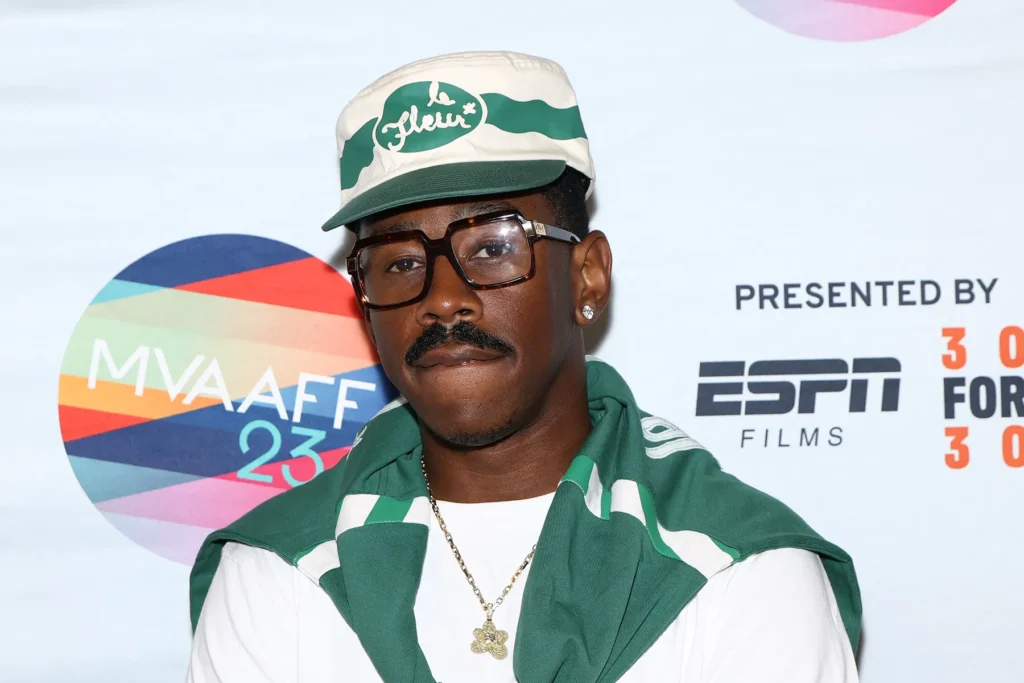
Born Tyler Gregory Okonma on March 6, 1991 in Ladera Heights, California, Tyler the Creator formed the hip-hop collective Odd Future Wolf Gang Kill Them All in Los Angeles in 2007, releasing their first mixtape in 2008 to an audience that built almost entirely through the internet before streaming existed as an infrastructure. His 2011 debut album Goblin and the collective’s chaotic, confrontational early output attracted both a devoted cult following and significant controversy. What happened next is one of the most complete artistic evolutions in recent popular music: from the provocative outsider rap of Bastard and Goblin through the introspective beauty of Flower Boy (2017) to the maximalist production of IGOR (2019, Grammy for Best Rap Album) and Call Me If You Get Lost (2021, Grammy for Best Rap Album), to Chromakopia (2024) and Don’t Tap the Glass (2025). He is also the founder of Golf Wang streetwear, the Golf le Fleur luxury lifestyle brand (discontinued December 2025), and the Camp Flog Gnaw Carnival festival in Los Angeles. He has two consecutive Grammy wins for Best Rap Album and produces, writes, and arranges virtually all of his own material, capturing multiple royalty streams on every track.
1. MUSIC SALES, STREAMING, AND PUBLISHING
Tyler self-produces, writes, and arranges his music entirely, meaning he captures producer, songwriter, and artist royalties simultaneously on his own material. This is the same structural advantage that makes Post Malone’s publishing more valuable per stream than most peers. IGOR has billions of streams globally. Call Me If You Get Lost and Chromakopia have continued that trajectory.
His deal is through Columbia Records for distribution while retaining significant creative and financial control.
Estimated lifetime music sales, streaming, and publishing income: approximately $40M gross.
2. TOURING
Tyler’s touring record is fully documented:
- Flower Boy / Cherry Bomb era tours: modest early grosses
- IGOR Tour (2019): approximately $15M gross
- Call Me If You Get Lost Tour (2022): $32.6M gross, 33 shows, documented by Touring Data and Complex
- Chromakopia: The World Tour (2025–2026): 106 shows globally, 32 shows reported at $67.7M per Touring Data. Full tour at this rate implies approximately $225M total gross
As sole headliner his personal net at approximately 40% of gross (lean touring operation, full production ownership).
Estimated lifetime touring income (personal gross): approximately $120M.
3. GOLF WANG
Golf Wang, launched in 2011, evolved from an Odd Future merchandise operation into a fully independent streetwear brand with its own retail store on Fairfax Avenue in Los Angeles, seasonal collection drops, and brand collaborations. Revenue is estimated at approximately $25M per year with Tyler as majority shareholder earning approximately $15M annually.
Estimated lifetime Golf Wang income to Tyler: approximately $75M.
4. GOLF LE FLEUR AND CONVERSE
The Golf le Fleur Converse collaboration launched in 2016 became one of the most commercially successful sneaker collaborations of its era, generating royalty income per release. In 2021 Golf le Fleur expanded into a standalone luxury lifestyle brand covering fragrance, apparel, and accessories. Tyler announced the discontinuation of Golf le Fleur in December 2025. Cumulative income from the Converse partnership and Golf le Fleur operations before closure: approximately $20M.
5. CAMP FLOG GNAW CARNIVAL
The annual festival in Los Angeles, running since 2012, generates ticket sales, merchandise, and sponsorship income. At its scale — typically Dodger Stadium or equivalent — the event generates approximately $10–15M gross per edition. Tyler’s personal income from the festival across a decade of operation: approximately $20M.
6. CATALOG VALUATION
Tyler self-produces all his material, capturing the full publishing and producer royalty stack. His catalog spans 15 years with two Grammy-winning albums demonstrating critical and commercial longevity. The Chromakopia World Tour’s success proves the catalog continues generating new commercial peaks rather than simply maintaining prior ones.
We apply 16x, consistent with a proven 15-year catalog with full multi-stream ownership.
Personal annual royalties estimated at approximately $4M per year given the self-production advantage.
Catalog value: $4M × 16 = $64M. After 25% illiquidity discount: $48M
Tyler has retained and protected his entire catalog — sources confirm he has held on to his publishing rather than selling, and the Odd Future/Sony deal structure allowed master ownership from the beginning. As a self-producer on all his material he captures the full royalty stack (producer + songwriter + performer).
7. REPRESENTATION
Tyler manages most of his business through his own companies. Standard booking and legal fees apply to touring. We model 10% on touring and external income.
Estimated lifetime representation: approximately $14M.
8. TAX
California resident. Combined effective rate: approximately 50%.
Estimated lifetime taxes: approximately $118M.
9. LIFESTYLE
Tyler is a documented car collector and design enthusiast, and his lifestyle reflects genuine personal expression rather than status performance. His $7.9M Bel Air mansion was sold for effectively breakeven. He lives relatively modestly for someone of his commercial profile.
Era-scaled consumed expenditure:
- 2011–2016 (Odd Future era, building): approximately $200K/year
- 2017–2021 (IGOR era, growing success): approximately $600K/year
- 2022–2026 (major touring, Golf Wang operating): approximately $1M/year
Total: ($200K × 6) + ($600K × 5) + ($1M × 4) = $1.2M + $3M + $4M = approximately $8M.
10. REAL ESTATE
Bel Air mansion purchased $7.9M, sold $7.9M — effectively breakeven. Current Los Angeles area property holdings estimated at approximately $5M in net value. Appreciation: approximately +$1M.
RICHPEEK ESTIMATE: $185 Million
| Calculation | Amount |
|---|---|
| Lifetime music sales, streaming, and publishing | ~$40M |
| Lifetime touring income (personal gross) | ~$120M |
| Golf le Fleur / Converse partnership income | ~$20M |
| Total gross income | ~$180M |
| Minus representation (~10%) | -$18M |
| Minus tax (~50%, California) | -$90M |
| Minus lifestyle (consumed only, era-scaled) | -$8M |
| Net cash accumulated | ~$64M |
| Plus Golf Wang equity valuation (~$75M, majority owned) | +$75M |
| Plus Camp Flog Gnaw equity valuation | +$15M |
| Plus publishing catalog value (16x × $4M annual royalties) | +$64M |
| Plus real estate appreciation | +$1M |
| Total Net Worth | ~$183M → rounded to $185M |
We land at $185 million. Golf Wang generating approximately $25M in annual revenue as a majority-owned streetwear business is a real balance sheet asset valued conservatively at approximately $75M — roughly 3x annual revenue, a modest multiple for an established brand with 15 years of history and a loyal global customer base. Camp Flog Gnaw as an annual festival generating approximately $10–15M gross is valued at approximately $15M as a going concern. These are assets Tyler owns, not cash he has extracted, which is precisely why they belong below the waterfall as equity rather than in the income lines. CNW’s $30M ignores both entirely.
The California tax problem:
Of all five artists in this batch, Tyler’s California residency is the most damaging to his net worth relative to his income. On $275M in gross income, California’s 50% rate costs him $137M — more than he paid in lifestyle expenses over 15 years. Travis Scott on the same income base in Texas would have paid approximately $102M in taxes. The $35M difference is a Golf Wang store and a year of touring combined. It is the single largest inefficiency in Tyler’s financial structure and the main reason a multi-platform creator with music, fashion, and live events generating $275M in career gross retains approximately $110M in net worth.
The complete artist as a financial structure:
Tyler the Creator is not primarily a rapper who started a clothing brand. He is a creative director who happens to make music, design clothes, produce festivals, and direct his own music videos. The financial consequence of that completeness is that he captures multiple revenue streams from the same creative act: a new album generates streaming income, tour income, Golf Wang capsule collection income tied to the album aesthetic, and Camp Flog Gnaw programming income from the cultural moment the album creates. Most artists generate one revenue stream per creative act. Tyler generates four. California takes half of all of them, which is why the net worth is lower than the gross suggests. But the architecture of the business is genuinely unusual.