$90 Million
WHO HE IS
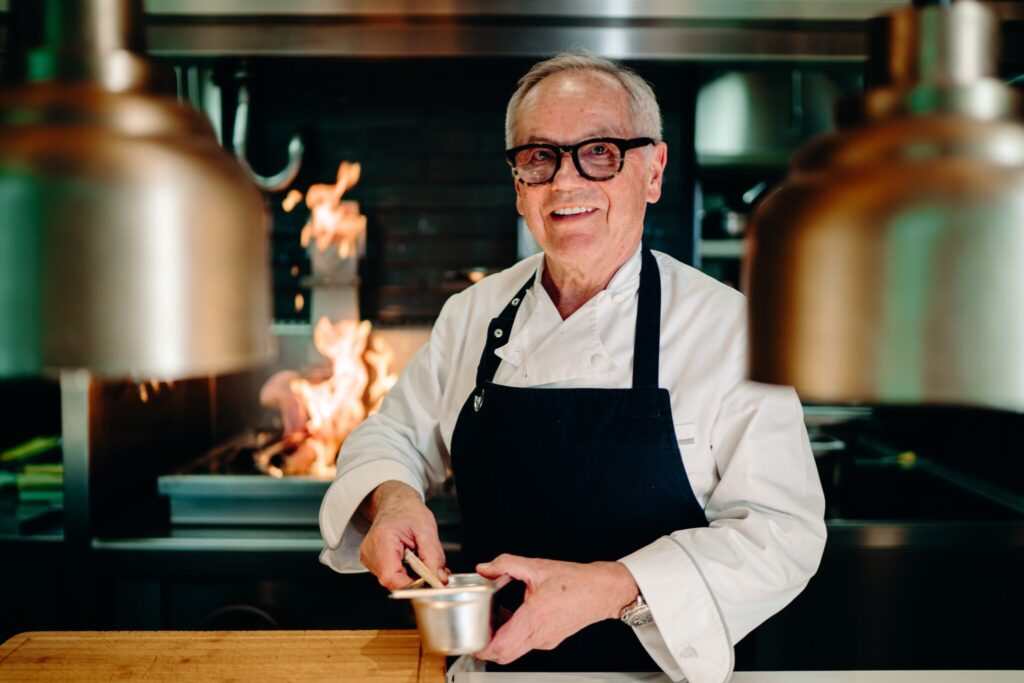
Wolfgang Johannes Puck, born Wolfgang Topfschnig on July 8, 1949, in Sankt Veit an der Glan, Austria, is an Austrian-American chef and restaurateur widely credited as a pioneer of California cuisine and the modern celebrity chef business model. Raised by a mother who worked as a professional chef, he began formal culinary apprenticeship at age 14 and trained in some of France’s top kitchens, including Maxim’s in Paris and L’Oustau de Baumanière in Provence, before immigrating to the United States in 1973. He became executive chef at the influential Los Angeles restaurant Ma Maison in 1975, and in 1982 opened his flagship restaurant, Spago, in West Hollywood, popularizing dishes like smoked salmon pizza and helping define the fusion of French technique with fresh California ingredients. Spago relocated to Beverly Hills in 1997, where it remains a celebrity fixture. He opened the Asian fusion restaurant Chinois on Main in Santa Monica in 1983, and has since built Wolfgang Puck Companies into three divisions: Wolfgang Puck Fine Dining Group, which operates more than 23 restaurants worldwide including CUT steakhouses and the newly opened Spago Shanghai; Wolfgang Puck Catering, established in 1998 and the official caterer of the Academy Awards Governors Ball for over 30 consecutive years; and Wolfgang Puck Worldwide, Inc., which licenses his name across frozen foods, cookware sold through HSN, and, since 2008, a soup and broth partnership with Campbell’s. He has published seven cookbooks and made numerous television and film appearances, including guest spots on Frasier, Iron Chef America, and Top Chef. He has been married three times and lives in Los Angeles with his wife, Gelila Assefa Puck.
1. Restaurant Ownership Distributions (1982-2026)
Puck’s fine dining group has grown from a single West Hollywood restaurant in 1982 to more than 23 locations worldwide, including Spago, Chinois on Main, and the CUT steakhouse brand, which holds four Michelin stars across its locations. Historically, these restaurants were structured as individual partnerships with his former business partner Barbara Lazaroff and outside investors rather than wholly owned by Puck alone; 1998 filings show Puck and Lazaroff held a 30% stake in the broader Wolfgang Puck Food Company. As an active owner-chef for 44 years holding a meaningful but partial stake, his distributions would have scaled with the group’s growth across distinct eras.
- Early growth, Spago and Chinois on Main established (1982-1990): ~$300K/yr = $2.4M
- Expansion era, Spago’s move to Beverly Hills, Wolfgang Puck Express airport rollout (1990-2005): ~$1.5M/yr = $22.5M
- Global expansion era, CUT steakhouse brand, continued international growth through Spago Shanghai’s 2025 opening (2005-2026): ~$3M/yr = $63M
Restaurant ownership distributions: $87.9M gross.
2. Wolfgang Puck Catering and Events (1998-2026)
Established in 1998, Wolfgang Puck Catering has become, per independent sourcing, a cornerstone of the broader Wolfgang Puck Companies portfolio, serving as the exclusive caterer of the Academy Awards Governors Ball for more than 30 consecutive years, alongside a wide range of other high-profile private and corporate events.
- Catering and events income (1998-2026, 28 years): ~$1.5M/yr = $42M
Catering and events: $42M gross.
3. Wolfgang Puck Worldwide Licensing (1985-2026)
Puck’s consumer products licensing division dates back to a frozen desserts line in 1985 and frozen pizzas in 1987, expanded into cookware sold through HSN starting in 1998 (more than 10 million units sold since), and added a soup and broth licensing agreement with Campbell’s in 2008 after Campbell’s separately acquired the underlying Wolfgang Puck soup manufacturing business, which had approximately $22M in annual sales at the time, from Country Gourmet Foods. Puck has consistently operated as licensor across these categories rather than as an equity owner of the manufacturing entities involved.
- Early frozen foods era (1985-1998): ~$500K/yr = $6.5M
- HSN cookware and Wolfgang Puck Express franchise royalty era (1998-2008): ~$1M/yr = $10M
- Campbell’s soup and broth licensing alongside continued cookware and franchise royalties (2008-2026): ~$2M/yr = $36M
Wolfgang Puck Worldwide licensing: $52.5M gross.
4. Cookbook Royalties (1981-2026)
Puck has published seven cookbooks since his 1981 debut, a notably smaller output than some other chefs in this database, reflecting his primary focus on restaurants, catering, and licensing rather than publishing.
- Cookbook royalties (1981-2026, 45 years): ~$200K/yr = $9M
Cookbook royalties: $9M gross.
5. Television and Media Appearances (1990-2026)
Puck has made numerous television and film appearances over his career, including guest spots on Tales from the Crypt, Frasier, Iron Chef America, Top Chef, and his own early-2000s Food Network series, alongside a 2021 documentary about his life and career. This is a secondary income stream relative to his restaurant, catering, and licensing businesses.
- Television and media appearance income (1990-2026, 36 years): ~$150K/yr = $5.4M
Television and media appearances: $5.4M gross.
6. Representation
Standard entertainment representation applies to Puck’s licensing, publishing, and television income. Restaurant and catering distributions are not run through standard talent representation.
- Representation on licensing income (10% x $52.5M): -$5.25M
- Representation on cookbook royalties (10% x $9M): -$0.9M
- Representation on television and media appearances (10% x $5.4M): -$0.54M
Total representation: -$6.69M.
7. Tax
Puck has been a California resident for most of his career, one of the highest state income tax jurisdictions in the country. We use approximately 48% effective.
- Tax on all income net of representation (48% x $190.11M): -$91.25M
Total tax: -$91.25M.
8. Lifestyle Burn
Puck has been married three times and has maintained a high-end Los Angeles lifestyle across multiple decades and properties.
- Early to mid-career (1982-2000, 18 years): ~$300K/yr = $5.4M
- Established wealth era, including the 2003 Beverly Hills home purchase (2000-2013, 13 years): ~$700K/yr = $9.1M
- Peak luxury era, following the 2013 Villa Les Violettes purchase (2013-2026, 13 years): ~$1.2M/yr = $15.6M
Total lifestyle burn: ~$30.1M.
9. Real Estate
Puck purchased a Beverly Hills home for $3.675M in 2003 and listed it for sale at $8.495M in 2015, though no source confirms the property actually sold or at what final price. In 2013, he and his wife paid $14M for Villa Les Violettes, a 12,289-square-foot Bel Air estate, which they continue to own. Because the Beverly Hills listing was never confirmed as a completed sale, and the Bel Air property has not been resold, no realized real estate gain is counted here.
Real estate: $0 counted (documented, unrealized).
10. Business Equity
Beyond the distributions already counted, Wolfgang Puck Companies, spanning the Fine Dining Group, Catering and Events, and Worldwide licensing divisions, represents a going-concern asset of unusual scale and diversification relative to most other chef-owned companies on this site, built over more than four decades with a Fortune 500 licensing partner in Campbell’s.
- Wolfgang Puck Companies, estimated standing value: +$20M
Business equity: +$20M.
11. Wealth Management
No independently documented wealth management program has been found for Puck beyond the business interests already priced above.
Wealth Management: None reported ($0).
Net Worth Waterfall
| Line Item | Amount |
|---|---|
| Restaurant ownership distributions (1982-2026) | +$87.9M |
| Wolfgang Puck Catering and Events (1998-2026) | +$42M |
| Wolfgang Puck Worldwide licensing (1985-2026) | +$52.5M |
| Cookbook royalties (1981-2026) | +$9M |
| Television and media appearances (1990-2026) | +$5.4M |
| Less: representation | -$6.69M |
| Less: tax | -$91.25M |
| Less: lifestyle burn (era-scaled, consumed only) | -$30.1M |
| Real estate | $0 |
| Wolfgang Puck Companies business equity (estimated) | +$20M |
| Wealth Management | $0 |
| Raw Total | $88.76M |
| Total Net Worth (rounded) | $90M |
Why Our Figure Differs From Consensus
Our build lands at $90M, below the $120M figure widely cited by Celebrity Net Worth and repeated across most outlets. A meaningful part of the gap is deliberate: we hold his real estate at $0, since his 2015 Beverly Hills listing was never confirmed as a completed sale, a conservative choice most competitor figures do not appear to make explicit. We also treat Puck consistently as a licensor rather than an equity owner across his frozen food, cookware, and soup partnerships, mirroring how Campbell’s actually acquired the underlying soup manufacturing business from a separate company, Country Gourmet Foods, rather than from Puck directly. If the Beverly Hills sale is confirmed at or near its list price, or if Puck holds an equity stake in any of his licensing partners beyond a royalty arrangement, this number would move upward.
The Licensor Who Never Stopped Cooking
Wolfgang Puck’s fortune is unusual among celebrity chefs for how little of it rests on any single blockbuster deal or television contract. Instead, it is the accumulated result of more than four decades spent doing the same handful of things at increasing scale: opening one more restaurant, catering one more Oscars, licensing his name to one more product category, from frozen pizza in 1987 to a Fortune 500 soup partnership two decades later. He built the template that chefs like Emeril Lagasse and Guy Fieri would later scale into media empires, but Puck himself never fully left the kitchen for the screen. What he has instead is one of the oldest, most diversified operating businesses in this entire category, still adding restaurants in 2025 the same way he did in 1983.entually. But nobody will forget who did it for thirty years.