$330 Million
WHO HE IS
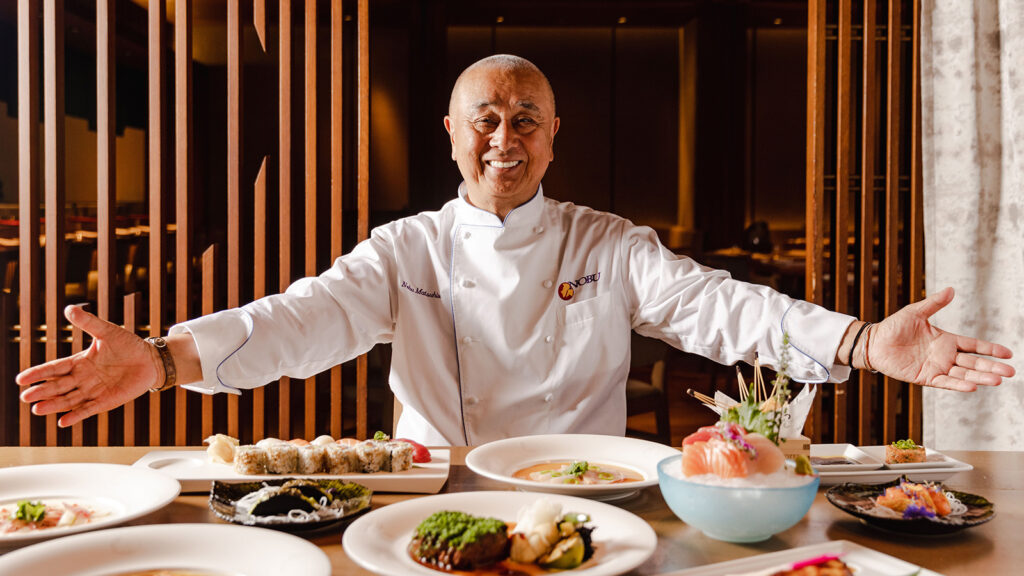
Nobuyuki “Nobu” Matsuhisa, born March 10, 1949, in Saitama, Japan, is the chef and restaurateur behind Nobu, one of the most recognized luxury dining and hospitality brands in the world. After training as a sushi chef in Tokyo, Matsuhisa moved to Lima, Peru, in 1973, where he developed his signature fusion of Japanese technique and Peruvian ingredients after struggling to source traditional Japanese ingredients locally. Following restaurant ventures in Peru, Argentina, and Alaska that each ended in closure or disaster, he settled in Los Angeles and opened his eponymous restaurant, Matsuhisa, in Beverly Hills in 1987. A regular customer named Robert De Niro became a friend and, in 1994, a business partner, and the two of them, alongside producer Meir Teper and restaurateur Drew Nieporent, opened the first Nobu-branded restaurant in New York’s Tribeca neighborhood. That partnership has since grown into Nobu Hospitality, a global company spanning more than 50 restaurants and roughly 20 hotels across five continents. Matsuhisa is married to Yoko Matsuhisa, with whom he has two daughters, and splits his time between the United States and Japan.
1. Nobu Hospitality Equity
The dominant driver of Matsuhisa’s fortune is his ownership stake in Nobu Hospitality, the parent company behind the global Nobu restaurant and hotel brand. In October 2015, Crown Resorts, then controlled by Australian billionaire James Packer, acquired a 20% stake in Nobu Hospitality for $100M, implying a company valuation of roughly $500M at that time. In July 2024, following Blackstone’s 2022 acquisition of Crown Resorts, that 20% stake was sold again, this time to a Blackstone-affiliated entity, in a transaction the Australian Financial Review reported as valuing the entire restaurant and hotel group at approximately $1.3B.
The remaining 80% of the company is held collectively by the three founding partners who retained majority control: Matsuhisa, Robert De Niro, and Meir Teper. Multiple sources describe the trio’s roles as complementary but roughly equally weighted, with Matsuhisa overseeing cuisine, De Niro handling brand and image, and Teper managing operations and real estate deals, and no source indicates a meaningfully unequal split among the three. Assuming a roughly even division of that collective 80% stake, each partner’s individual share would fall in the 20% to 30% range of the total company, depending on how precisely even the split actually is. We use 25% as a conservative point estimate within that range.
- Nobu Hospitality total valuation (July 2024, Blackstone transaction): $1.3B
- Matsuhisa’s estimated ownership share (conservative point estimate within a 20%-30% range): 25%
Nobu Hospitality equity, Matsuhisa’s estimated stake: $325M.
This figure reflects founder’s equity built through decades of direct contribution to the brand, not a stake purchased with previously earned income, so no cost basis is subtracted here.
2. Nobu Hospitality Owner Distributions
The equity figure above captures the current paper value of Matsuhisa’s stake, but as a working owner for over three decades, he would also have received a share of the company’s actual profits along the way, real cash distributions that funded his lifestyle and asset purchases long before the 2024 valuation event existed. Industry data from Technomic, cited by Forbes, puts Matsuhisa’s 21 U.S. restaurants alone at $190M in sales in 2023, and the global business, spanning roughly 56 restaurants and 20 hotels, is understood to generate substantially more when hotel revenue is included. Hospitality businesses at this scale typically distribute only a portion of profit to owners, especially during an active expansion phase, reinvesting the rest into new locations, consistent with the numerous Nobu hotels currently in development across multiple countries.
Building a conservative, era-scaled estimate of Matsuhisa’s 25% share of cumulative owner distributions, reflecting the company’s growth from a single New York restaurant in 1994 to its current global scale:
- Early growth era (1994-2005, 11 years): ~$0.5M/yr gross = $5.5M
- Restaurant expansion, first hotel launch (2005-2015, 10 years): ~$2M/yr gross = $20M
- Hotel expansion era, post-Crown investment (2015-2024, 9 years): ~$5M/yr gross = $45M
- Current, post-$1.3B valuation era (2024-2026, 2 years): ~$7M/yr gross = $14M
- Gross cumulative distributions (25% share): $84.5M
- Tax (~40% blended, US/international): -$33.8M
Net owner distributions: $50.7M.
3. Personal Earnings (Books, Appearances, Film)
Separate from his equity in Nobu Hospitality, Matsuhisa has earned modest additional personal income over his career through cookbooks (including “Nobu: The Cookbook,” “Nobu Now,” and a 2014 memoir), a James Beard Foundation Award-winning public profile that supports paid appearances and consulting, and brief film cameos in “Casino,” “Austin Powers in Goldmember,” and “Memoirs of a Geisha.” Proceeds from his World of Nobu culinary festival are explicitly directed to philanthropic causes rather than personal income, so they are not counted here.
- Cumulative career earnings (books, appearances, film cameos): ~$15M gross
- Representation (10%): -$1.5M
- Tax (~40% blended, US/Japan): -$5.4M
Net personal earnings: $8.1M.
4. Lifestyle Burn
Matsuhisa maintains a lower public profile than many of his celebrity-chef peers, with no documented car collection, yacht, or private jet turning up in public reporting. His clearest documented asset is a Bel-Air, Los Angeles mansion, purchased in 2013 for $15.625M, a 13,000-square-foot estate designed by architect Hugh Newell Jacobson. Building a lifestyle estimate across three career phases:
- Early career, restaurant-building years (1973-1994, 21 years): ~$0.3M/yr = $6.3M
- Nobu brand growth era (1994-2013, 19 years): ~$1M/yr = $19M
- Established wealth era, including Bel-Air purchase and upkeep (2013-2026, 13 years): ~$2M/yr = $26M
Total lifestyle burn: ~$51.3M.
5. Real Estate
Matsuhisa’s Bel-Air mansion, purchased in 2013 for $15.625M, does not carry a documented current value distinct from its purchase price in available reporting, so no real estate gain is counted here. He also holds unspecified property in Japan, with no purchase price or current value disclosed for that holding either.
Real estate: $0 counted (held, no documented gain over cost).
6. Other Business Interests
Matsuhisa also operates Matsuhisa Restaurants, a smaller, family-run restaurant group distinct from the Nobu-branded chain, and continues to be involved in the original Matsuhisa restaurant in Beverly Hills where his partnership with De Niro began. No separate valuation or revenue figures for this smaller restaurant group have been publicly disclosed, so no value is assigned to it here, despite it representing real, additional business activity beyond the Nobu Hospitality stake already counted above.
Matsuhisa Restaurants: $0 counted (documented, unvalued).
7. Wealth Management
No broadly disciplined public-markets portfolio or third-party wealth management mandate has been documented for Matsuhisa beyond the direct business and equity positions already discussed above.
Wealth Management: None reported ($0).
Net Worth Waterfall
| Line Item | Amount |
|---|---|
| Nobu Hospitality equity (25% estimated stake of $1.3B valuation) | +$325M |
| Nobu Hospitality owner distributions (25% share, cumulative, net of tax) | +$50.7M |
| Net personal earnings (books, appearances, film) | +$8.1M |
| Less: lifestyle burn (era-scaled, consumed only) | -$51.3M |
| Real estate | $0 |
| Matsuhisa Restaurants | $0 |
| Wealth Management | $0 |
| Raw Total | $332.5M |
| Total Net Worth (rounded) | $330M |
Why Our Figure Differs From Consensus
Consensus figures for Matsuhisa cluster tightly around $200M across Celebrity Net Worth and the outlets that cite it. Our build lands meaningfully higher, at $330M, and most of the gap comes down to two related questions consensus sources do not appear to address: how much is Matsuhisa’s personal stake in Nobu Hospitality actually worth, and how much cash has he actually drawn from the business as a working owner over three decades. On the first, we anchor to the real, arm’s-length valuation established when Crown Resorts sold its 20% stake to a Blackstone-affiliated buyer in 2024, a transaction that values the whole company at $1.3B. On the second, we build a conservative, era-scaled estimate of owner distributions rather than assuming his equity value alone tells the whole story, since a working co-founder of a hospitality group generating hundreds of millions in annual restaurant sales alone would reasonably have drawn real income from that business well before any external transaction priced the equity. The main sources of remaining uncertainty in our own figure are the exact split among the three founding partners and the actual historical distribution rate, neither of which has been publicly disclosed.
The Chef Who Kept His Seat at the Table
Nobu Matsuhisa’s path to a quarter-billion-dollar fortune ran through two restaurant fires, a failed partnership in Peru, and a decade of false starts before he ever opened the restaurant that made his name. What separates his story from many celebrity chefs who eventually cash out their brand to private equity is that he never fully did. Two different waves of outside investors have now paid real money for a fifth of his company, first Crown Resorts, then a Blackstone-affiliated buyer, and each time, Matsuhisa and his original partners held onto the rest. That decision to keep a majority stake in a business now independently valued at $1.3B, rather than selling down further, is the single biggest reason his fortune looks nothing like the modest, restaurant-profits-only chef exit that consensus estimates seem to assume.what was available, and what came out of that necessity became the foundational grammar of Japanese-Peruvian fusion, now one of the most replicated styles in global high dining. His restaurant burned down in Alaska. His first South American venture closed. He arrived in Los Angeles at 28 with no capital, no local reputation, and no famous friends. He became one of the wealthiest chefs in the world the same way he created his cuisine: by improvising brilliantly under constraint and then scaling what worked.