$475 Million
WHO HE IS
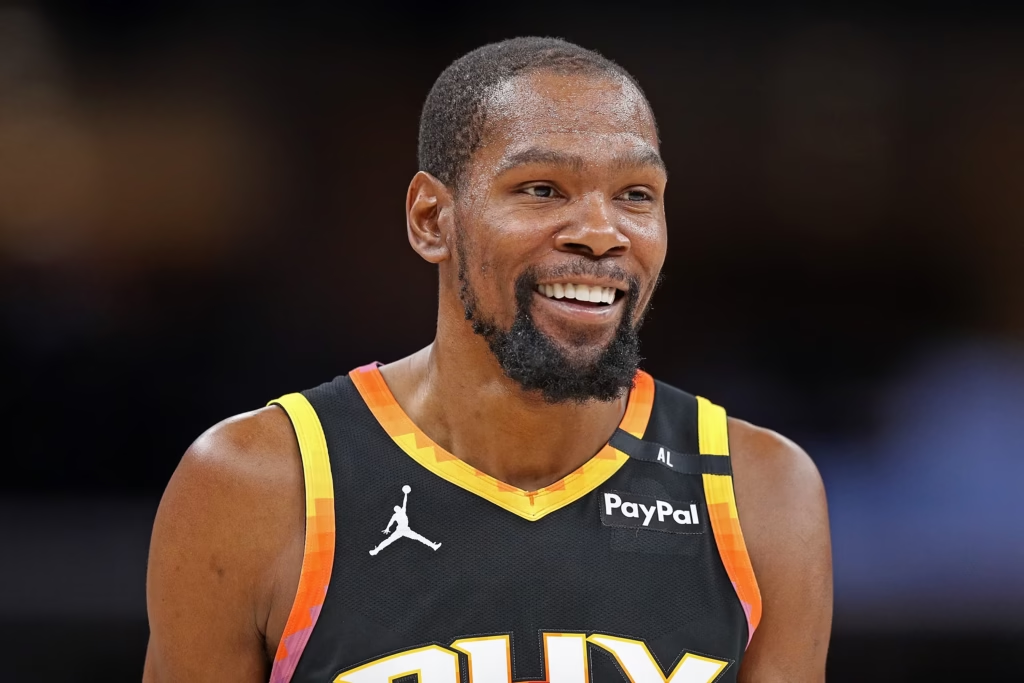
Kevin Wayne Durant, born September 29, 1988, in Washington, D.C., is one of the greatest scorers in NBA history: a four-time scoring champion, two-time NBA champion, two-time Finals MVP, and 2014 MVP across stints with the Seattle SuperSonics/Oklahoma City Thunder, Golden State Warriors, Brooklyn Nets, Phoenix Suns, and now the Houston Rockets, acquired via a record-setting seven-team trade in July 2025.
Off the court, Durant has built a genuinely unusual reputation among athletes: a legitimately active, hands-on venture investor rather than a passive face-for-hire. Through Thirty Five Ventures (35V), the firm he co-founded with longtime manager and business partner Rich Kleiman in 2016-17, Durant has made more than 100 startup investments spanning fintech, media, sports, and technology, with several genuine, documented wins, most famously an early Coinbase stake that returned over 50x at IPO. He also holds ownership positions in MLS’s Philadelphia Union, NWSL’s Gotham FC, Major League Pickleball’s Brooklyn Aces, and, since August 2024, a stake in Paris Saint-Germain that was restructured into a direct minority position with the club’s majority owner in June 2025.
1. NBA Career Salary (2007-2026)
Durant’s NBA salary is unusually well documented. HoopsHype’s tracked career earnings figure, updated as of May 2026, puts his total at $511,827,648 through the completed 2025-26 season. This is corroborated by Shams Charania’s October 2025 reporting that Durant’s career earnings including current and future contracted salary reached $598.2M after his new Houston extension, surpassing LeBron James for the NBA record; the roughly $86.4M difference between that figure and HoopsHype’s tally is consistent with the two remaining years (2026-27 and 2027-28) on his new deal, which have not been played yet. In October 2025, Durant signed a two-year, $90M extension with Houston covering those seasons (with a player option), but since the 2026-27 season has not yet begun as of this writing, none of that new money has been earned yet and it is excluded here.
NBA salary, earned through 2025-26 season: $511.8M gross.
2. Off-Court Income (2007-2026)
Durant signed his first major extended Nike deal in 2014, a reported 10-year, $250M agreement that beat back a competing offer from Under Armour, and in 2023 he became just the third athlete after Michael Jordan and LeBron James to sign a lifetime Nike contract, currently paying an estimated $26M annually. Sportico’s 2025-26 season earnings estimate puts his combined endorsement and business income (Nike, Boardroom, and other partners) at $50M for that year alone, roughly matching Stephen Curry’s off-court total and trailing only LeBron James among NBA players.
- 2007-2014 (early career, pre-mega Nike deal): ~$4M/yr = $28M
- 2014-2023 (the $250M/10-year Nike deal era, Warriors dynasty and Brooklyn years): ~$22M/yr = $198M
- 2023-2026 (lifetime Nike deal plus Boardroom and other current endorsements, matching the Sportico $50M/yr figure): ~$50M/yr = $150M
Off-court income (2007-2026): $376M gross.
3. Representation
Durant’s business affairs, both NBA contract negotiation and his broader off-court empire, are managed by Rich Kleiman, his longtime manager and 35V co-founder. We apply the standard capped 4% NBA agent rate to salary and a higher rate reflecting comprehensive management of his endorsement and business affairs to off-court income.
- NBA salary (4% of $511.8M): -$20.5M
- Off-court income (10% of $376M): -$37.6M
Total representation: -$58.1M. Post-representation gross: ~$829.7M.
4. Tax
Durant’s tax exposure is genuinely unusual for an NBA player given how many different state tax jurisdictions his career has spanned: Oklahoma (moderate state tax, 2007-2016), California (Golden State, among the highest state rates in the country, 2016-2019), New York (Brooklyn, also high, 2019-2023), Arizona (Phoenix, a flat and comparatively low rate, 2023-2025), and Texas (Houston, no state income tax at all, 2025-present). We apply a blended effective rate reflecting this genuinely diverse jurisdictional history rather than defaulting to a single state’s rate across his whole career.
Tax (43% effective): -$356.8M. Net after representation and tax: ~$472.9M.
5. Lifestyle Burn
Durant is frequently and specifically described, including by his own public persona, as living a relatively modest lifestyle for a player of his earnings level: no widely reported supercar collection, no messy public spending controversies, and a well-documented focus on family (his mother, Wanda) and basketball over conspicuous consumption. We apply a lifestyle burn below typical superstar benchmarks to reflect this well-sourced pattern.
- 2007-2014 (early career): ~$1.5M/yr = $10.5M
- 2014-2020 (established star, Warriors championship years): ~$3M/yr = $18M
- 2020-2026 (peak wealth, business empire, Hidden Hills compound): ~$4M/yr = $24M
Total lifestyle burn: ~$52.5M. Available to accumulate: ~$420.4M.
6. Investment Portfolio: The Real Story
This is where Durant’s financial profile genuinely diverges from most athletes, and it holds up to scrutiny better than most celebrity investment narratives. Consistent with our standard treatment of investments, we credit only the gain above what he actually paid in, not the full current value, since the original capital invested already came from his earned income and is already reflected in his accumulated cash above. Crediting full current value would double-count that principal.
Postmates (realized). Durant invested roughly $1M in the food-delivery startup in 2016 in exchange for promotional endorsement. Uber acquired Postmates in December 2020 for $2.65 billion, and Durant’s stake was valued at $15M at close, a genuine $14M gain. After capital gains tax (~23%), this nets to approximately $10.8M realized.
Coinbase (held). Thirty Five Ventures invested a reported $250,000 in Coinbase’s 2017 Series D round at a $1.6 billion company valuation. At Coinbase’s April 2021 direct listing, that stake was valued at approximately $13.5M, with shares trading around $328-$381 that day. Coinbase’s stock has since been genuinely volatile: it peaked near $444 in July 2025 but has fallen substantially since, trading around $163 as of this writing, roughly 50% below its 2021 listing-day price. If Durant’s position has tracked that decline, its current value is closer to $7M than the 2021 peak. Netting out the $250,000 original investment leaves a gain of approximately $6.75M.
Philadelphia Union (held). Durant purchased a 5% stake in the MLS club in 2020, when the team was valued at “more than $325 million” according to majority owner Jay Sugarman, implying an approximate $16.25M cost basis for his stake. MLS franchise values have risen league-wide since (Sportico’s 2026 valuations put the league average at $767M), though Philadelphia Union sits below the top tier of the league. Applying a conservative updated club valuation of roughly $500M, his 5% stake is worth approximately $25M today, a gain of $8.75M above his original cost.
Paris Saint-Germain (held). Durant’s PSG position is older than it might appear. He first invested in August 2024, shortly after the Paris Olympics, taking a reported “single-digit millions” shareholding through a vehicle tied to Arctos Sports Partners’ 12.5% stake in the club (acquired in December 2023 at a $4.3B-$4.6B valuation). In June 2025, he restructured into a direct minority stake with PSG’s majority owner, Qatar Sports Investments, described as roughly the same dollar size as his original investment. That means Durant has now held PSG-linked exposure for close to two years, spanning the club’s 2025 Champions League title, a period genuinely long enough for some appreciation, unlike a same-year investment. Using a conservative cost basis estimate of $5M (the low end of “single-digit millions”) against a club valuation that has likely grown from the $4.3B-4.6B range at his entry to somewhat higher post-Champions League, we credit a modest gain.
Overtime. Durant and fellow NBA star Carmelo Anthony participated in a $35M funding round for sports media startup Overtime, which has grown substantially in subsequent funding rounds. His specific check size and the fund’s current valuation multiple for that round are both undisclosed, so we apply a conservative gain estimate rather than crediting an assumed markup.
Broader 35V portfolio. Beyond the headline names, Thirty Five Ventures holds stakes in more than 80 companies across fintech, media, wellness, and technology, including Acorns, Whoop, Dapper Labs, Guild Education, Weedmaps, and fintech company Rec, alongside additional sports ownership and investment positions in NWSL’s Gotham FC, Major League Pickleball’s Brooklyn Aces, The Snow League, Athletes Unlimited, and TMRW Sports (the tech-driven golf league co-founded by Tiger Woods and Rory McIlroy). Without individual cost basis or current valuation data for this long tail of investments, we apply a conservative aggregate gain estimate rather than a precise-looking figure the underlying data doesn’t support.
Boardroom (media brand, built rather than bought). Unlike the positions above, Boardroom is a business Durant and Kleiman built from scratch rather than an equity stake purchased in someone else’s company. Consistent with how we treat other athlete-built businesses (such as Beckham’s DB Ventures or Ibrahimovic’s Padel Zenter), we credit its full estimated equity value rather than applying a cost-basis discount, since sweat equity and operational buildup aren’t a simple buy-low transaction with a clean purchase price to net out.
| Investment | Cost Basis | Current Value | Gain Credited |
|---|---|---|---|
| Postmates (realized, after CGT) | $1M | $15M | $10.8M |
| Coinbase (held) | $0.25M | ~$7M | $6.75M |
| Philadelphia Union (5% stake) | $16.25M | ~$25M | $8.75M |
| PSG (minority stake, held since Aug 2024) | ~$5M | Undisclosed | $3M |
| Overtime | Undisclosed | Undisclosed | $3M |
| Broader 35V portfolio (80+ companies) | Undisclosed | Undisclosed | $11M |
| Boardroom (built business, full equity credited) | – | – | $10M |
Investment portfolio total (gain-only, plus Boardroom equity): ~$53.3M.
7. Real Estate
Durant’s real estate history shows more churn than accumulation: a $12M+ Malibu home bought in 2018 and sold in 2019 for roughly the same price, an Oakland Hills property listed without a confirmed sale price, and his current Hidden Hills, California compound, purchased for $15.6M in July 2021. Given the relatively recent purchase date of his primary current property, we apply a modest, conservative appreciation estimate.
Real estate appreciation: ~$3M.
8. Wealth Management
Beyond the specific holdings itemized in the investment portfolio above, no separate wealth management mandate with disclosed returns was found in available sourcing.
Wealth Management: None reported beyond items captured above ($0).
Net Worth Waterfall
| Line Item | Amount |
|---|---|
| NBA salary, earned through 2025-26 season | +$511.8M |
| Off-court income (2007-2026) | +$376M |
| Less: representation (4% NBA / 10% off-court) | -$58.1M |
| Less: tax (43% effective) | -$356.8M |
| Less: lifestyle burn (era-scaled, below-typical for a superstar) | -$52.5M |
| Investment portfolio (gain-only, plus Boardroom equity) | +$53.3M |
| Real estate appreciation | +$3M |
| Wealth Management | $0 |
| Total Net Worth | ~$476.7M -> $475 Million |
Why Our Figure Differs From Consensus
Most published estimates for Durant cluster around $300M to $350M, below our figure, and the gap traces to a familiar pattern: those estimates generally rely on cumulative NBA salary figures that undercount his actual, well-documented career earnings. His NBA salary alone, tracked by HoopsHype at $511.8M through the completed 2025-26 season and independently corroborated by Shams Charania’s October 2025 reporting on his career-earnings record, already exceeds most published total net worth figures before any endorsement or investment income is added. The reputation Durant has built as a genuinely active, successful venture investor also checks out under scrutiny rather than collapsing into the usual celebrity-investor puffery: the Postmates exit and Coinbase stake are both real, well-documented, cashed or paper gains with specific dollar figures attached, not vague “invests in startups” framing. That said, our investment portfolio credits only the gain above what Durant actually paid in, not the full current value of each position, since the original capital came from his earned income and is already counted elsewhere. This is a meaningfully more conservative approach than simply listing “he owns 5% of a $500M team” as a $25M asset; the real contribution to his net worth from that position is the $8.75M he’s gained since buying in, not the full stake value. Applying this discipline across his newer, less-documented positions (PSG, Overtime) in particular keeps our investment total well below what a surface-level read of his portfolio might suggest.
The Athlete Who Actually Reads the Term Sheet
Plenty of athletes slap their name on a startup for a check and a photo op. Kevin Durant sat in Coinbase’s Series D in 2017, years before most of the country had heard of the company, wrote a check with his manager, and watched it turn into an eight-figure stake by the time the company went public at an $86 billion valuation. He did the same with Postmates before Uber came calling. It is a genuinely rare thing in professional sports: a player whose business reputation isn’t built on his name being attached to something, but on the actual numbers holding up when someone checks them. Durant has been traded five times, criticized for nearly as many team decisions, and is still, quietly, one of the more disciplined investors to ever put on an NBA jersey.p in a way a basketball contract never could. He is the inverse of an aging star coasting on past earnings. His balance sheet is front-loaded with salary and back-loaded with optionality, and the interesting number is not what he is worth now but what the portfolio is worth when it matures.