$510 Million
WHO HE IS
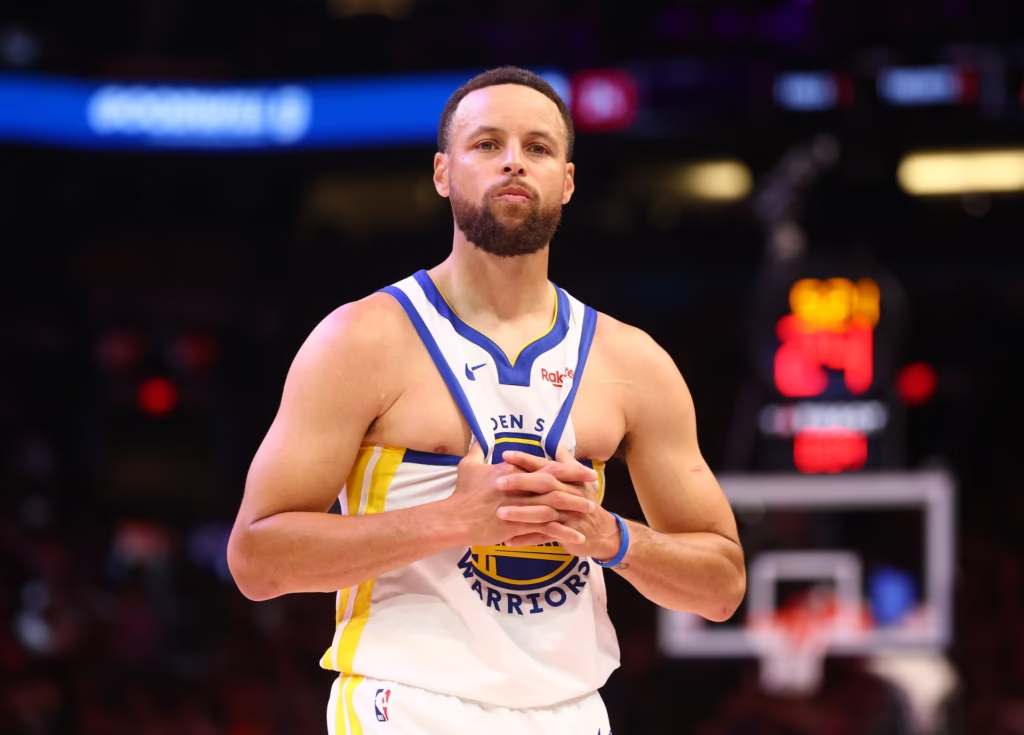
Wardell Stephen Curry II, born March 14, 1988, is the greatest shooter in basketball history and the most influential offensive player of his generation, having fundamentally changed how the sport is played by making the three-point shot a primary weapon rather than a specialty one. Drafted 7th overall by the Golden State Warriors in 2009 out of Davidson, Curry has spent his entire 17-season career with Golden State, winning four NBA championships, two MVP awards (including the league’s only unanimous MVP selection), and becoming the first player to reach $60 million in single-season salary.
Off the court, Curry built a business empire anchored for over a decade by Under Armour and Curry Brand, the sub-label he grew into a genuine rival to Nike’s Jordan Brand. That chapter ended abruptly in November 2025, when Curry and Under Armour mutually terminated their 13-year partnership. Seven months later, in June 2026, Curry signed a new 10-year, $400M+ deal with Chinese sportswear giant Li-Ning to carry Curry Brand forward globally. He also runs production company Unanimous Media and a broader portfolio of investments under his umbrella company Thirty Ink.
1. NBA Career Salary (2009-2026)
Curry’s five NBA contracts are unusually well documented and consistent across sources: a 2009 rookie deal (2-4 year, $12.7M), a 2012 extension (4 year, $44M), a 2017 designated veteran deal (5 year, $201.16M), a 2021 extension (4 year, $215.35M), and a 2024 one-year extension worth $62.59M covering the 2026-27 season. Spotrac, SalarySwish, and ESPN independently confirm the same cumulative total across all five contracts: $535.8M. However, the 2026-27 season has not yet started as of this writing, meaning that final $62.59M has not yet been earned. We count only the portion actually earned through the completed 2025-26 season.
NBA salary, earned through 2025-26 season: $473.2M gross.
2. Off-Court Income (2009-2026)
This is where treatment matters most, and where a lazy calculation would badly overstate Curry’s actual take-home. Curry’s Under Armour relationship, which ran from 2013 until its termination in November 2025, is frequently described in circulating coverage as a “$1 billion lifetime deal,” a figure drawn from a 2023 renegotiation that was structured with performance triggers and was never a guaranteed, fully-earned sum. That 2023 deal included a grant of 8.8 million Under Armour shares (valued at $75M at signing) set to vest in two installments in 2029 and 2032. Because the partnership was terminated in November 2025, before either vesting date, that equity grant did not vest and is excluded here rather than credited as realized wealth. What we do count is the actual disclosed cash flow: direct payments from Under Armour described in contemporary reporting as “eight figures a year,” plus a separate, substantial endorsement portfolio (Chase, Rakuten, JPMorgan, Infiniti, and others) that CB Insights and other trackers put at over $40M annually in recent years, independent of Under Armour. Forbes’ 2025 list placed Curry second among the world’s highest-paid athletes with $100M in off-court earnings in 2024, the peak year of this relationship.
- 2009-2013 (Nike, early UA transition): ~$2M/yr = $8M
- 2013-2020 (UA signature shoe growth, MVP years): ~$12M/yr = $84M
- 2020-2025 (Curry Brand president era, UA plus broader endorsement portfolio, peaking near Forbes’ cited $100M in 2024): ~$65M/yr = $325M
- 2025-2026 (post-UA transition; Li-Ning deal signed June 2026 but not yet generating meaningful earned income): ~$40M
Off-court income (2009-2026): $457M gross.
3. Representation
Curry has been represented by Jeff Austin of Octagon, who negotiated both his NBA contracts and his endorsement deals. NBA agent fees are capped at 4% by the players’ union; marketing and endorsement representation typically runs higher. We apply each rate to its corresponding income stream rather than a single blended rate across both, since the two are separately documented here.
- NBA salary (4% of $473.2M): -$18.9M
- Off-court income (12% of $457M): -$54.8M
Total representation: -$73.7M. Post-representation gross: ~$856.5M.
4. Tax
Curry has been a California resident throughout his career. California’s top marginal rate combined with federal tax puts effective rates for a W-2 NBA salary, which does not benefit from the loan-out and deferral structures available to entertainers with more flexible income structuring, close to the higher end of what we track for high earners in high-tax states.
Tax (46% effective): -$394M. Net after representation and tax: ~$462.5M.
5. Lifestyle Burn
Curry is broadly described across sourcing as more financially disciplined and family-oriented than many peers at his earnings level, though still maintaining multiple high-value properties and a large family. Spending scaled with fame and family size across each career phase.
- 2009-2015 (rising fame, rookie to first MVP): ~$1.5M/yr = $9M
- 2015-2020 (superstar era, first major home purchases): ~$4M/yr = $20M
- 2020-2026 (established wealth, multiple properties, growing family): ~$6M/yr = $36M
Total lifestyle burn: ~$65M. Available to accumulate: ~$430M.
6. Real Estate
Curry’s real estate moves are unusually well tracked. His original Atherton, California estate, purchased in 2019 for $31M, sold in September 2021 for $31.15M, essentially flat. His current Atherton compound, purchased for $30M in December 2020, is now estimated at $32M. He also purchased a $50.1M Malibu oceanfront estate in November 2021 and holds an approximately $8.5M San Francisco property. Given most of this portfolio was acquired within the last five to seven years, documented gains above purchase price are modest rather than the kind of multi-decade appreciation seen in longer-held athlete real estate.
Real estate appreciation (documented gains only): ~$8M.
7. Curry Brand
Following the November 2025 Under Armour split, Curry retained full, sole ownership of Curry Brand for the first time, a meaningful shift from his prior “president” role inside a larger company. Under Armour’s own securities filings estimated the brand’s global basketball business at $100M to $120M in annual revenue heading into fiscal 2026. As a newly independent entity just transitioning to a new manufacturing and retail partner in Li-Ning, with no standalone track record yet, we apply a conservative valuation multiple to that revenue base rather than a full brand-equity multiple, reflecting the genuine uncertainty of an early-stage standalone transition.
Curry Brand (standalone, conservative valuation): ~$60M.
8. Unanimous Media
Curry’s production company, founded in 2018 with backing from Sony Pictures and subsequent deals with Comcast NBCUniversal (2021) and Audible (2020), has produced or co-produced multiple film and television projects. Industry estimates place its standalone valuation at approximately $25M.
Unanimous Media: ~$25M.
9. Investment Portfolio
Through SC30 Inc. and umbrella company Thirty Ink, Curry holds a diversified portfolio of minority stakes including autonomous vehicle company Aurora Innovation, phone maker Palm/TCL, Michelle Obama-co-founded PLEZi Nutrition, muscle recovery brand Oxigen, tech startup Mos, and education platform Guild Education, alongside bourbon brand Gentleman’s Cut and marketing consultancy 7k. None carry individually disclosed valuations, so we apply a conservative combined estimate.
Investment portfolio: ~$20M.
10. Wealth Management
Beyond the specific holdings itemized above, no separate, verified wealth management mandate with disclosed returns was found in available sourcing.
Wealth Management: None reported beyond items captured above ($0).
Net Worth Waterfall
| Line Item | Amount |
|---|---|
| NBA salary, earned through 2025-26 season | +$473.2M |
| Off-court income (2009-2026) | +$457M |
| Less: representation (4% NBA / 12% off-court) | -$73.7M |
| Less: tax (46% effective) | -$394M |
| Less: lifestyle burn (era-scaled) | -$65M |
| Real estate appreciation | +$8M |
| Curry Brand (standalone, conservative) | +$60M |
| Unanimous Media | +$25M |
| Investment portfolio | +$20M |
| Wealth Management | $0 |
| Total Net Worth | ~$510.5M -> $510 Million |
Why Our Figure Differs From Consensus
Published estimates for Curry are unusually scattered, ranging from $100M to $250M across the sources we reviewed, and nearly all of them land well below our figure. The gap traces mainly to two things. First, many trackers appear to be working from outdated cumulative NBA salary figures that predate his 2021 and 2024 contract extensions; the actual, independently-confirmed total across all five of his NBA contracts through the completed 2025-26 season is $473.2M, not the $100M-$300M range some older articles still cite. Second, the widely repeated “$1 billion lifetime Under Armour deal” figure was always a speculative maximum tied to performance triggers and long-dated equity vesting, not a guaranteed or realized sum, and the partnership was terminated in November 2025 before the associated stock grant ever vested. We exclude that unrealized equity entirely rather than crediting Curry with wealth he never actually received. We also do not credit any meaningful current value from his brand-new Li-Ning deal, signed only in June 2026, since a ten-year contract that has barely begun has not yet generated realized income. Our figure is higher than most published estimates specifically because it corrects for stale salary data, and lower than a naive “$1B Nike-style lifetime deal” framing would suggest, since that framing does not reflect what Curry has actually been paid.
The Deal That Never Vested
For over a decade, “Steph Curry’s billion-dollar lifetime deal” was one of the most repeated numbers in sports business writing, right up until the day it quietly wasn’t true anymore. In November 2025, Under Armour and Curry ended their partnership with a one-paragraph statement, and the 8.8 million shares Curry had been granted two years earlier, worth $75 million at signing, were still sitting years away from vesting when the relationship ended. Curry walked, kept the only thing that mattered, full ownership of the Curry Brand he’d spent five years building inside someone else’s company, and turned around seven months later with a ten-year deal of his own making at Li-Ning. The lifetime deal is gone. The brand, and the leverage that built it, is entirely his.