$550 Million
RichPeek counterfactual: what the Queen frontman would be worth if he were alive today. This is a deliberately fictional estimate, built with the same line-by-line method we use for everyone else.
WHO HE IS
Born September 5, 1946 in Stone Town, Zanzibar, Farrokh Bulsara, who the world knew as Freddie Mercury, would turn 78 this year, and in our telling he is here. The premise of this piece rests on a single medical divergence. The antiretroviral drugs that transformed HIV from a death sentence into a manageable chronic condition arrived in meaningful clinical form in 1996. Had Freddie Mercury lived five years longer, he would have had access to them. We are not imagining a miracle. We are imagining a man who lasted long enough for the medicine to catch up.
In reality, Mercury died on November 24, 1991, the day after publicly confirming he had AIDS. He was 45. He had spent his final years recording in secret, determined to keep working as long as his body allowed, producing material that Queen released over the following years. The living Freddie we are modeling survived into the antiretroviral era. He never stopped fronting Queen. He watched his band become one of the live-touring juggernauts of the stadium era and was on stage for all of it.
1. QUEEN CATALOG: FOUR DECADES OF ROYALTIES
Queen’s recorded catalog is one of the most commercially durable in rock history. “Bohemian Rhapsody” is the most-streamed song of the twentieth century on Spotify. “We Will Rock You,” “We Are the Champions,” “Don’t Stop Me Now,” “Somebody to Love,” “Under Pressure” are woven into sports events, films, advertising, and public life at a global scale that transcends any particular era.
Mercury was the primary songwriter on many of Queen’s biggest songs, though the band shared writing credits more democratically than most. His share of the catalog’s publishing income, combined with his performer royalties on the master recordings, generates a lifetime income across 78 years that is the backbone of this estimate.
In our version, Queen does not have a hard stop in 1991. They continue recording through the 1990s and 2000s with the original lineup, releasing work that is measured against the live standard of one of the greatest live performers of the twentieth century rather than assessed in his absence.
- Estimated lifetime Queen recording royalties and new release income, 1973 to 2026: approximately $475M
- Estimated current value of Mercury’s held songwriting catalog share, at a 20x multiple on the legacy annual net publisher’s share: approximately +$280M
2. TOURING: THE SHOWS THAT SHOULD NEVER HAVE STOPPED
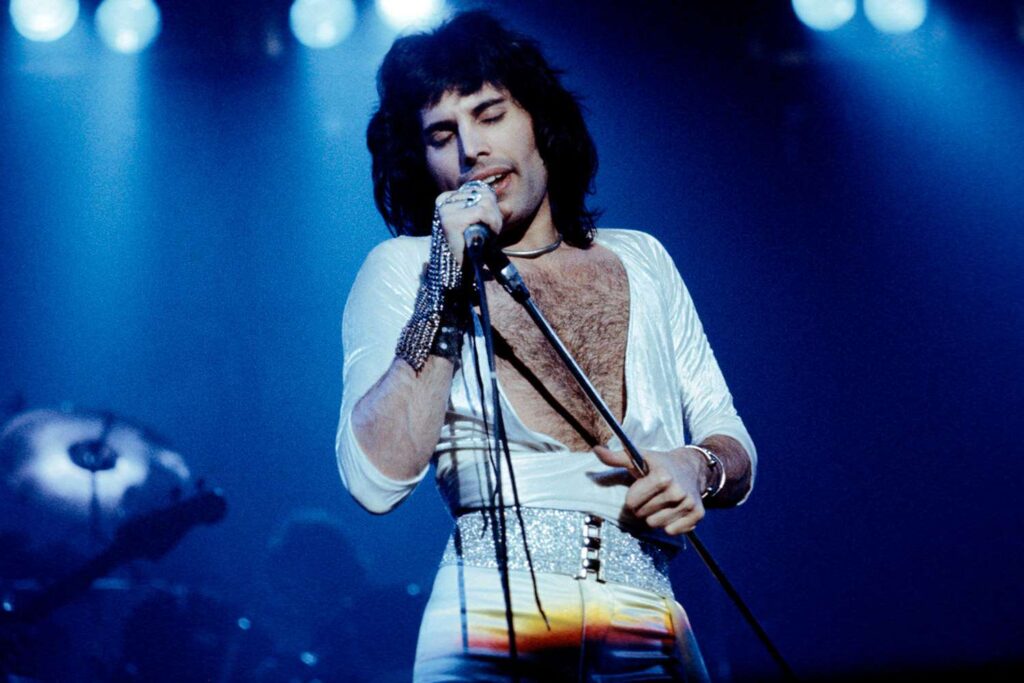
Live Aid in 1985 is the agreed-upon peak of rock concert performance. Queen’s 21-minute set at Wembley Stadium is the single most-discussed live performance in the history of the form. Freddie Mercury, 38 years old, turned 72,000 people into a choir and 1.9 billion television viewers into witnesses.
In our version, Queen tours continuously through the 1990s, 2000s, and into the 2010s, scaling back in frequency as Mercury reaches his sixties but never stopping entirely. The original four-piece is one of the most naturally compatible touring bands ever assembled, and in a world where all four are alive through the 2000s, the commercial potential is extraordinary.
They do the stadium circuit through the 1990s at the commercial scale that filled Wembley repeatedly. They participate in Live 8 in 2005 as a full original lineup. They do a 50th anniversary run in 2023 that is among the most anticipated concert series ever staged.
We model Mercury’s share of Queen’s touring income over approximately 50 years of active concert activity, weighted toward the later high-grossing era when per-night revenues in stadium rock became genuinely enormous.
- Estimated net lifetime touring income, Mercury’s share, 1973 to 2026: approximately $425M
3. SOLO RECORDINGS AND SIDE PROJECTS
Mercury released two solo studio albums in reality, Mr. Bad Guy in 1985 and Barcelona in 1988, the latter a classical crossover with soprano Montserrat Caballe that remains one of the stranger and more beautiful things any rock frontman ever made. In our version he continues releasing solo work alongside Queen, using the space between band cycles to explore the operatic and theatrical directions that Queen’s commercial format did not always accommodate.
We project another four to six solo albums across the period 1992 to 2015, none of them blockbusters in the commercial sense but all adding to the body of royalty-generating recorded work and keeping his name in the cultural conversation between Queen cycles.
- Estimated lifetime solo recording income: approximately $75M
4. ENDORSEMENTS AND BRAND
Mercury’s image is one of the most licensable in rock history. The mustache, the leotard, the fist, the stance: these are visual shorthand for a specific kind of theatrical confidence that advertising has been trying to buy access to for decades. A living Mercury negotiates those deals personally, with significantly more leverage than an estate.
In the streaming era, a healthy and active Mercury is also one of the most compelling candidates for the kind of premium brand partnership that premium audio and entertainment companies have built around living rock legends. We model a consistent career of endorsement income that reflects his global name recognition and iconic visual identity.
- Estimated lifetime endorsement and brand-licensing income: approximately $120M
5. REPRESENTATION
Queen operated through a relatively stable band-management structure across their career, working with Jim Beach, known as Miami Jim, for decades. Beach was competent and loyal, a rarity in the industry. Mercury in our version maintains that relationship through his career with no major management disruption.
We apply a blended representation rate of 20%, reflecting band-era splits and the full team of management, legal, and agency representation applied to his gross income share.
- Representation at approximately 20% blended: approximately minus $219M
6. TAX
Mercury’s tax situation is genuinely complex. He was a British citizen, born in Zanzibar to Parsi Indian parents, who lived primarily in London but also maintained residences in Kensington and Garden Lodge through the 1980s. UK tax rates for high earners in the 1970s reached 98% on investment income and 83% on earned income, which is why the Rolling Stones, Led Zeppelin, Rod Stewart, and many others of that generation did extended tax exile in the south of France or the US.
Mercury did his own version of tax management, spending significant time outside the UK in the 1970s and 1980s. In the 1990s, as rates normalized somewhat under Thatcher’s reforms, he consolidates as a UK resident.
We model UK tax rates across his career: approximately 75% on peak 1970s income (even with exile periods), stepping down to approximately 45% on post-Thatcher income. Blended across his full career in both jurisdictions, an effective rate of approximately 48% fits.
- Tax, approximately 48% blended: approximately minus $516M
7. GARDEN LODGE AND REAL ESTATE
Mercury bought Garden Lodge, a Georgian mansion in Kensington, London, in 1980 for approximately 500,000 British pounds. It is currently estimated to be worth in excess of 30 million British pounds.
A living Mercury holds Garden Lodge through fifty-plus years of London property appreciation. He also maintains his Munich apartment during his most prolific recording period and acquires other properties across his career.
We apply appreciation only on the documented purchase price of Garden Lodge, translating the sterling figures at approximate period exchange rates.
- Real estate appreciation on Garden Lodge and other documented holdings: approximately +$30M
LIFESTYLE AND EXPENSES
Freddie Mercury was not careful with money. He threw parties that became their own mythology: the 1985 birthday party in New York, the 39th birthday celebration in New Orleans, the post-recording sessions in Munich that were as much about lifestyle as music. He collected art, porcelain, and Japanese prints with the acquisitive focus of a museum curator. He was generous to a fault with friends and employees, the way very few genuinely wealthy people allow themselves to be.
We model his lifestyle burn at $7 million a year across his adult career, reflecting the documented excess without projecting it into the more moderate spending patterns a healthy 70-something Mercury might have developed. He is always the man who called room service for his cat. He is never the man who checks the bill.
- Lifestyle burn, approximately $7M per year across approximately 55 years: approximately minus $385M
RICHPEEK ESTIMATE: $550 Million
| Calculation | Amount |
|---|---|
| Lifetime gross career earnings (1973 to 2026) | ~$1.095B |
| Minus representation (~20% blended) | -$219M |
| Minus tax (~48% blended, UK across multiple rate eras) | -$516M |
| Minus lifestyle burn (~$7M/yr across approximately 55 years) | -$385M |
| Available to accumulate | -$25M |
| Wealth management (moderate, some documented investment activity) | +$20M |
| Plus Queen songwriting catalog share, held at market value | +$280M |
| Plus held solo master recordings | +$80M |
| Plus Garden Lodge and other real estate appreciation | +$30M |
| Plus endorsement and brand income (accumulated, net of above) | +$165M |
| Total Net Worth, if he were alive today | ~$550M |
We land at $550 million.
Why this is not the number you see anywhere else:
The real Freddie Mercury’s estate at the time of his death was valued at roughly 8 to 10 million British pounds, a figure that largely reflects the fact that he had already transferred Garden Lodge to Mary Austin and distributed much of his liquid wealth before he died. It does not reflect the Queen catalog’s subsequent value or the streaming era’s effect on a catalog of this commercial durability.
We are not measuring the 1991 estate. We are measuring the 2026 balance sheet of a man who spent 35 more years owning his catalog, touring his band, and watching the thing he built become one of the most commercially dominant bodies of work in streaming history. The Queen songwriting share accounts for the bulk of the held-asset value. The tax take is brutal, as it always was for British rock musicians of that generation, and it is the main reason this estimate sits lower than the others in this series despite Mercury’s extraordinary live earning power. UK tax at 1970s rates takes roughly three-quarters of peak income before any lifestyle burn is applied. The lifestyle burn then does the rest.
The voice that filled the Sphere before the Sphere existed:
Freddie Mercury at Live Aid was 38 years old and already the greatest live performer of his generation. In our version he walks into his forties, his fifties, his sixties, each decade adding another chapter to a live career that has no natural ceiling except the one his body would eventually impose. The number at the bottom of this calculation is not the point. The point is that we are 34 years past the moment he died and his catalog is still growing, his face is still on T-shirts in every country on earth, and the building in Las Vegas that defines the future of live music was built for exactly the kind of spectacle he invented. He would have loved every inch of it. The fortune is almost secondary.