$1.1 Billion
RichPeek counterfactual: what the former Beatle would be worth if he were alive today. This is a deliberately fictional estimate, built with the same line-by-line method we use for everyone else.
WHO HE IS
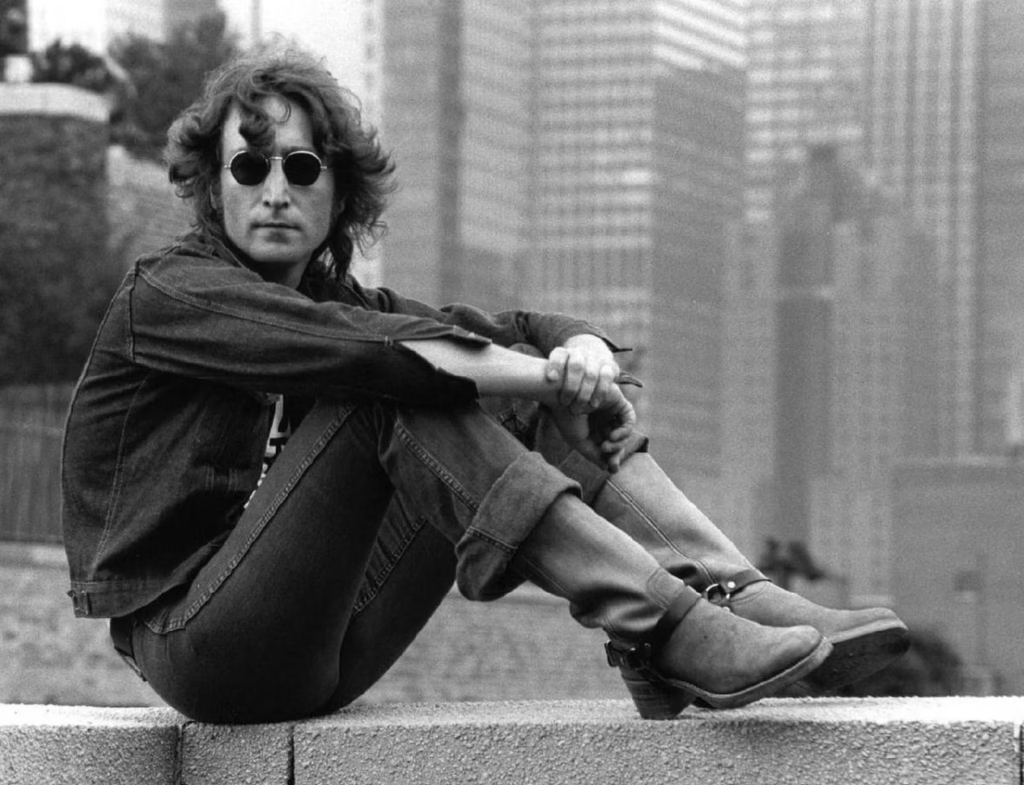
Born October 9, 1940 in Liverpool, England, John Winston Ono Lennon would turn 85 this year, and in our telling he is very much still here. The premise is this: Mark David Chapman misses. Or does not show up. Or is stopped at the door. Whatever the mechanism, John Lennon walks back into the Dakota on the evening of December 8, 1980, and the second half of his life begins.
What that second half looks like is genuinely interesting to map, because 1980 was already a comeback. Double Fantasy had just been released to the best critical reception of his solo career. He was energized, clean, present, and by all accounts happier than he had been in years. He had a five-year-old son he was raising as a house husband and a wife who was his creative equal. The man who walked back into that building had things left to say, and the world was about to enter the decade in which he would have had the most to say about it.
We are modeling what happens when that man gets to be 85. The Beatles catalog is still the most valuable body of recorded music ever assembled. His solo catalog is among the most streamed of any artist from his generation. And unlike Elvis, unlike Michael Jackson, Lennon understood early and instinctively that the system was not designed to enrich the artist. The fact that he still lost a great deal of money along the way makes the living version of him more careful, not less creative.
1. THE BEATLES CATALOG: THE ASSET THAT NEVER STOPS
John Lennon’s share of the Beatles’ songwriting catalog is the foundation of this entire estimate. The Lennon-McCartney partnership produced some of the most performed, recorded, covered, sampled, and streamed songs in history. “Yesterday,” “Let It Be,” “Hey Jude,” “Come Together”: these are not songs, they are infrastructure.
The Beatles’ publishing rights have had a complicated real-world history involving ATV, which Michael Jackson bought in 1985, and Sony/ATV. A living Lennon’s lawyers would have been engaged in every stage of that dispute alongside McCartney’s, and in our scenario he recaptures his share of the pre-1978 compositions under the US Copyright Act’s 35-year termination rule in the mid-2010s, the same window McCartney has pursued in reality.
His Lennon-McCartney co-write share, combined with the approximately 25% he holds in the overall Beatles royalty stream as a performer, generates a royalty income across 85 years of life that is almost impossible to overstate.
- Estimated lifetime Beatles-related royalty income, writer and performer share: approximately $550M
- Estimated current value of held Beatles publishing co-write share (legacy catalog at 22x multiple on annual receipts): approximately +$600M
2. SOLO RECORDINGS: FROM IMAGINE TO WHAT CAME AFTER
In reality, Lennon released six solo studio albums after the Beatles broke up, plus the deeply personal Plastic Ono Band, which remains one of the most critically admired records in rock history. In our version, he releases another twelve to fifteen albums between 1981 and 2026.
We are not projecting that all of them are Imagine-level masterpieces. We are projecting that a living Lennon, operating across four more decades and responding to the Reagan years, the internet age, the 9/11 era, the social media collapse, and the political environment he would have found irresistible to comment on, produces a body of solo work that keeps him commercially relevant through every decade.
His streaming numbers would be extraordinary for a catalog of this cultural weight backed by ongoing new releases. A living Lennon releasing work through 2026 compounds the catalog base continuously.
- Estimated lifetime solo recording income, 1970 to 2026: approximately $350M
3. TOURING: THE ARTIST WHO ALWAYS HATED IT, THEN LOVED IT AGAIN
Lennon famously despised touring by the mid-1960s. The Beatles stopped playing live in 1966 partly because he said the experience had become meaningless, the crowds too loud to hear the music and the venues too small for the scale of what they had become. He did essentially no touring in his solo career.
The living Lennon of our scenario does not become a touring machine. But he does what Paul McCartney has done: a selective, premium, stadium-level run every five or six years from his early forties through his late sixties, each tour a cultural event rather than a commercial obligation. He does the 1985 Live Aid slot. He does a final solo tour in 2010, at 69, that sells out stadiums on the back of fifty years of accumulated mythology.
- Estimated net lifetime touring income, 1980 to 2026: approximately $350M
4. THE BEATLES REUNION: THE CONCERT THAT ACTUALLY HAPPENS
This deserves its own line. In our version, John Lennon is alive for the mid-1990s, when the appetite for a Beatles reunion was at its commercial and cultural peak. He and Paul and George and Ringo do press together. They record together. We model a limited Beatles reunion tour circa 1993 to 1995, before George Harrison’s cancer diagnosis, as one of the highest-grossing concert series in history at that point. Even a limited run of 20 to 30 dates would have grossed at a scale that makes every other touring estimate in this piece look modest.
- Estimated Beatles reunion gross earnings, Lennon’s share: approximately $150M
5. PUBLISHING, LICENSING, AND THE LENNON BRAND
Lennon was always more interested in ideas than commerce, but he was not naive about the value of what he had created. The living John manages his own brand with the same discipline and selectivity that defined his personal life post-1975.
Imagine the song has a licensing value that makes it one of the most commercially significant individual compositions ever written. It appears in films, political campaigns, and public events globally. In our version, Lennon controls all of that personally and negotiates each placement with the leverage of a living artist rather than an estate operating without the creator’s voice.
- Estimated lifetime publishing, licensing, and brand income: approximately $200M
6. REPRESENTATION
Lennon’s management arrangements were turbulent. Allen Klein, whom he backed over McCartney’s objection, cost him real money and real relationships. The living Lennon, older and more careful, restructures around a lean legal and management team post-1985.
We model a blended representation rate of 15%, reflecting a mature artist with strong professional boundaries and no longer subject to the exploitative structures of the Klein era.
- Representation at approximately 15% blended: approximately minus $248M
7. TAX
This is one of the most interesting tax stories in the entire counterfactual series. Lennon was a UK citizen who became a US permanent resident in 1971 after a years-long battle with the Nixon administration to stay in New York. He never took American citizenship, reportedly in part because he did not want to give up his UK passport.
As a UK citizen and US permanent resident, he would have been subject to US tax on worldwide income, with the UK getting a credit for taxes already paid. At his income level, the US federal rate dominates. For the post-1980 career, we model him remaining in New York and paying the combined federal and New York State/City rate at approximately 47%.
He also carries a decade of pre-1980 UK income taxed at the top marginal rate that reached 98% in the mid-1970s, which is why the Beatles were effectively bankrupted at their peak earnings in real life. The living Lennon’s pre-1980 earnings net very little after UK tax.
- Tax, approximately 50% blended across UK and US income, adjusting for jurisdictional differences by era: approximately minus $825M
8. THE DAKOTA AND REAL ESTATE
John and Yoko famously owned multiple apartments in the Dakota, the Gothic Revival building on Central Park West that is one of the most prestigious addresses in New York City. They owned several units at various points. He also held real estate outside the city, including a farm in upstate New York.
The Dakota apartments, bought in the 1970s for hundreds of thousands of dollars each, are now worth several million dollars each. We model only the documented appreciation on properties we can trace to real purchase prices.
- Real estate appreciation on the Dakota units and other documented holdings: approximately +$35M
LIFESTYLE AND EXPENSES
The Lennon of the late 1970s had actually simplified considerably from the chaotic spending of the early solo years. He was baking bread, raising Sean, buying dairy farms. The living Lennon post-1980 is not a conspicuous consumer. He is a private man with expensive tastes in art and a deep suspicion of the trappings of celebrity wealth.
We model his lifestyle burn at $4 million a year across a post-1980 adult life, rising to $6 million in the peak years of his commercial recovery, landing at a total that reflects comfort and cultural engagement without the extravagance of peers like Jagger or McCartney.
- Lifestyle burn, approximately $4-6M per year across approximately 45 years post-1980: approximately minus $225M
RICHPEEK ESTIMATE: $1.1 Billion
| Calculation | Amount |
|---|---|
| Lifetime gross career earnings (1960 to 2026) | ~$1.65B |
| Minus representation (~15% blended, post-Klein era) | -$248M |
| Minus tax (~50% blended, UK marginal peak then NY combined) | -$825M |
| Minus lifestyle burn (~$4-6M/yr across approximately 45 years) | -$225M |
| Available to accumulate | ~$352M |
| Wealth management (conservative, documented trust structures) | +$55M |
| Plus Beatles publishing co-write share, held at market value | +$600M |
| Plus Dakota and other real estate appreciation | +$35M |
| Plus owned solo master recordings | +$65M |
| Total Net Worth, if he were alive today | ~$1.1B |
We land at $1.1 billion.
Why this is not the number you see anywhere else:
The Lennon catalog’s value is regularly discussed in the press in terms of annual licensing income or estimated estate worth, neither of which is a net worth calculation built from first principles. We are doing something different. We are asking what a living man’s balance sheet looks like when he did not die at 40.
The critical variable is the Beatles publishing co-write share. In the real world, that asset has been traded, merged, bought by Michael Jackson, and sold to Sony in ways that obscure its true market value to any individual holder. A living Lennon’s share of that catalog, held for 45 more years than it was in reality and appreciated at the pace the market has actually delivered, is worth somewhere north of $600 million on its own. Add the solo catalog, the touring, the brand, and the decade and a half of streaming revenue on a catalog that would have kept growing, and the billion is not a stretch. It is the floor.
The man who almost stopped believing:
There is a version of this story that ends at $400 million, not $1.1 billion, and it is the version where Lennon does what he did in real life between 1975 and 1980: retreats from the world, stops releasing music, stops touring, and lives privately on what he already has. That version is not without appeal. But the John Lennon who recorded Double Fantasy was not a man who had run out of things to say. He was a man who had been waiting five years to say them, and the decade of Reagan and Thatcher and the collapse of the post-war consensus would have pulled him back into the room with a microphone and a piano whether he planned to go or not. The money in this estimate is not the reason to want him alive. It is simply what happens to the catalog when the owner is still around to defend it.