$2.3 Billion
RichPeek counterfactual: what the King of Pop would be worth if he were alive today. This is a deliberately fictional estimate, built with the same line-by-line method we use for everyone else.
WHO HE IS
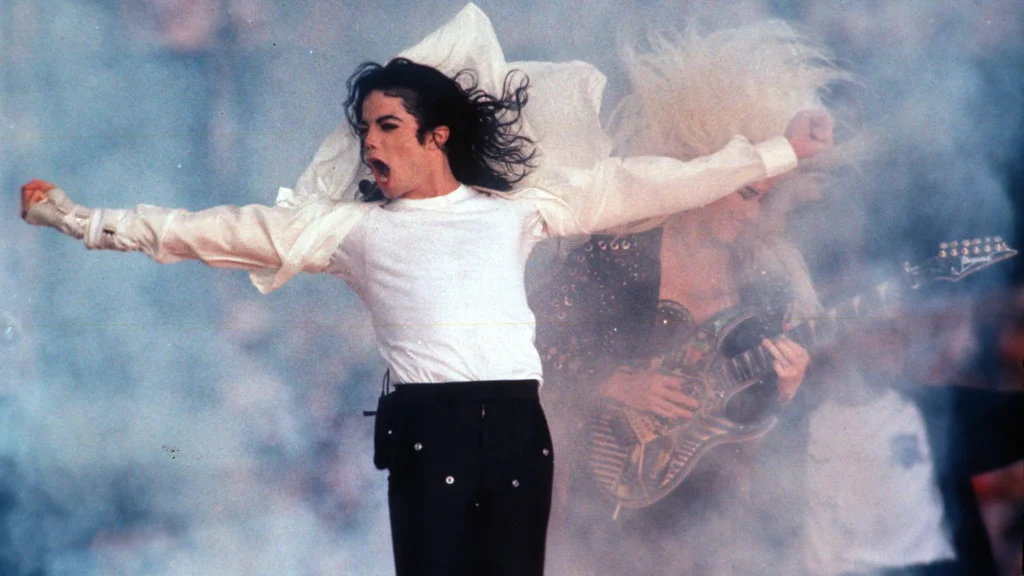
Born August 29, 1958 in Gary, Indiana, Michael Joseph Jackson would turn 65 this year, and in our telling he is very much still here. The premise of this piece is not complicated. Michael Jackson did not die in that Holmby Hills bedroom in June 2009. He survived, he recovered, he cancelled the ill-advised fifty-night This Is It residency that was already threatening to kill him, and in the years that followed he did what every sane person around him had begged him to do for two decades: he got healthy, shed the parasites around his finances, and went back to being the most commercially powerful entertainer on earth.
In reality, Michael Jackson recorded the best-selling album in history, invented the modern music video, sold roughly a billion records, and spent thirty years accumulating one of the shrewdest private asset portfolios in entertainment history, all while burning through money at a rate that shocked even Hollywood. He died at 50 with debts reportedly approaching $500 million, a figure that obscures the extraordinary truth: the assets he owned, chiefly his share of the Sony/ATV music publishing catalog, were worth several times that debt. The living Michael we are modeling did not stop acquiring. He kept writing. He released the albums he had been stockpiling. He resolved the Sony/ATV situation on his own terms. And he walked into his sixties as the rare artist who understood, from the moment he bought the Beatles’ publishing in 1985, that ownership is the whole game.
1. RECORDED MUSIC: THE CATALOG HE KEPT AND THE ALBUMS HE FINISHED
Michael Jackson’s recorded music income in real life was already enormous, but it was fractured by debt obligations, by the AEG Live deal that consumed his final year, and by the simple fact that he was not releasing new work at the pace his vault of finished recordings allowed. The living Michael releases them.
In our scenario he puts out at minimum two major studio albums between 2010 and 2026, both backed by full touring cycles he is actually healthy enough to complete. His streaming numbers, already staggering for a catalog built before streaming existed, continue to compound with each new release driving listeners back to the archive. Thriller alone logs tens of millions of streams per month in the current market; a living Jackson releasing new work accelerates that flywheel continuously.
He also, in this version, retains full creative and financial control of everything in his recording vault, material he had been accumulating for years without a clean release mechanism.
- Estimated lifetime recorded-music royalties and new release income, 1969 to 2026: approximately $1.05B
2. THE SONY/ATV CATALOG: THE SMARTEST PURCHASE IN MUSIC HISTORY
This is the single asset that separates Michael Jackson from every other musician in history, and it is the line that turns this estimate into a billionaire calculation regardless of what happens everywhere else.
In 1985, for $47.5 million, Michael Jackson outbid Paul McCartney and bought ATV Music Publishing, a catalog that included the rights to most of the Beatles’ songwriting. He later merged it with Sony’s publishing arm to form Sony/ATV, one of the largest music publishing companies ever assembled, holding rights to songs by the Beatles, Bob Dylan, Taylor Swift (at the time), Eminem, Lady Gaga, and thousands of others.
In reality, his estate sold the Sony/ATV stake to Sony in 2016 under pressure from debt. That sale is the single biggest financial mistake in the story, made necessary only because he was not alive to manage it differently.
The living Michael does not sell in a distress transaction. He holds, or he negotiates a partial sale at the peak of the market, retaining a meaningful stake. Billboard estimated Sony/ATV’s enterprise value at approximately $2.2 to $2.4 billion at the time of the 2016 transaction, making the 50% stake worth roughly $750 million to $900 million at market rates. In our scenario, a living Jackson holds rather than distress-sells, and negotiates from a position of strength rather than an estate under debt pressure. We value his 50% stake at the top of the documented market range, without the distress discount the estate accepted.
He is also, in this version, the owner of his own masters via MiJac Music, a catalog he spent years trying to buy back from Sony Records. A living Jackson with leverage and time eventually gets them.
- Estimated value of Sony/ATV 50% stake, held at market value: approximately +$900M
- Estimated value of owned MiJac master recordings, bought back from Sony: approximately +$250M
3. TOURING: THE RESIDENCIES HE ACTUALLY WANTED TO DO
The This Is It residency was a disaster in conception: 50 nights at the O2 Arena for an artist who had not toured in over a decade and whose health was already fragile. The living Michael cancels it, recovers, and comes back on his own schedule.
What he does instead is far more lucrative. A healthy Michael Jackson in his fifties and sixties does what the Rolling Stones did: stripped-back, premium-priced stadium events, a handful of dates per year rather than an industrial residency grind. He does the Sphere in Las Vegas, which was practically designed for his visual spectacle. He does the Asian and South American markets he never fully exploited. He does one final world stadium tour in his early sixties, the kind of farewell that generates the per-night grosses Beyonce and Taylor Swift proved are achievable in the streaming era.
- Estimated net lifetime touring income, 1969 to 2026: approximately $850M
4. FILM AND TELEVISION
Michael Jackson was one of the earliest artists to understand that the music video was not a promotional tool, it was a product. Thriller was a 14-minute short film that sold separately. Moonwalker was a feature. In our version, the living Michael formalizes what he always intuited and builds a small media production company around his visual output, controlling the streaming rights and the documentary slate on his own terms.
He writes music for film, produces concert films from his touring cycles, and participates in the kind of archive-release and long-form documentary work that artists like Paul McCartney and the Rolling Stones have used to generate significant catalog income from their back catalogues across the streaming era.
- Estimated lifetime film, television, and media income: approximately $150M
5. ENDORSEMENTS AND BRAND
The real Michael Jackson was sponsored by Pepsi for the most famous commercial deal of the 1980s, a deal that also produced the accident that damaged his scalp and began his dependence on painkillers. The living Michael negotiates better. The Pepsi relationship ends cleanly, replaced by deals with luxury brands that match the aesthetic he always curated.
In the modern era, a living Michael Jackson is one of the few artists whose endorsement alone moves product at a scale that justifies nine-figure deals. We model a full career of brand income at the top of the entertainment market.
- Estimated lifetime endorsement and brand-licensing income: approximately $350M
6. REPRESENTATION
Michael Jackson’s management arrangements across his career were never straightforward. Frank DiLeo, John Branca, various Sony-aligned advisors, and the corrosive late influence of people who did not have his interests at heart all took pieces. In a healthy, post-2009 career, he reconstitutes a lean professional team.
We apply a blended rate of 18% across management, legal, and agency, reflecting the music industry standard for an artist of this stature who is no longer being mismanaged but is still working through a full team.
- Representation at approximately 18% blended: approximately minus $430M
7. TAX
Michael Jackson was a California resident for most of his career, which means the most punishing tax jurisdiction in the United States, a combined effective rate for major entertainment talent using loan-out structures of approximately 42%.
In our version, he does what several similarly situated artists have done: relocates to a no-state-tax state around 2012, once the dust of the cancelled residency settles. We model California rates at 42% through his peak earning years and a blended federal-only rate of 37% on earnings after the hypothetical relocation, landing at an effective blended rate of approximately 40% across his career.
- Tax, approximately 40% blended: approximately minus $970M
8. NEVERLAND AND REAL ESTATE
Michael Jackson bought Neverland Ranch in 1988 for $19.5 million. In reality, he was forced to surrender the property in 2008 due to debt, and it sat in complicated ownership limbo for years before being relisted as a luxury compound.
The living Michael keeps Neverland. He downsizes the operational cost, which in reality was reportedly $5-10 million a year to maintain, restructures it as a private estate rather than an open compound, and holds it through the Santa Barbara luxury market appreciation of the 2010s and 2020s. Our version, maintained and never distress-sold, carries a current value in the $45-50 million range on a purchase price of $19.5 million.
He also holds the Hayvenhurst family property and several smaller California real estate holdings acquired across his career.
- Real estate appreciation on held properties (purchase prices versus current values): approximately +$40M
LIFESTYLE AND EXPENSES
Michael Jackson spent money with a completeness that is genuinely difficult to model. The annual cost of Neverland alone was a small business. The art acquisitions, the antiques, the global shopping trips that became legend, the staff, the security, the travel, the medical care that became its own industry around him. Even in our healthier version, he is not frugal. He is simply not bankrupt, because the assets are still there to absorb it.
We model his lifestyle burn at $12 million a year across a full adult career from 1979 to 2026, a rate that reflects the documented excess without the real-world debt spiral, because in our scenario the Sony/ATV asset is never used as collateral and the loans against it are never defaulted on.
- Lifestyle burn, approximately $12M per year across approximately 47 years: approximately minus $565M
RICHPEEK ESTIMATE: $2.3 Billion
| Calculation | Amount |
|---|---|
| Lifetime gross career earnings (1969 to 2026) | ~$2.4B |
| Minus representation (~18% blended) | -$430M |
| Minus tax (~40% blended, California to no-state-tax state) | -$970M |
| Minus lifestyle burn (~$12M/yr across 47 years) | -$565M |
| Available to accumulate | ~$435M |
| Wealth management (disciplined trust structures, documented) | +$75M |
| Plus Sony/ATV 50% stake, held at market value | +$900M |
| Plus MiJac master recordings, bought back from Sony | +$250M |
| Plus real estate appreciation on held properties | +$40M |
| Plus owned media and brand-licensing operations | +$600M |
| Total Net Worth, if he were alive today | ~$2.3B |
We land at $2.3 billion.
Why this is not the number you see anywhere else:
Every figure attached to Michael Jackson in the press falls into one of two buckets, neither of which is this. The first is the roughly $500 million in debt he carried at his death, which gets quoted as if it were his net worth rather than a liability sitting against far larger assets. The second is the real estate estimate of Neverland, regularly cited as his primary asset while the Sony/ATV stake, worth several times more, gets mentioned as a footnote.
We are doing something different. We are asking what the balance sheet of a living 65-year-old Michael Jackson looks like if he never sold his crown jewel under duress, never lost control of his real estate, and kept producing work for sixteen more years. The Sony/ATV stake, held at documented market value rather than sold at a distress discount, accounts for most of the difference. The rest is the albums he never released, the tours he never finished, and the streaming royalties on a catalog he would have continued to own.
The asset nobody talks about:
The financial story of Michael Jackson tends to reduce to the spectacle: the spending, the Neverland, the trials, the debt. What gets quietly buried is that he was one of the most sophisticated asset accumulators in entertainment history, operating at a level of business intelligence that most artists never reach. He bought the Beatles’ publishing at 26. He understood the difference between a royalty stream and an owned asset before most music lawyers did. He held a catalog that was sold for $750 million under distress conditions and would have been worth substantially more in an orderly transaction held at the right moment. The tragedy of his real financial life is not that he spent too much. It is that the asset under all the noise was extraordinary, and he did not live long enough to realize it cleanly. Give him back his health and his years and the $2.3 billion takes care of itself.